Building links is easy. Building the right links, to the right pages, at the right time, is where most teams get stuck.
If your site is new, your content can be solid and still never rank because Google has no reason to trust it yet. If your site is older, rankings can plateau because competitors keep earning fresh mentions while your link profile stays flat. A link building strategy fixes both problems by turning backlinks into an intentional system, not a random set of tactics.
You get a practical framework for choosing which pages deserve links, which tactics fit your stage, how to use directories without looking spammy, and how to measure whether links are actually driving signups, not just vanity metrics.
What is a link building strategy?
A link building strategy is the plan you follow to earn backlinks that improve rankings and bring qualified traffic. It defines your link targets (which pages you want to rank), your link sources (where you will earn links), and your operating rules (quality checks, cadence, and tracking) so results compound over months, not days.
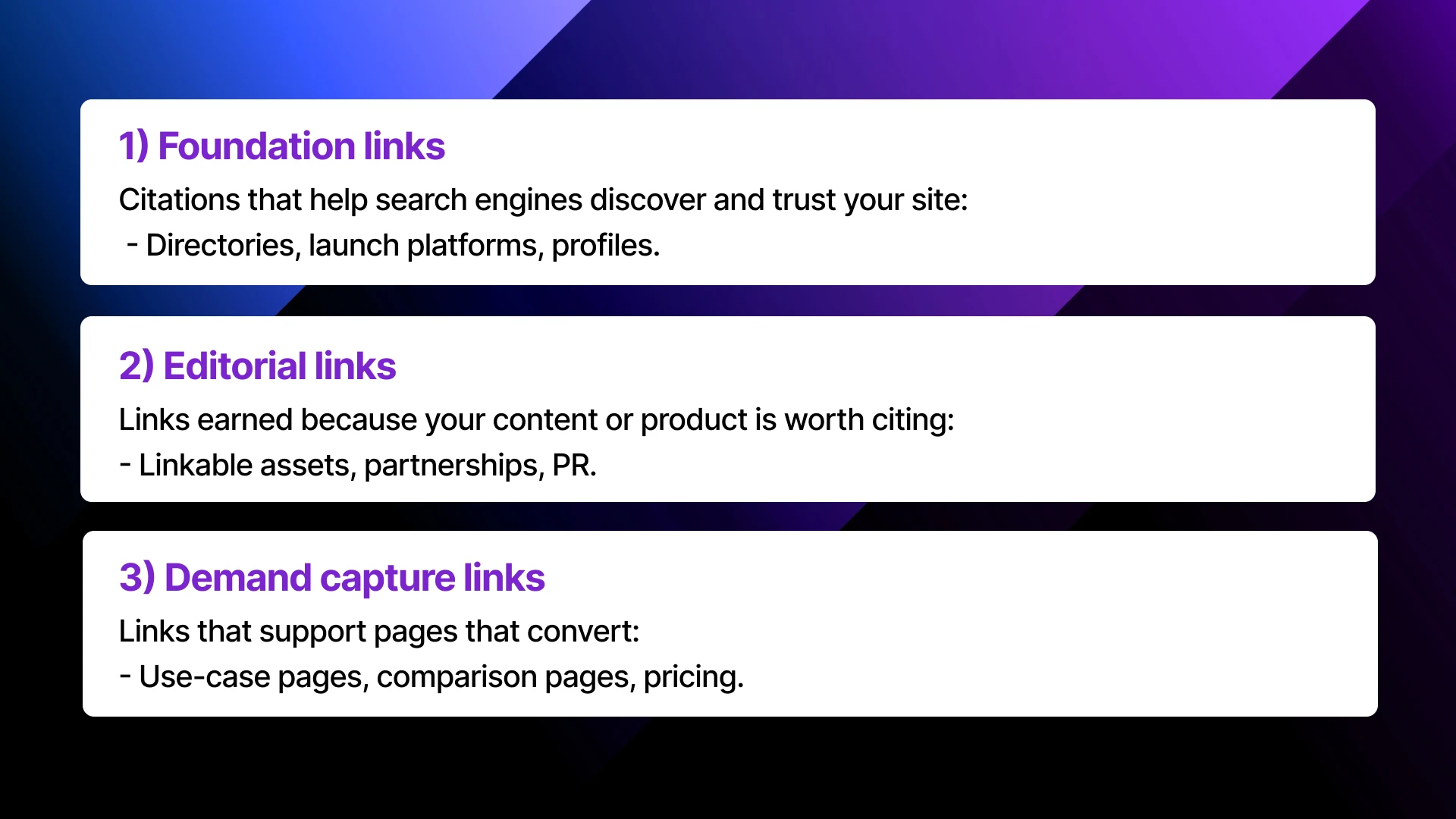
The simple model: three layers that compound
Set a goal that ties links to outcomes
Backlinks are not a trophy. They are an input to outcomes: rankings, traffic, and conversions. The fastest way to waste months is to celebrate links that point to pages nobody wants to rank.
Choose one primary outcome for the next 60 days
Pick one, and keep the rest as supporting metrics:
- Pipeline outcome: more demo requests, trials, or signups from organic search
- Visibility outcome: rankings for a small set of buyer keywords
- Authority outcome: a stronger domain profile so new pages rank faster later
Then define what “done” looks like. Example: “Rank top 10 for three high-intent keywords and generate 30 trials per month from those pages.”
Decide what you will not do
This is where strategy becomes practical.
- You will not chase irrelevant high-DR sites if the audience does not match.
- You will not buy “guest posts” that exist only to sell links.
- You will not build 50 links to your homepage while your pricing page is thin.
Google’s spam policies are explicit about link schemes and manipulative link practices. Treat that as your guardrail, not as an afterthought.

Build your link target map (the pages that deserve links)
A common failure mode is building links to “the site” instead of to specific pages. Links pass authority through your internal linking, but the page that earns the link still matters.
Pick 4 pages to prioritize first
For most SaaS and tools, these four create the best compounding effect:
- Homepage (brand trust and navigation searches)
- Pricing page (conversion, comparisons, buyer intent)
- One use-case page (high intent, easier to rank than broad keywords)
- One comparison or alternatives page (demand + links)
If any of these pages are weak, fix them first. You cannot out-link a confusing landing page.
Match link types to page types
Use this as a quick rule of thumb:
| Page type | Best link sources | Why it works | Common mistake |
|---|---|---|---|
| Homepage | directories, product listings, partnerships | trust and discovery | over-optimizing anchors |
| Pricing | comparisons, reviews, “best tools” lists | buyer intent and qualified traffic | hiding pricing details |
| Use-case | niche blogs, communities, integrations | topical relevance | writing generic copy |
| Alternatives | list posts, roundups, affiliates | natural link magnet | stuffing competitor names |
Choose tactics by stage in your link building strategy
The tactic that works for a DR 5 MVP is different from the tactic that works for a DR 60 product with a content team. The goal is to pick the smallest set of tactics you can repeat.
A practical menu of tactics
| Tactic | Cost | Risk | Time to impact | Best for |
|---|---|---|---|---|
| Curated directory submissions | low | low | weeks | new domains, MVP launches |
| Niche directories and “tool lists” | low | low | weeks | focused use cases |
| Linkable assets (data, templates, calculators) | medium | low | months | editorial links at scale |
| Targeted outreach to relevant pages | medium | medium | weeks to months | early authority growth |
| Partnerships and integrations | medium | low | months | SaaS ecosystems |
| Digital PR (news hooks, stories) | high | medium | weeks to months | brand and authority bursts |

A realistic cadence that does not look suspicious
Link velocity should look like a product that is being discovered, not a site that bought a package.
- New site: 10-25 quality links per month, spread across sources and pages
- Growing site: 20-60 links per month, with more editorial mentions over time
- Established site: focus on linkable assets and partnerships, not volume
The pattern matters more than the number. Diversity across domains, page types, and link attributes is what looks natural.
Directory links that do not look like spam
Directories are not glamorous, but they are the cleanest foundation layer for new sites. The trap is submitting everywhere. Low-quality directories waste time and produce pages that never get indexed.
How to pick directories worth your time
Before you submit, check four things:
- The listing pages are indexed in Google
- The directory has real categories and real users (not empty shells)
- Outgoing links are not stuffed on a single page
- The directory matches your niche or buyer persona
Launch Directories is built around these filters: verified DR, traffic stats, and link types, plus an archive of inactive listings so you avoid dead submissions.
Write listings like landing pages, not like bios
Directory profiles rank for your brand surprisingly often. Treat them as mini landing pages:
- Lead with a one-sentence outcome, not a feature list
- Add 2-3 concrete use cases and who it is for
- Include one screenshot that shows the “aha” moment
- Use a consistent URL (do not rotate between homepage, blog, and random UTM links)
Refresh your best listings
A simple habit: update your top 10 directory listings every time you ship a meaningful feature or positioning change. Some directories re-feature updates, and even when they do not, you keep your brand search results accurate.
Earn editorial links with a “citation hook”
Editorial links are the links competitors cannot copy in an afternoon. They come from someone choosing to cite you.
Three citation hooks that work for founders
- Original data: a benchmark, survey, or scraped dataset that answers a real question.
- A tool: free calculator, directory, checklist, or template that saves time.
- A strong point of view: a contrarian, experience-based explanation that people reference.
Outreach that earns replies (and respect)
Outreach fails when it is selfish. It works when it is specific and helpful.
A simple structure that gets responses:
- Start with the page you are referencing, not your product
- Point out a gap, a broken link, or an outdated example
- Offer a replacement that genuinely improves their page
- Keep it short and include the exact URL you want them to consider
Never pitch a homepage if the page owner is writing about a specific use case. Match your pitch to the intent of their page.
Measure quality and avoid link debt
Link building gets expensive when you do not track what you are doing. A basic operating system prevents you from repeating mistakes.
Track the three metrics that matter
- Indexation: is the linking page indexed and visible in Google?
- Relevance: does the linking page belong in your topical neighborhood?
- Outcomes: did the target page improve in rankings, traffic, or conversions?
If you want one simple report, track links at the page level:
- Target page (your URL)
- Linking URL
- Source type (directory, blog, community, partner)
- Link attribute (follow, nofollow, sponsored, UGC)
- Status (live, removed, noindex)
Quality checklist before you spend time
Before you submit or pitch, validate:
- The site publishes real content consistently
- The page has search traffic or at least looks indexable
- The page is not a link farm (hundreds of outgoing links)
- The link placement will be visible to readers
Red flags that increase risk
If you see these patterns, walk away:
- “Pay $X for a dofollow guest post” on unrelated sites
- Networks of sites with identical templates and thin posts
- Forced exact-match anchors in every link
- Links injected into footers or sitewide widgets
When in doubt, choose slower and cleaner. It compounds.
with 100+ Directory Listings
Skip the grind. We'll submit your product to top directories so you get real users, feedback, and lifetime backlinks without lifting a finger.
Practical Application: a 30-day link building strategy sprint
Week 1: Build your target map and fix the pages.
- Choose 4 target pages and tighten their messaging.
- Add internal links so authority can flow to these pages.
- Prepare one “asset” you can pitch (template, checklist, small dataset).
Week 2: Lay the foundation with curated directories.
- Submit to 15-25 high-quality directories and launch platforms.
- Aim for variety: mix general launch platforms, niche directories, and a couple of high-traffic marketplaces.
- Use one consistent URL per target page, not random tracking links.
- Track indexation and remove any directories that noindex listings.
Week 3: Send 20 targeted outreach emails.
- Find pages that already discuss your topic and are actively maintained.
- Pitch one relevant target page, not your homepage.
- Follow up once, 5-7 days later, with a single helpful note.
Week 4: Turn one win into a repeatable system.
- Update your best directory listings and add 5 more.
- Turn the outreach angle that got replies into a reusable template.
- Publish one linkable asset upgrade (new data point, new section, new tool).
Conclusion
A link building strategy works when it is boring in the best way: clear targets, repeatable tactics, and tracking that forces honesty. Start with the pages that convert, earn a foundation of clean citations, then invest in assets and partnerships that produce editorial mentions competitors cannot clone.
You do not need hundreds of links. You need the right mix of links pointing to the pages that matter, built at a cadence that looks like real discovery. Commit to a 30-day sprint, measure at the page level, and your next 6 months of content and product work will rank faster. A solid link building strategy turns that momentum into a compounding asset.

FAQ
What is the best link building strategy for a new website?
Start with foundation links from curated directories and niche listings, then add a small round of targeted outreach to pages already ranking for your topic. Prioritize links to your homepage, pricing, and one use-case page. Track indexation so you only keep links that Google can actually see.
How many backlinks do you need to rank?
There is no universal number. The answer depends on keyword difficulty, your content quality, and the authority of competing pages. A better approach is to compare: look at the top 5 results and estimate their referring domains, then build a plan to earn a credible slice of that profile over months.
Are directory backlinks still worth it?
Yes, when you choose directories that are indexed, relevant, and maintained. Directory links are a foundation layer, not a complete strategy. They help new domains get discovered and create brand search footprints. Avoid low-quality directories that exist only to publish outgoing links.
Do nofollow links help SEO?
Nofollow links generally do not pass PageRank, but they still matter for a natural link profile and for referral traffic. High-visibility nofollow links can lead to brand searches, reviews, and secondary editorial links. Treat nofollow as a distribution and trust signal, not a ranking shortcut.
How do you measure if link building is working?
Measure at the page level. Track whether target pages improve in rankings for specific keywords, gain organic traffic, and drive conversions. Also track link indexation and removal rates. If links are live but pages do not move after several weeks, the issue is usually the page, the keyword, or the relevance of the links.
Ready to build high-quality backlinks?
We'll submit your product to 100+ directories and build valuable backlinks for your SEO. Save hours of manual work so you can focus on what's important — selling and building, not submitting boring forms.