Most founders learn about backlinks the hard way: rankings stall, competitors outrank you with fewer pages, and every "easy link" offer in your inbox feels like a trap. White hat link building is the opposite of buying your way to the top. It is a repeatable way to earn links because your pages are genuinely useful, your outreach respects editorial standards, and your growth does not depend on loopholes. Done well, links become a compounding asset: they speed up indexing, lift your best pages, and make every new page easier to rank.
You will see what counts as white hat, which assets consistently attract editorial links, how to run outreach without spamming, and how to build early authority with directory listings and partnerships.
What is white hat link building?
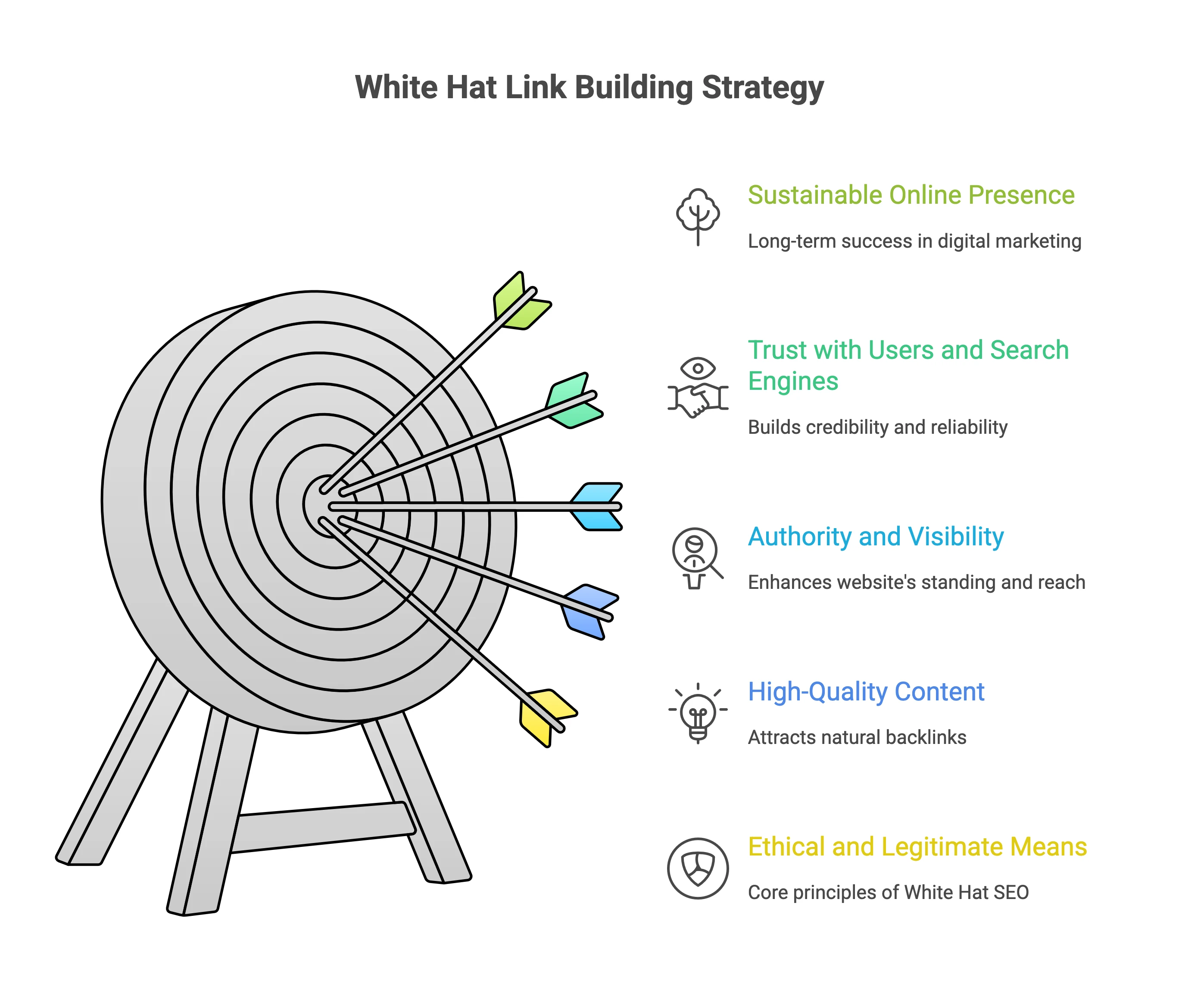
White hat link building is the practice of earning backlinks by creating real value and getting links through editorial choice, not through manipulation. It avoids paid links meant to pass ranking signals, automated link creation, and excessive reciprocal exchanges that exist mainly to influence rankings.
A useful way to think about it:
- White hat: links happen because someone would still link even if Google did not exist.
- Gray hat: links "look natural" but rely on patterns that break when guidelines tighten.
- Black hat: links exist mainly to influence rankings, and penalties are part of the business model.
If you are a startup or an agency shipping fast, white hat matters because clean link equity is hard to replace. You can always publish more pages. Undoing a bad link profile is slower, expensive, and distracting.
The simplest test for any link tactic
Ask two questions before you invest time:
- Would a real editor approve this link?
- Does the link help their reader do something better or faster?
If either answer is "no", you are not building authority. You are borrowing it on credit.
The 3 signals that make links count
Not all links move the needle. The links that reliably lift rankings tend to share three traits.
1) Relevance beats raw authority
A DR 30 blog in your niche often helps more than a DR 90 site that never covers your category. Relevance affects everything: where your link sits, what anchors make sense, and whether visitors actually click.
2) Editorial standards are the moat
Editorial links are hard to fake because the publisher is protecting their own reputation. This is why Google's guidance is strict about link spam patterns like paid links for ranking and excessive exchanges.
In practice, "editorial" looks like:
- Your link supports a claim, a definition, or a recommended resource
- The page would still work without your link
- The publisher can say "no" and often does
3) Crawlable links and clean context
A link that is hidden behind scripts, blocked, or buried in a messy page can be ignored. Google also publishes link best practices focused on crawlability and clear anchor text.
This is why the best links are simple:
- Plain HTML links
- Clear, natural anchors
- Placed where a reader expects a citation
Linkable assets that earn editorial links

Original data you can defend
You do not need a 50-page industry report. Small data wins if it is real.
Examples that earn citations:
- A scrape of 200 pricing pages and what patterns convert
- A benchmark of 15 tools in a category with the same test script
- A "state of the niche" survey with 50-100 responses
Publish the dataset, even if it is messy. Writers link to sources they can trust, and raw data signals confidence.
Free tools, generators, and calculators
Tools are link magnets because they are easy to recommend.
If you build SaaS, start with tools that sit one step before a purchase decision:
- ROI calculator for your category
- Template generator (policy, checklist, brief)
- Free audit or grader
You already see this pattern on Launch Directories itself: small utilities like the badge generator create natural reasons for directory owners and creators to reference the site.
Comparison pages that feel fair
Founders love alternatives pages, but most are thin and biased. A fair comparison earns links from both sides of the market.
A high-performing structure:
- Who each option is for
- Pricing and limits (with screenshots and dates)
- Feature differences that change outcomes
- Migration notes and pitfalls
If your page reads like a sales page, it will not get cited. If it reads like a decision memo, it will.
Outreach that works without burning your reputation
Good outreach is not volume. It is fit and timing.
Build a target list that is worth your time
Before you write a single email, qualify your list:
- The page already links out to resources like yours
- The author covers your niche consistently
- The article is updated in the last 12-18 months
- The audience overlaps with your ideal buyer
You want 30 great targets, not 300 random ones.
The "reason to link" framework
A pitch fails when it asks for a link without reducing the editor's effort. Use this structure:
- Context: one sentence proving you actually read the page
- Gap: what the reader is missing today
- Asset: the specific section on your page that fixes it
- Proof: one data point or screenshot
- Easy next step: offer a one-line suggestion they can paste
Follow-ups that do not feel spammy
Two follow-ups is the ceiling for most founders. After that, you are training people to ignore you.
A clean sequence:
- Day 0: initial email
- Day 3-4: send a second note with one extra proof point
- Day 8-10: close the loop and offer to stop
If you want more volume, increase the quality of targets, not the number of follow-ups.
Product-led white hat link building

Integration and partner links
If you integrate with Stripe, Notion, Slack, or any ecosystem tool, you can earn links from:
- Integration directories
- Partner pages
- Co-marketing posts
- Templates that require both tools
The key is to ship something that users can actually use, not just a checkbox integration.
Guest contributions that are actually useful
Guest posting is not dead. Low-effort guest posting is dead.
A white hat guest contribution has:
- A specific use case
- Real screenshots, numbers, or code
- A strong opinion backed by evidence
- A link that supports the reader, not your sales funnel
If you cannot write something you would proudly publish on your own blog, skip it.
Launch Directories is built around making this step efficient. The database tracks DR, traffic estimates, and link types so you can prioritize directories that actually help. If time is your bottleneck, the manual submission service can execute consistent listings across 100+ directories and deliver a report you can audit.
White hat link building for startups: your first 30 links
New domains do not need "viral" links. They need a believable profile: branded anchors, a mix of link types, and a few deep links to pages that convert.
Here is a clean early-stage map:
| Link source | Why it is white hat | What to link to |
|---|---|---|
| Founder profile and social bios | Brand signal + discovery | Homepage or about |
| Company listings (reputable directories) | Real discovery + citations | Homepage + one feature page |
| Niche communities (curated resources pages) | Contextual relevance | A guide or tool |
| Partner pages and integrations | Editorial by product fit | Integration or use case |
| Podcasts and interviews | Brand mentions + authority | Homepage or founder story |
| Templates/tools you publish | Linkable utility | Tool page |
| Guest contributions on niche blogs | Earned editorial placement | A deep guide |
The link targets most founders forget
Most people only chase homepage links. That wastes the best opportunity.
Earn deep links to pages that convert:
- Use cases
- Comparisons
- Templates
- Pricing or "how it works" pages
Deep links reduce your dependence on one page ranking for everything.
A safe anchor text pattern
Early on, keep anchors boring:
- Brand name
- URL
- "Launch Directories database" style descriptive anchors
- Light topical anchors only when they are natural in context
If you push exact-match anchors aggressively, you create a pattern that looks manufactured.
White hat link building metrics: measure quality, not vanity
Link building becomes predictable when you treat it like a growth channel.
Quality checklist for any potential link
Before you celebrate a new link, validate it:
- The page is indexable and not blocked
- The link is crawlable (plain HTML, not hidden)
- The site has real content and real readers
- The link sits in a relevant section, not a footer list
- The anchor reads naturally
Google's own documentation highlights crawlable links and clear anchors as best practices.
The only numbers worth tracking weekly
- Referring domains (not raw backlink count)
- Links to your top 3 money pages
- New branded searches (a proxy for trust)
- Search Console impressions and clicks on linked pages
Large correlation studies still show a strong relationship between backlinks and first-page ranking outcomes. What changes year to year is which links count, not whether links matter.
When to slow down
Fast link velocity is not a problem by itself. Unexplained link velocity is.
Slow down if you see:
- A sudden spike from unrelated countries or languages
- Lots of sidebar and footer links
- Many links with the same commercial anchor
- Directories that look cloned and empty
with 100+ Directory Listings
Skip the grind. We'll submit your product to top directories so you get real users, feedback, and lifetime backlinks without lifting a finger.
Practical application: a 21-day white hat sprint
If you want results without losing weeks, run this sprint once per quarter.
- Days 1-3: build your link targets
- Pick one primary page to grow (a guide, tool, or comparison).
- Add internal links from your homepage and top posts to that page.
- Create a short "evidence block": 3 screenshots, 3 numbers, 3 quotes from customers.
- Days 4-7: lock in foundational links
- Submit to 15-30 reputable directories in your niche.
- Prioritize directories with real traffic and clear editorial rules.
- If you are managing multiple launches or you just hate submissions, use a done-for-you directory submission service and keep the report for future launches.
- Days 8-14: ship one linkable asset
- Publish a tool, a benchmark, or a small dataset.
- Make it skimmable: a summary box at the top, then the details.
- Add a "cite this" section with the exact statistic and the date.
- Days 15-21: run focused outreach
- Build a list of 30 pages that already link to similar resources.
- Send 10 highly-personalized pitches per day for 3 days.
- Use one follow-up, then move on.
Conclusion
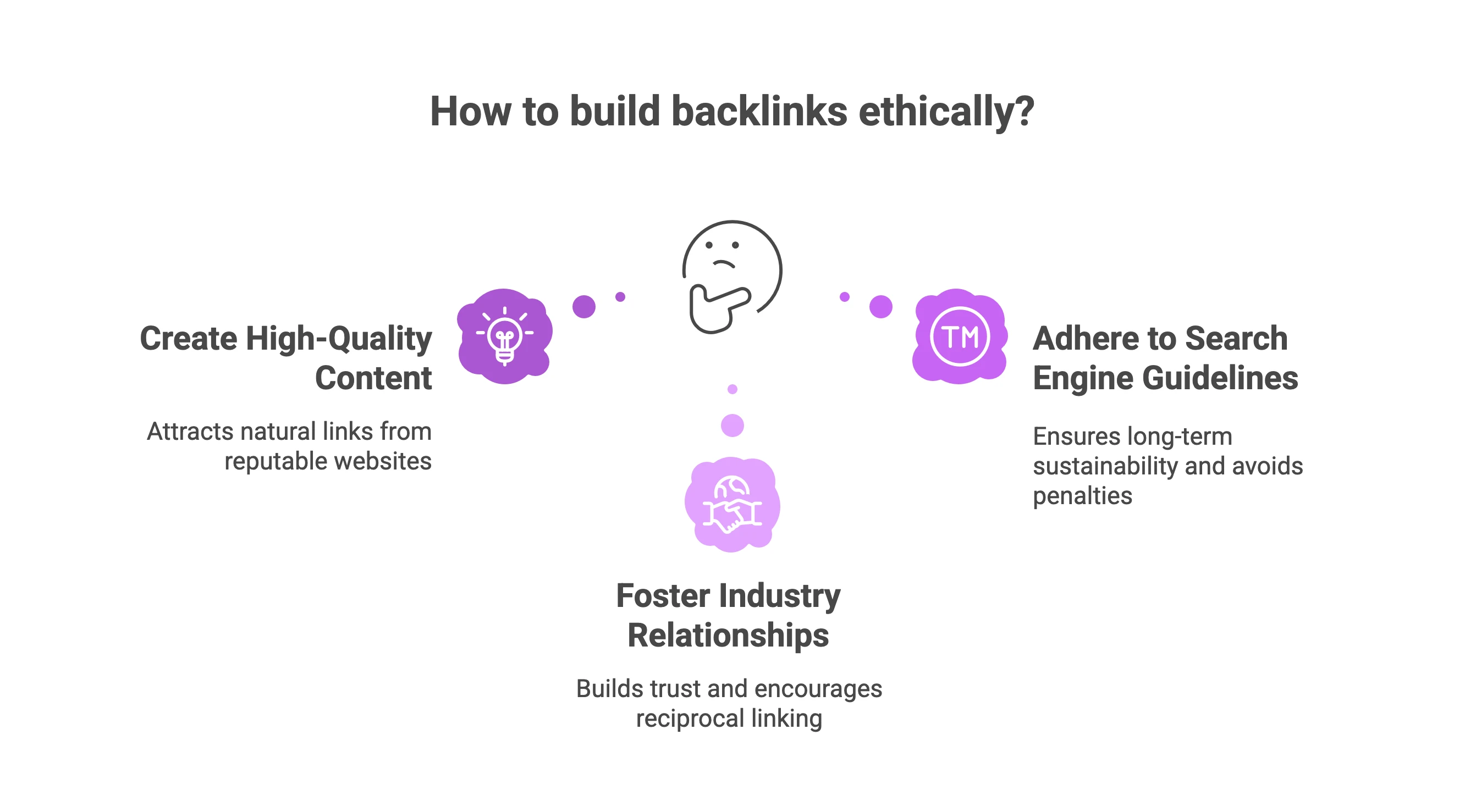
White hat link building works because it aligns with how the web already behaves: people cite resources that save them time, strengthen their argument, or help their audience make a decision. Build one asset worth referencing, earn a base layer of reputable directory links, then use focused outreach and partnerships to stack editorial mentions over time. When you measure progress by referring domains and rankings on your money pages, the work becomes predictable and repeatable.
If you want to move faster, start with a curated directory database to choose the right platforms, then scale with a done-for-you submission workflow once you know what converts. White hat link building is a long game, but the compounding starts earlier than most founders expect.
FAQ
Is white hat link building still effective in 2026?
Yes. Algorithms get better at ignoring manufactured links, not at ignoring real citations. The link types that keep working are editorial references, partner links tied to real integrations, and useful resources that earn mentions naturally. The playbook stays stable: relevance, value, and clean execution.
How long does white hat link building take to work?
You usually see early movement in 2-6 weeks after earning a few quality referring domains and improving internal linking to the target page. Competitive keywords take longer because authority compounds. The fastest wins come from pages already getting impressions that need more trust signals.
Are directory links white hat?
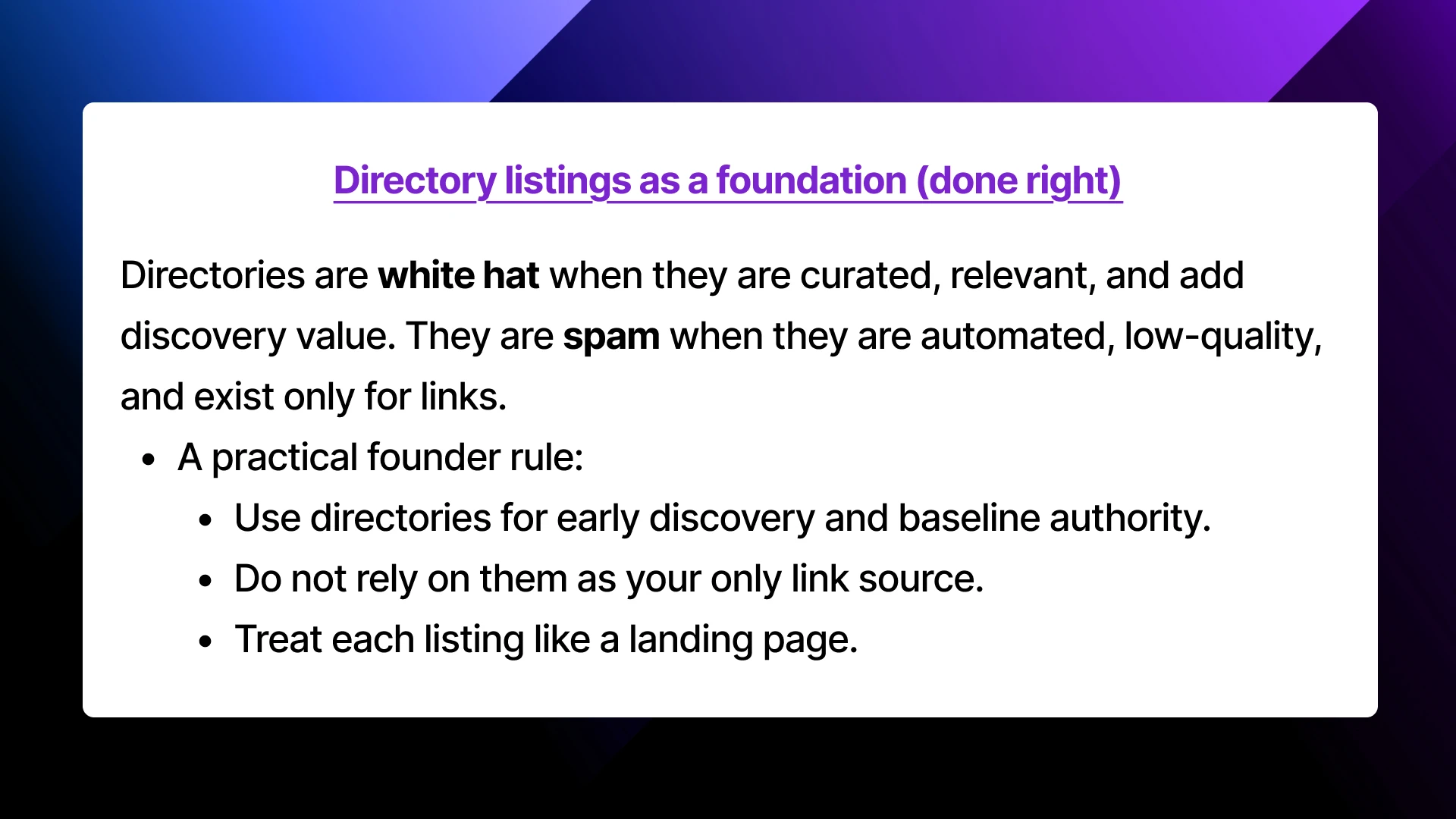
Directory links are white hat when the directory is curated, relevant, and provides real discovery value to readers. They become risky when the directory exists mainly to sell links, has thin or duplicated content, or is filled with spam. Treat directories as a foundation, not the whole strategy.
Do nofollow links matter?
Nofollow links can still drive real referral traffic and brand discovery, which often leads to earned editorial links later. They also help your link profile look natural, since real brands attract a mix of dofollow and nofollow mentions. Focus on relevance and audience fit first.
What is the safest first link building tactic for a new SaaS?
Start with links you can earn without negotiation: founder profiles, reputable SaaS and niche directories, and partner pages for your integrations. Then publish one genuinely useful asset (tool, benchmark, dataset) that gives writers a reason to cite you. This builds trust fast without risk.
Ready to build high-quality backlinks?
We'll submit your product to 100+ directories and build valuable backlinks for your SEO. Save hours of manual work so you can focus on what's important — selling and building, not submitting boring forms.