If your site is brand new, the hardest part is not writing content. It’s getting Google to treat you like you exist.
Ahrefs found that only 1.74% of newly published pages reached Google’s top 10 within a year in a recent analysis, and most top-ranking pages are years old. That sounds brutal, but it also tells you the game: you do not win by publishing 50 random posts and hoping. You win by making your site easy to crawl, picking winnable queries, building a tight set of pages that prove relevance, then stacking early authority signals.
What SEO looks like for a brand-new website?
When your domain has no history, Google has zero reasons to trust it. SEO for a new website is the process of earning that trust step by step: first making sure your pages can be found and indexed, then proving you’re relevant for a tight set of topics, and finally building enough authority (through quality links and mentions) to compete.
Most new sites stall because they jump straight to publishing lots of content or chasing big keywords. The faster path is sequencing:
Get indexing and internal linking right, ship a small cluster of genuinely helpful pages around one theme, then earn a first wave of credible backlinks so Google sees signals beyond your own site.
SEO for new websites starts with crawlability and indexing
Before you worry about rankings, make sure Google can reliably find and understand your pages. Most “new site SEO” problems are boring: wrong canonicals, no internal links, blocked crawling, thin pages that look like placeholders.
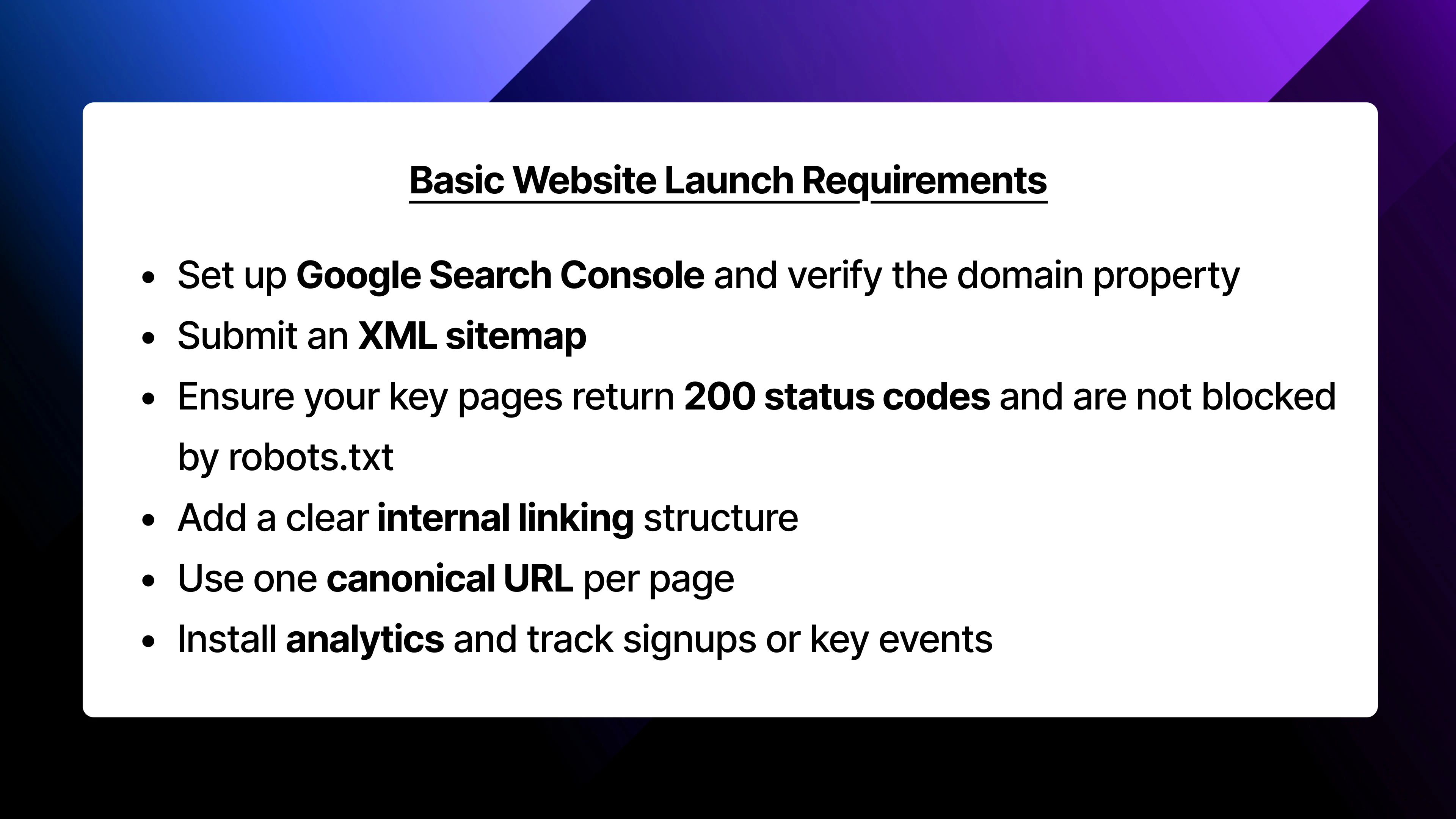
The “why isn’t Google indexing me?” reality check
If you launch with 5 pages and none of them have external links, it’s normal to see slow discovery. Google uses links to find new pages and understand what matters. That’s why the earliest wins often come from:
- A handful of directory or community profiles that link back to your site
- A couple of partners or **integrations **that mention you
- Tight internal linking so every important page is reachable within 2-3 clicks
A simple architecture that works on day one
For a new SaaS or product site, avoid sprawling navigation. Start with a structure you can expand:
- Home
- Product
- Pricing
- Use cases (1-3)
- Blog / resources (only if you can publish consistently)
- Company pages (About, Contact, Privacy)

Keyword research for new sites: pick fights you can win
Most new sites don’t have a content problem. They have a keyword selection problem.
If you target “project management software” on a fresh domain, you’re competing with brands that have thousands of links, years of history, and entire teams. Your goal is to start where Google has room to trust a newcomer.
The quickest way to find winnable keywords
Look for queries with these traits:
- Specific pain + specific audience
- Clear intent (the searcher knows what they want)
- SERPs that are not dominated by mega brands
These tend to be lower competition, convert better, and map naturally to product positioning.
Map keywords to pages (so you stop creating overlap)
A new site should not have 6 pages targeting the same idea with slight wording changes. Create a simple map:
- 1 primary keyword per page
- 2-5 close variations per page
- Every supporting page links to one main page
If your product is “time tracking for agencies,” your cluster might look like:
Main page: time tracking for agencies
Supporting pages:
- time tracking for creative agencies
- time tracking vs project management (comparison angle)
- how agencies handle billable hours (education angle)
That cluster becomes your early topical footprint.
Build the pages that actually move the needle
New websites rank faster when their pages do two jobs at once: they match intent and they prove credibility.
Start with 5 core pages (and make them excellent)
- Homepage: one clear positioning line, who it’s for, the outcome, and proof
- Product page: features tied to outcomes, not a checklist
- Pricing page: transparent tiers, who each tier is for, and FAQ
- Use case page: a specific audience and their workflow (not generic)
- Proof page: testimonials, case study, or “how it works with real examples”

Add one page type that new sites underuse: comparisons
Comparison pages are often the first pages that rank because the intent is narrow and the query is explicit.
Examples:
- “Tool X vs Tool Y”
- “Best alternatives to Tool X”
- “Tool X for [audience]”
Do not fake comparisons. If you’re early, keep it honest:
- Who your tool is best for
- Where the competitor wins
- What the trade-off is
That honesty builds trust and reduces bounces.
Content that earns trust without publishing 3x per week
Publishing volume is not a strategy. It’s a capacity test.
For new websites, the best content is usually:
- Problem-first (a real pain, explained clearly)
- Specific (audience, workflow, constraints)
- Demonstrated (screenshots, examples, numbers)
The content formats that work best early
- “How to” posts tied to your product’s workflow
- Templates, checklists, and calculators (simple wins)
- Integration guides (even if it’s just “how to connect X and Y”)
- Case-study style breakdowns (even if it’s your own build process)
If you get asked “Can your tool do X?” or “What’s the best way to handle Y?”, that question is usually a strong keyword candidate.
Answer it once, thoroughly, and make it a page you can link forever.
Do not publish content you can’t defend
Thin posts hurt new sites because they dilute quality signals. If a page has no unique insight, no examples, and no reason to exist besides “we should have a blog,” skip it.
Authority for new domains: how to build links safely
Google uses links to discover pages and understand relevance. For a new site, your first goal is not “a thousand links.” It’s a few dozen legitimate mentions from real sites, ideally in your niche.
The safe order of operations (what works in month 1)
Foundational profiles (fast indexing and legitimacy)
- Launch platforms
- Relevant directories
- Founder profiles that allow a website link
Niche directories (tighter relevance, often higher conversion)
Partner mentions (integrations, co-marketing, agencies, communities)
Editorial links (guest posts, resource page inclusions, interviews)
Directory submissions that actually help (and the ones that waste time)
A good directory has at least one of these:
- Real traffic (people browse it)
- Editorial standards (not “accept everything”)
- Strong domain metrics and consistent indexing
A bad directory looks like:
- Thousands of categories with no curation
- Copied descriptions everywhere
- Pages that don’t even get indexed
This is where a curated database saves time. Launch Directories, for example, surfaces DR, traffic estimates, and link types so you can filter out dead weight and prioritize listings that get crawled and seen.
If you’re short on time, a manual submission service can also make sense. The value is not “someone else clicks submit” The value is consistent copy, clean tracking, and avoiding low-quality targets.

How many links does a new website need?
There is no magic number, but there is a pattern:
- 10-20 referring domains: you usually see faster crawling, more impressions, and brand terms begin to show
- 30-60 referring domains: you can start competing for non-brand long-tails
- 60+: your content starts to rank with less friction, assuming it’s good
Focus on diversity of domains, relevance, and consistent growth.
The metrics that matter in the first 90 days
New site SEO is about momentum. Track the signals that tell you you’re moving.
Search Console metrics to watch weekly
- Pages indexed (is Google actually storing your content?)
- Impressions (are you appearing at all?)
- Queries (what Google thinks you’re relevant for)
- Average position (direction matters more than the number early)
- Top pages (which URLs are earning visibility)
The 3 outcomes you want by Day 90
- Your core pages are indexed and stable (no constant deindexing)
- You’re getting impressions for non-brand terms you intentionally targeted
- You have a small but real backlink foundation from relevant sources
If you have those three, the compounding phase begins.
A quick prioritization table (bookmark this)
| Timeframe | What to focus on | What “good” looks like |
|---|---|---|
| Week 1-2 | Indexing + architecture | Core pages indexed, sitemap processed, no major errors |
| Week 3-4 | One topic cluster | 3-6 pages tightly linked, all targeting one theme |
| Week 5-8 | Authority basics | 10-20 quality referring domains, early referral traffic |
| Week 9-12 | Expansion | Second cluster, comparisons/integrations, refresh top pages |
Conclusion
SEO rewards sites that look real, stay consistent, and earn trust over time. New websites rarely win by brute force. They win by picking a tight niche, publishing pages that match intent, and stacking early authority signals that help Google discover and validate them.
If you want to move faster, start by making indexing effortless, then build one topic cluster you can dominate. Add 10-20 legitimate referring domains, and watch impressions turn into rankings.
That’s seo for new websites that compounds: fewer guesses, more momentum, and a clear path from “brand new” to “search traffic that brings users.”
with 100+ Directory Listings
Skip the grind. We'll submit your product to top directories so you get real users, feedback, and lifetime backlinks without lifting a finger.
FAQ
How long does SEO take for a new website?
Most new sites need a few months to build enough trust to rank consistently, and competitive terms can take much longer. You can often see early impressions and long-tail rankings within 30-90 days if indexing is clean, content is focused, and you earn initial links.
Do backlinks matter for new websites?
Yes. Links help search engines discover your pages and act as trust signals, especially when your domain has no history. Start with legitimate directory and community links, then earn niche mentions through partnerships and content that others reference.
How many blog posts does a new website need to rank?
There’s no fixed number. A new site can rank with a small set of strong pages if they match intent and are well linked internally. Focus on one topic cluster (3-6 pages) before scaling volume, otherwise you spread authority too thin.
Should I submit my new website to directories?
If the directories are legitimate, yes. High-quality directories can drive referral traffic, speed up discovery, and diversify your backlink profile. Skip low-quality “accept everything” directories and prioritize curated platforms with real users and consistent indexing.
What should I do first: content or technical SEO?
Technical setup comes first because it determines whether your content can be crawled and indexed. Once the basics are right (sitemap, canonicals, internal links), publish a focused cluster. Then build authority so those pages actually compete.
Ready to build high-quality backlinks?
We'll submit your product to 100+ directories and build valuable backlinks for your SEO. Save hours of manual work so you can focus on what's important — selling and building, not submitting boring forms.