Most SaaS marketing fails for a boring reason: it is a pile of tactics, not a system. You post on X, run a few ads, ship a launch, publish a blog post, then wonder why signups do not compound. A real SaaS marketing strategy turns your product, your positioning, and your channels into repeatable loops: people discover you, hit value fast, and come back with teammates. The goal is not “more traffic.” The goal is predictable growth you can measure, improve, and defend when competitors copy your features.
You are going to build that system here: clear positioning, a funnel designed for recurring revenue, channel choices based on your stage, and a measurement cadence that stops you from guessing.
How SaaS marketing works?
SaaS marketing is the work of building demand for subscription software and turning that demand into recurring revenue. It covers the full customer lifecycle: how people discover you, evaluate you against alternatives, experience value quickly, and keep getting value month after month.
A SaaS marketing strategy is the system that organizes all of that into a repeatable plan, aligning your ICP, positioning, channels, onboarding, and measurement so growth becomes something you can run, track, and improve every week.
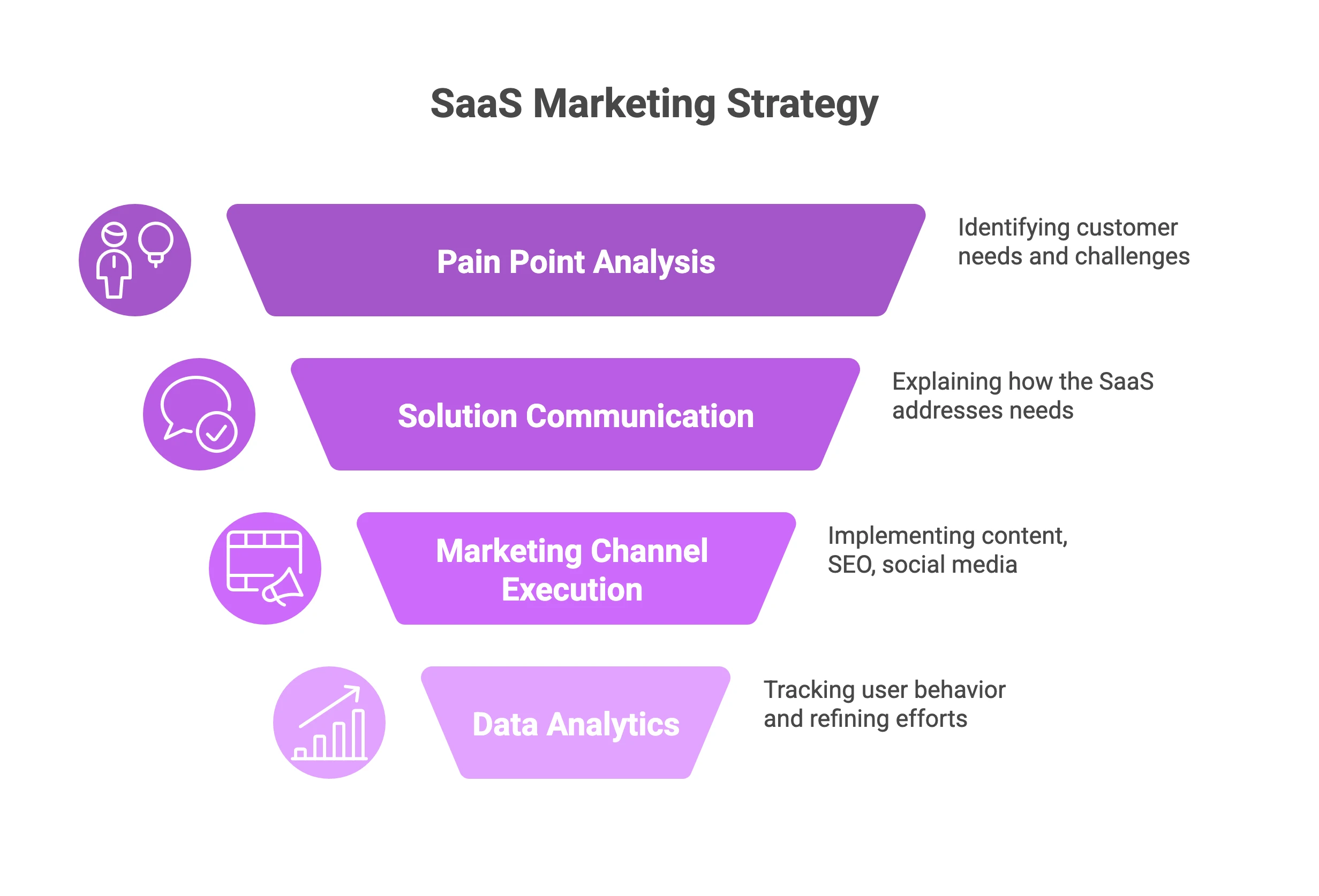
A useful strategy has five parts:
- Positioning: who you serve, what problem you own, and why you win.
- Acquisition: how new users discover you (and why they trust you).
- Activation: how fast users reach the “aha” moment.
- Monetization: how you turn value into revenue (pricing, packaging, sales motion).
- Retention + expansion: how you keep customers and grow accounts over time.
The founder-friendly rule: one audience, one promise, two channels
Early-stage SaaS teams burn months by trying to market to everyone and be everywhere. Pick:
- One primary audience (the people who feel the pain most often).
- One clear promise (the outcome they want, in their words).
- Two acquisition channels you will run for 6-8 weeks without switching.
Everything else is a distraction until this works.
Positioning that makes every channel cheaper
Positioning is not a tagline. It is a set of decisions that makes your marketing easier and your sales conversations shorter. Weak positioning forces you to “outspend” competitors. Strong positioning lets you win with clarity.
Define your ICP like you are excluding people on purpose
Your ideal customer profile is not “startups” or “marketers.” It is a specific situation. A good ICP has:
- Role (who buys and who uses)
- Context (industry, team size, tech stack, constraints)
- Trigger (what changed that makes them buy now)
- Success criteria (what “good” looks like in 30 days)

Build a funnel that fits recurring revenue
SaaS funnels are different because the relationship continues after the first purchase. Your “top of funnel” work is wasted if activation and retention are weak.
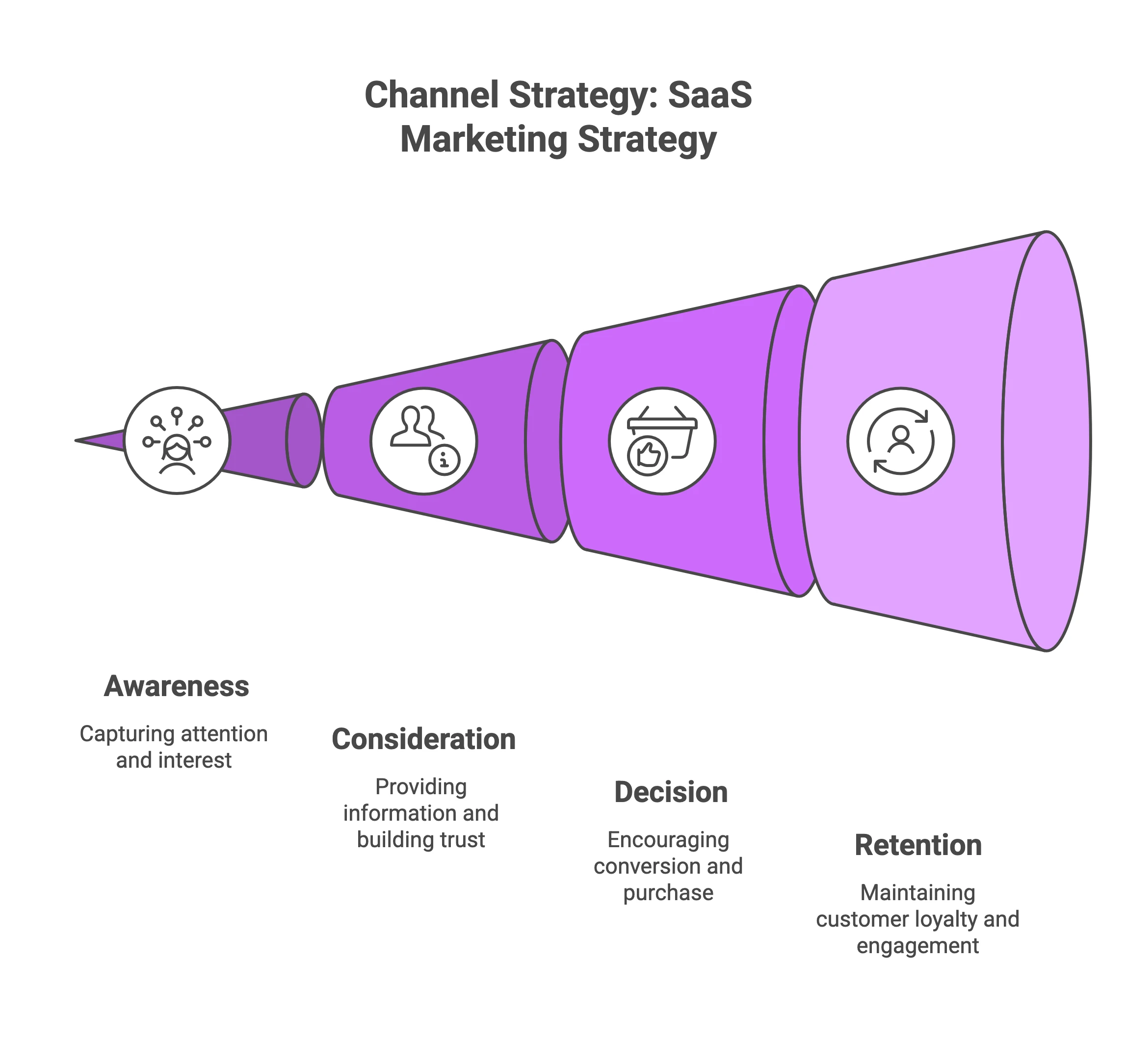
Map the journey in four stages
Use this simple model:
- Aware: they know the problem exists.
- Evaluating: they compare options and need proof.
- Activated: they hit value and build a habit.
- Expanded: they add seats, upgrade, or buy add-ons.
Each stage needs different assets.
Match your motion to your price and complexity
A common mistake is copying an enterprise playbook for a $19/mo tool, or forcing self-serve for a complex product.
Use these guidelines:
- Self-serve (typically low ACV, low complexity): prioritize SEO, directories, templates, freemium, in-product prompts.
- Sales-assist (mid ACV, moderate complexity): prioritize webinars, case studies, outbound sequences, review sites, partners.
- Sales-led (high ACV, high complexity): prioritize account-based content, events, targeted outbound, proof-heavy collateral.

Define activation in one sentence
Activation is not “signed up.” It is the moment a user experiences value. Examples:
- “Created a workspace and invited one teammate”
- “Connected the data source and generated the first report”
- “Published the first widget and got one view”
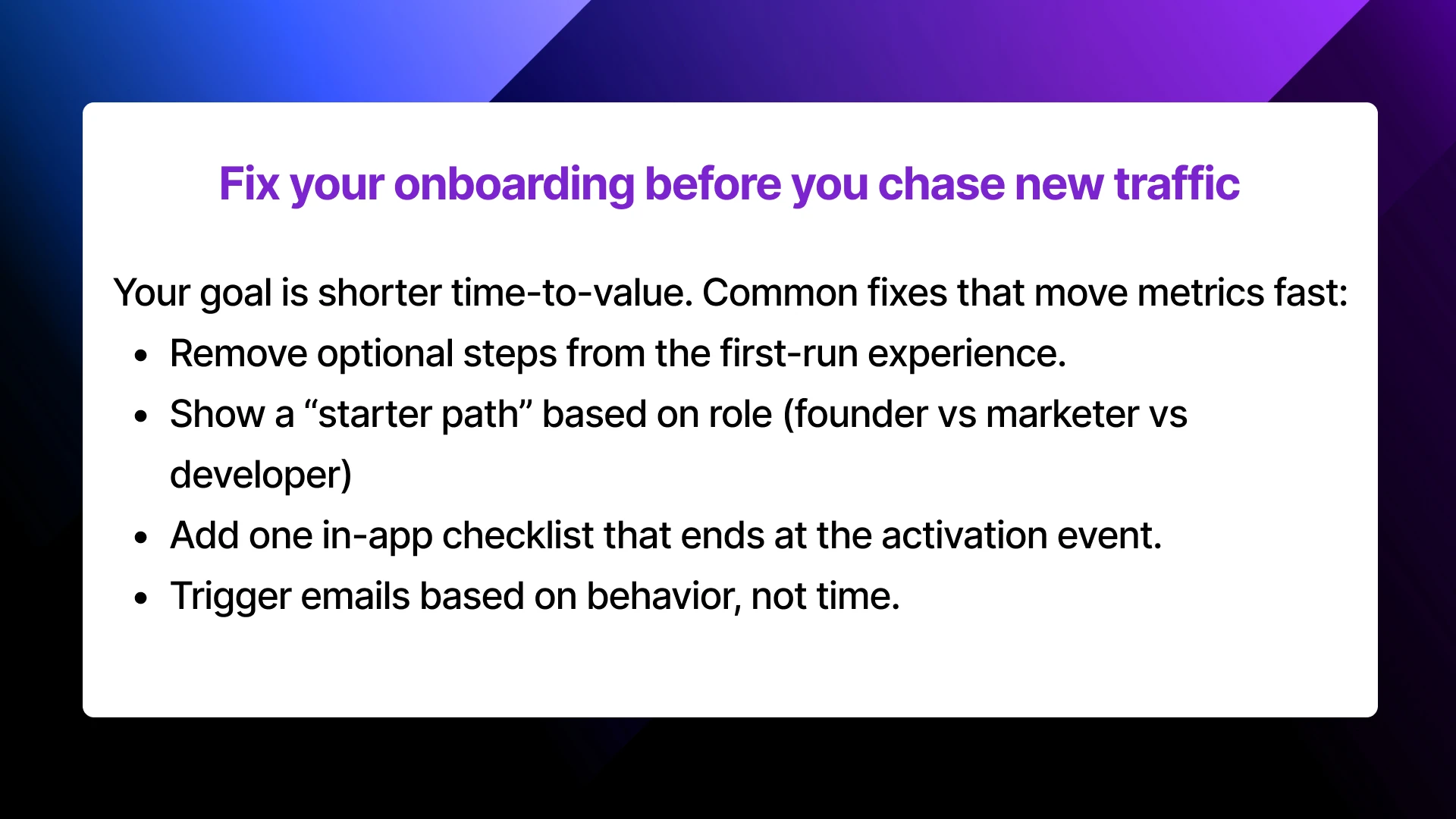
Your onboarding, emails, and in-app prompts should push to that one event.
Channel strategy: SaaS marketing strategy by stage
The best channel depends on where you are, not what is trendy. Here is a simple way to choose.
| Stage | Primary goal | Best channels to start | What to measure weekly |
|---|---|---|---|
| Pre-PMF | Learn fast, get first users | Founder-led outbound, niche communities, directory listings, short demos | Qualified conversations, activation rate |
| Early PMF | Repeatable acquisition | SEO + content, directories, partnerships, lightweight paid tests | Trial-to-paid, CAC payback trend |
| Growth | Scale efficient demand | Paid search/social, affiliates, integrations, review sites, programmatic SEO | Pipeline, payback, retention, expansion |
Pre-PMF: prioritize feedback loops over volume
At this stage, 50 perfect users beat 5,000 random visitors.
What works:
- Direct outreach to people who already feel the pain
- Small communities where your ICP asks questions
- Micro-content showing the product solving one problem
- Directory listings that get you discovered by early adopters browsing for tools
Directory listings are a useful early channel because they create three wins at once:
- Referral traffic from people already looking for solutions
- Backlinks that support long-term authority building
- Trust signals when prospects Google you
Launch Directories is built around this workflow, with a searchable database that includes DR, traffic estimates, and dofollow vs nofollow link types so you can prioritize where you submit first.
Early PMF: stack channels that compound
Once you can convert users reliably, you want channels that get cheaper over time.
Two reliable “compounding pairs”:
- SEO + distribution (content plus consistent listings, partner mentions, and linkable assets)
- Product-led growth + lifecycle (activation, upgrades, referrals driven inside the product)
A practical example of directory-led compounding: one Launch Directories case study shows a new SaaS going from 0 backlinks and DR 0 to 115 backlinks and DR 22 after a directory submission campaign, with 61+ directories indexed.
Growth: scale what is already working, then add leverage
At growth stage, you are choosing between:
- Efficiency (lower payback, stable margins)
- Speed (higher spend, faster pipeline)
Do not scale paid until:
- You know which message converts
- Your onboarding is solid
- Your website has clear pages for use cases, pricing, and comparisons
Otherwise you will just pay to discover your positioning is unclear.
SEO and distribution inside your SaaS marketing strategy
SEO is not “write blog posts.” For SaaS, it is building pages that match how people evaluate software, then earning enough authority that those pages rank.
A useful reminder: Backlinko’s analysis of Google search results found that very few pages have any backlinks, and that roughly 95% of pages have zero backlinks. That is why distribution and link earning matter if you want organic visibility.

Build a revenue-tied topic cluster
Pick one core topic that maps to what you sell. Create:
- 1 hub page (the “best answer” for the topic)
- 5-8 supporting articles (specific problems, workflows, templates)
- 2-3 comparisons (once you have credibility)
This structure helps search engines understand what you own and helps readers find the next step.
The SaaS pages that convert search into revenue
Most SaaS sites underinvest in “money pages.” Prioritize:
- Use case pages (role + problem + outcome)
- Comparison pages (vs competitors or alternatives)
- Integration pages (especially if your users care about stack fit)
- Pricing and packaging pages(reduce uncertainty)
Blog content supports these pages. It is not the end goal.
Where directories fit (without turning into spam)
Directory listings work when you treat them like mini-landing pages:
- Tight description that matches your positioning
- Screenshots that show the “aha” moment
- Consistent naming, categories, and links
- A plan to refresh listings when features evolve
Quality matters. Launch Directories checks and updates directory data (including DR, traffic, and active status) monthly, which helps you avoid wasting time on dead platforms.
If you want the fastest execution path, the done-for-you directory submission service aims to get products listed on 100+ directories in 3-5 days.
Lifecycle marketing that drives retention and expansion
If acquisition is the engine, lifecycle is the flywheel. It is where most SaaS teams leave money on the table.
Expansion is a product + marketing collaboration
| Expansion happens when customers | Marketing supports this with |
|---|---|
| Invite teammates | Use case campaigns for existing customers |
| Use more features | Feature education that maps to outcomes |
| Upgrade plans | Proof (case studies, benchmarks) for upgrades |
| Buy add-ons | Referral loops (templates, shareable outputs, collaboration features) |
Measurement and cadence: stop guessing every Monday
Metrics do not make you mature. Picking the wrong metrics makes you busy.
Start with three numbers
Most early-stage teams can run a strong marketing machine with:
- Activation rate (your product actually delivers value)
- Trial-to-paid or lead-to-customer conversion (your offer is working)
- CAC payback period (your growth is capital-efficient)
CAC payback is how long it takes to earn back what you spend acquiring a customer, and it is one of the cleanest ways to judge go-to-market efficiency.
The simplest experiment cadence that works
Run marketing like product:
- Weekly: 1 experiment per channel (headline test, landing page variant, new listing copy, outreach angle)
- Biweekly: review cohort metrics (activation, conversion, churn)
- Monthly: pick one “compounding project” (topic cluster, integration page set, directory wave, partner push)
The compounding projects are what make next month easier than this month.

Practical application: a 30-day SaaS marketing strategy sprint
Days 1-5: Nail positioning
- Write your ICP in one paragraph and exclude who you are not for.
- Interview 5-10 users (or prospects) and capture exact language.
- Publish a simple homepage update: one promise, one primary CTA, one proof point.
Days 6-12: Build the funnel
- Define the activation event and add an onboarding checklist that drives to it.
- Create 3 money pages: one use case, one comparison, one pricing explainer section.
- Set up basic tracking: activation rate, conversion rate, and payback inputs.
Days 13-20: Pick two acquisition channelsChoose based on your stage:
- Early: directories + niche community
- Post-PMF: SEO cluster + lightweight paid test
- Sales-assist: outbound + partner content
Execute one “first wave”:
- Submit to a curated set of directories (prioritize relevance, DR, and dofollow where it makes sense).
- Publish one hub page and two supporting articles tied to your primary use case.
Days 21-30: Create your weekly cadence
- One experiment per channel per week.
- One dashboard you review every Monday.
- One monthly compounding project you commit to finishing.
Tools that keep this lightweight: GA4, Search Console, a product analytics tool (PostHog or Amplitude), a CRM if you sell (HubSpot or Pipedrive), and an SEO suite (Ahrefs or similar) for link and ranking visibility.
Conclusion
A SaaS marketing strategy is not a list of tactics. It is a system you can run: positioning that attracts the right buyers, a funnel that gets users to value fast, channels chosen for your stage, and metrics that tell you what to fix next. If you do this well, growth stops feeling like luck. You trade random spikes for compounding loops.
Start small: one audience, one promise, two channels. Build proof as you go, then scale what already converts. If directory distribution is part of your plan, use a curated database to prioritize the listings that actually matter, or outsource the manual work so you can stay focused on product and activation.
FAQ
What is a SaaS marketing strategy?
A SaaS marketing strategy is a repeatable system for growing a subscription software business. It aligns your ICP, positioning, channels, onboarding, and measurement so you can acquire users, activate them fast, convert them to paid, and retain and expand revenue over time.
What are the best marketing channels for early-stage SaaS?
For early-stage SaaS, the best channels are the ones that produce fast feedback and qualified users: founder-led outbound, niche communities, directory listings, and a small set of high-intent pages. After early traction, add SEO content clusters and lightweight paid tests.
How do you measure whether a SaaS marketing strategy is working?
Track activation rate, trial-to-paid (or lead-to-customer) conversion, and CAC payback period. These show whether your product delivers value, your offer converts, and your acquisition is financially sustainable. Review them weekly by cohort to spot improvements or leaks.
How long does it take for SaaS SEO to work?
Most SaaS teams see meaningful SEO movement in 3-6 months, with bigger wins compounding over 6-12 months. Results depend on competition, site authority, and how well your pages match buyer intent. You can speed this up by pairing content with consistent distribution and link earning.
Are directory listings worth it for SaaS?
Yes, if you choose directories strategically and treat listings like mini landing pages. They can drive referral traffic, add trust signals, and diversify referring domains, which supports long-term SEO. Avoid low-quality directories and focus on relevance, active platforms, and clear positioning.
Ready to build high-quality backlinks?
We'll submit your product to 100+ directories and build valuable backlinks for your SEO. Save hours of manual work so you can focus on what's important — selling and building, not submitting boring forms.