Marketing budgets are tighter than most founders expect. Gartner reports the average marketing budget fell to 7.7% of company revenue in 2024 - down from 9.1% in 2023. That squeeze is exactly why choosing a startup marketing agency matters: one wrong retainer can burn a chunk of runway without moving signups, pipeline, or activation.
The usual failure mode is hiring for the wrong job: paying for output when you needed clarity or distribution. You can de-risk the decision quickly with a clear scorecard, a pricing reality check, and questions that expose fluff fast.
What is a startup marketing agency?
A startup marketing agency is a team you hire to plan and execute growth work across channels (content, SEO, paid, partnerships, lifecycle, and launch distribution) with startup constraints in mind: limited runway, messy data, and fast iteration. The best ones do not just “run campaigns”. They build a repeatable acquisition system and a measurement layer so you can scale what works.
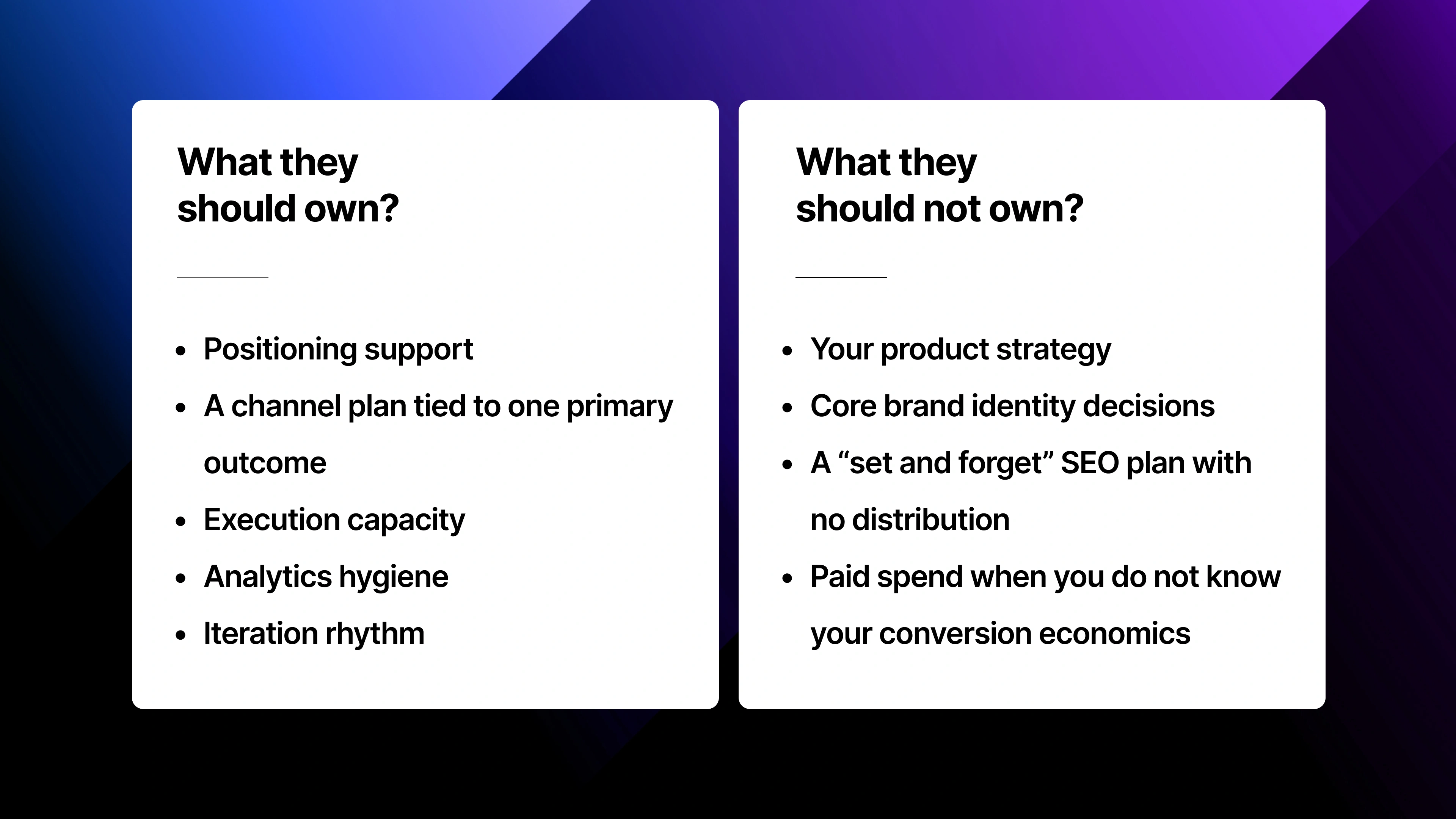
The fastest way to spot “agency theater”
If their proposal is heavy on deliverables and light on:
- Your current numbers
- Your bottleneck
- A prioritized experiment backlog
- How they will measure impact
When it makes sense to hire (and when it does not)
The right time to outsource is not “when you feel behind”. It is when you can feed the machine.
Hire a startup marketing agency if you have at least 3 of these
- Clear ICP: you can describe who buys, why, and what they replace today
- A working funnel: at least one path from traffic to signup to activation exists
- Assets: you can ship stories, screenshots, benchmarks, templates, or tools
- Founder bandwidth: you can do weekly reviews and unblock decisions in 24-48 hours
- A 90-day window: you can run long enough to learn, not panic-stop
Wait if you are missing these fundamentals
- You cannot articulate your customer in one sentence
- Your onboarding is broken and conversion is unknown
- You are relying on “more traffic” to fix a retention problem
- You have zero capacity to produce proof (case studies, screenshots, demos)

Startup marketing agency vs freelancer vs in-house: what to choose
There is no universal best choice. Your stage, speed, and constraints decide it.
| Option | Best for | Typical cost | Strengths | Trade-offs |
|---|---|---|---|---|
| Startup marketing agency | You need a cross-channel plan + execution | $5k-$50k/month for digital marketing services (wide range) | Strategy + bandwidth + systems | Risk of “black box” work if reporting is weak |
| Fractional marketer | You need senior guidance, not a production team | Custom retainer | Fast clarity, founder-level thinking | Still need executors |
| Specialist freelancer | You need one channel (SEO, ads, design, copy) | Hourly or project | Flexible, deep skill | Harder to coordinate, uneven quality |
| In-house hire | You have repeatable motion and want control | Salary + tools + ramp | Alignment, long-term knowledge | Slow ramp, expensive mistakes |
| Hybrid | You have a marketer but need bursts of execution | Mix of above | Best of both | Requires strong internal owner |
A simple decision rule
- If you need direction: hire fractional first.
- If you have direction and need throughput: hire an agency or a small pod.
- If you have throughput and need ownership: hire in-house.
How to vet a startup marketing agency
Most agencies are decent at selling. Few are disciplined at diagnosing. Use this scorecard to force reality.
1) Strategy fit: do they understand your growth model?
Ask for a 10-minute teardown of:
- Your homepage positioning (who, outcome, proof)
- Your primary conversion path (demo, trial, waitlist, freemium)
- Your category dynamics (switching costs, search demand, buyer committee)
Green flags :
- They talk about activation, not just acquisition.
- They recommend one primary channel to win first, not six.
- They ask for access to Search Console, analytics, and current funnels.
Red flags:
- They pitch ads before they ask about conversion rates.
- They call every startup “early stage” and recycle the same plan.
- They cannot explain your product back to you in plain language.

2) Proof: can they show work that looks like your reality?
Ask for:
- Before/after screenshots of traffic and conversions
- The exact landing page or content they shipped
- The experiment log: hypothesis, test, outcome, next step
- A failed test and what they changed afterward
3) Process: how do they run weekly work?
A startup-friendly agency should have:
- Weekly 30-minute review with a “scoreboard”
- A shared backlog (Notion, Linear, Trello) with owners and due dates
- One place where assets live (folder + naming rules)
- A decision SLA: who approves copy, creative, and spend
If they cannot show you a sample dashboard or weekly update template, you are buying vibes.
4) People: who actually does the work?
Many agencies sell senior, then deliver junior. Ask:
- Who is the day-to-day owner?
- How many accounts does that person manage?
- What is the split between strategy time and execution time?
- What happens if the lead goes on vacation?
5) Measurement: do they tie work to outcomes?
Require a simple measurement contract:
- One north star metric (NSM)
- 2-3 input metrics they can influence weekly
- A baseline snapshot in week 1
- A target by day 90
If they cannot tell you what success looks like in 30, 60, and 90 days, they are guessing.

Pricing models: what you are really paying for
Most founders think they are paying for tactics. In reality, you are paying for four things:
- Senior thinking (what to do, what not to do)
- Execution bandwidth (shipping consistently)
- Distribution (getting your work seen)
- Measurement (knowing what worked)
Common pricing structures
- Monthly retainer: best for ongoing execution and iteration. Expect clearer ROI if you run at least 3 months.
- Project-based: good for positioning, messaging, or a launch sprint. Risk: you get assets without a distribution plan.
- Performance-based: attractive on paper, messy in practice. Attribution disputes are guaranteed unless your funnel is extremely clean.
- Hybrid: small retainer + milestone bonuses. Works well if metrics are defined upfront.
Budget reality check
Clutch data puts many digital marketing engagements in the $5,000 to $50,000 per month range, depending on scope and provider. The difference is usually:
- How many channels are included
- Whether creative and dev are included
- How senior the team is
- How much reporting and experimentation discipline exists
with 100+ Directory Listings
Skip the grind. We'll submit your product to top directories so you get real users, feedback, and lifetime backlinks without lifting a finger.
What the first 30 days should look like
This is where most engagements succeed or fail. Great agencies do not “start producing”. They start by fixing the decision system.
Week 1: baseline and diagnosis
You should see:
- Access to analytics and ad accounts
- Event tracking audit (what is missing)
- Funnel map: visit -> signup -> activation -> retained use
- A short list of bottlenecks ranked by impact
Week 2: positioning and offer clarity
You should see:
- Updated homepage messaging or a tested variant
- A “message bank” (headlines, claims, proof points, objections)
- 3-5 landing page angles tied to specific intents
- A content and distribution plan that matches your ICP
Week 3: ship the first growth loop
You should see:
- 1-2 high-leverage pages shipped (landing page, comparison page, integration page)
- 2-4 experiments launched (not “ideas”, actual tests)
- A weekly report that includes wins, losses, and next bets
Week 4: double down and cut
You should see:
- A clear call on what to stop doing
- A tighter plan for month 2 based on signal
- A shared backlog with deadlines for the next 2 weeks
Where directory submissions fit in your early growth stack
Startups underestimate how much distribution is the missing half of marketing. Publishing is not distribution. A directory footprint is one of the simplest ways to compound both.

Why directory coverage works for startups
- Faster discovery: bots and humans find you in more places.
- Baseline backlinks: early domains need credible mentions to build authority.
- High-intent referral: founders browse directories while actively shopping for tools.
The mistake is doing it blindly. Submitting to low-quality directories wastes time and can dilute your link profile.
A founder-friendly way to do it without losing a week
If directory submissions are on your roadmap, you have three sensible options:
- Use a searchable directory database to filter by DR, traffic, and link type, then submit to your top 20-30 targets.
- Use a curated manual submission service (Auto-Submit to 100+ directories) to get listed fast while you focus on product and core marketing.
- If you are running multiple products or client launches, build the motion in-house using a repeatable asset pack and a submission tracker. If building your own niche directory is part of your strategy, a Next.js boilerplate like Dirstarter helps you ship the site with SEO basics and payments wired.
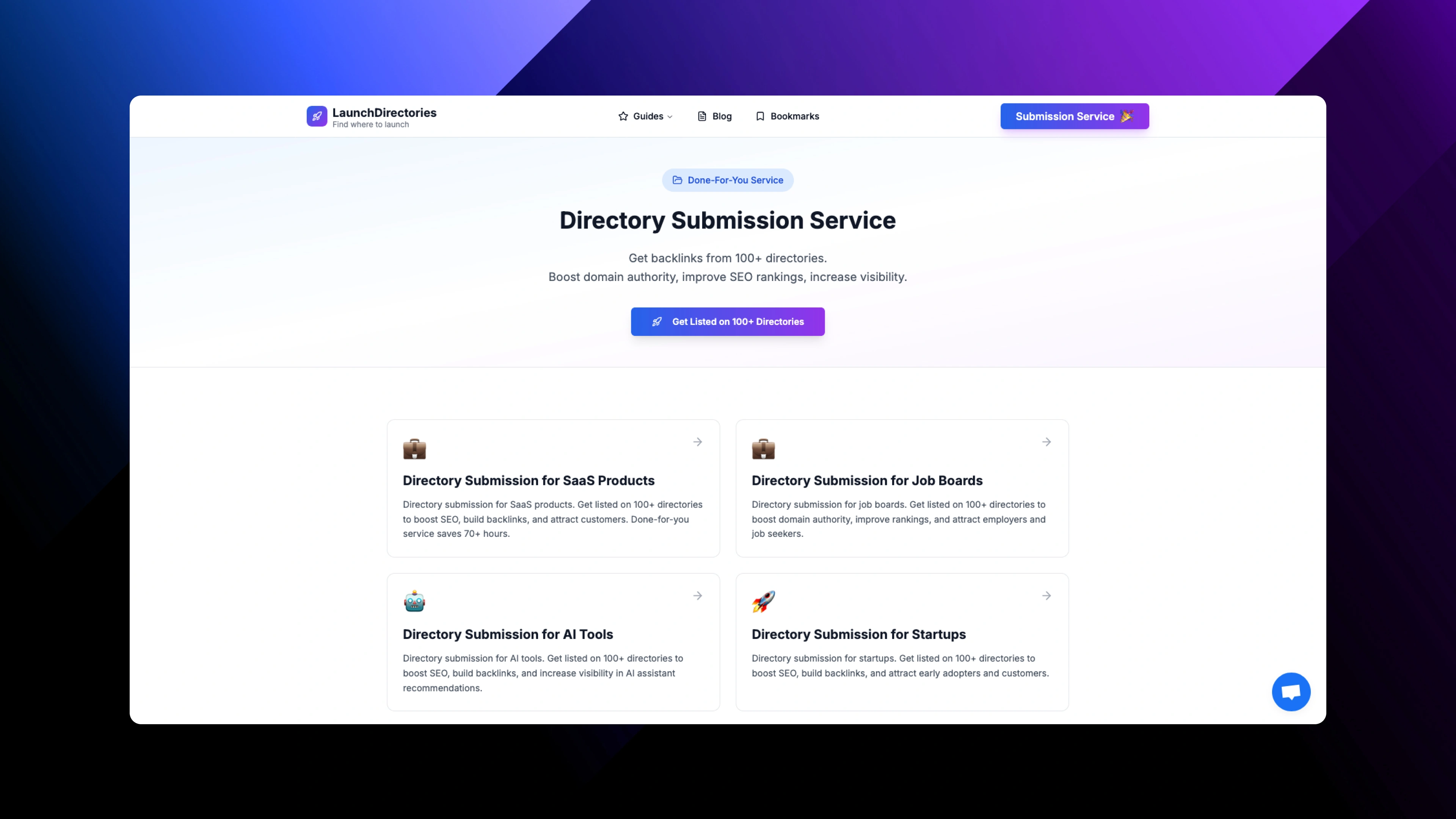
Launch Directories exists to make option 1 and 2 less painful: the curated database helps you pick the right directories fast, and the done-for-you directory submission service executes consistently with a report you can audit.
Practical Application: a 7-day startup agency hiring sprint
Use this to go from “we should hire” to a confident decision in one week.
Before you start, capture a baseline: last 28 days of sessions, signups, activation rate, and your top landing pages. Use it to spot progress.
Day 1: define the jobWrite a one-page brief: ICP, product, north star metric, budget, and the top 2 bottlenecks you want solved in 90 days. Add one boundary like “one primary channel in the first month”.
Day 2: build a shortlist of 8-10Pull from founder communities, similar startups you admire, and agencies that publish real work. Cut anyone who cannot show outcomes and a repeatable process.
Day 3: send the same 6 questions to everyoneAsk for: a teardown, a 90-day plan, the team roster, two case studies, their reporting template, and a “no” (what they will not do). Require a 1-page response, not a 30-slide deck.
Day 4-5: run structured callsScore each agency 0-2 on: strategy fit, proof, process, people, and measurement. One fast systems check: ask them to walk you through a real client backlog or dashboard.
Day 6: do reference checksAsk past clients two things: “What broke in month 2?” and “Did they take ownership without becoming a black box?”
Day 7: pick a 90-day pilotNegotiate a tight scope, weekly cadence, and one measurement dashboard. Add an exit clause tied to process (example: no weekly reporting, no shared backlog, missed deadlines).
Conclusion
Hiring a startup marketing agency is less about picking the fanciest deck and more about buying a disciplined growth system. The right partner helps you choose one channel to win first, ships consistently, and reports in a way that makes decisions easier.
Use the checklist: strategy fit, proof, process, people, measurement. Compare options honestly against your stage. Then run a 90-day pilot with a clear scoreboard and a tight scope.
If your near-term goal is credibility and compounding organic discovery, pair the agency work with strong distribution: directory coverage, launch platforms, and backlinks that keep paying you back. A startup marketing agency can accelerate that - but only if you stay in control of outcomes.
[widget]1
FAQ
How much does a startup marketing agency cost?
Most agencies price as a monthly retainer or a defined project. Market ranges vary widely based on scope and seniority, but many digital marketing engagements land between $5,000 and $50,000 per month. The safest approach is a 90-day pilot with one primary channel and clear reporting.
What should I ask a startup marketing agency on the first call?
Ask for a teardown of your funnel, a 90-day plan tied to one metric, who does the work day-to-day, and what their weekly report looks like. Then ask what they would not do for your startup. The “no” usually reveals how disciplined they are.
Is it better to hire in-house or use an agency for early-stage startups?
If you do not yet have a repeatable acquisition motion, an agency or fractional lead can create direction and throughput faster than a full-time hire. Once you have a working playbook and need tighter control, in-house becomes a better long-term investment.
How long before I see results from a marketing agency?
Expect early wins in the first 30 days to be measurement fixes, sharper messaging, and the first shipped experiments. Meaningful pipeline, signups, or SEO lift usually shows up in months 2-4, depending on your baseline and channel mix. Be wary of anyone promising major results in week 1.
Can a marketing agency help with SEO backlinks safely?
Yes, if they focus on credible sources: directories with real users, editorial mentions, partnerships, and linkable assets. Avoid mass spam submissions and “guaranteed DR” offers. Start with a curated list, consistent listings, and content worth citing, then layer in outreach once your foundation is solid.
Ready to build high-quality backlinks?
We'll submit your product to 100+ directories and build valuable backlinks for your SEO. Save hours of manual work so you can focus on what's important — selling and building, not submitting boring forms.