Most SaaS teams treat SEO like a content treadmill: publish blog posts, wait, then wonder why signups do not move. The winners do the opposite. They build a small set of pages that match buyer intent, make those pages easy to crawl and understand, then earn trust signals that compound over time. That is the whole game.
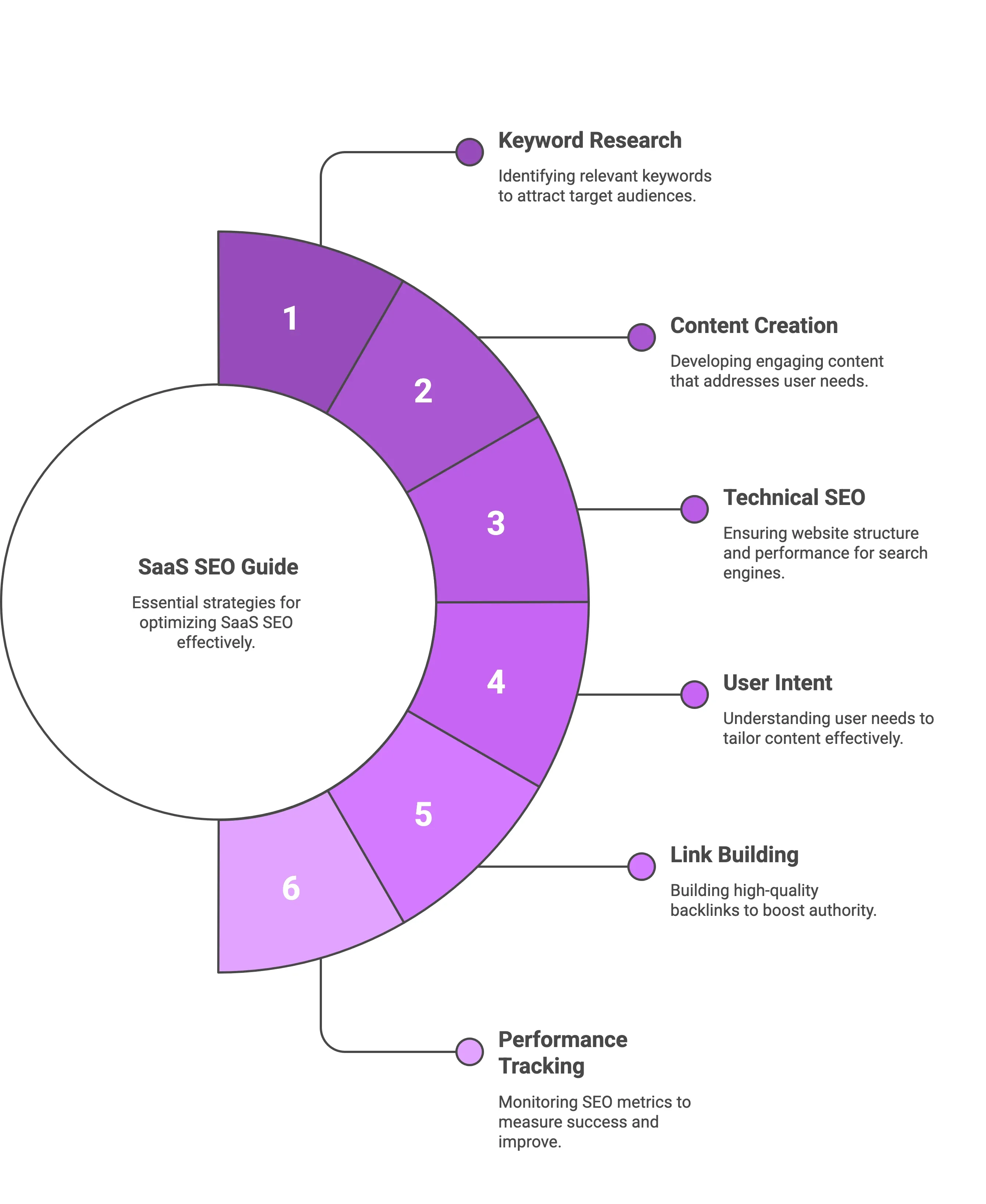
If you are launching an MVP, marketing a growing SaaS, or running launches for clients, this SaaS SEO guide gives you a practical system: what to build first, how to pick keywords you can actually win, how to turn your site into a lead engine, and how to earn backlinks without doing anything that risks your domain.
What is SaaS SEO?
SaaS SEO is the process of attracting high-intent search traffic to a software product by publishing pages that match specific problems, use cases, and comparisons, then converting that traffic into trials, demos, or signups. It blends technical execution (crawl, index, performance), intent-driven content (product and solution pages), and authority building (relevant backlinks and mentions).
Google discovers most pages through automated crawling, then decides what to index and rank based on signals of relevance and quality. You cannot pay to crawl or rank better, so your advantage comes from execution and usefulness.

SaaS SEO guide basics: the model that wins
SEO works best for SaaS when you stop thinking in keywords and start thinking in decisions. A search query is usually one of these moments:
- "I have a problem" (solution aware)
- "I need a tool" (category aware)
- "I am choosing between tools" (comparison aware)
- "I am ready to buy" (pricing, demo, trial)
The model is simple: build the pages that answer those moments, then stack trust signals behind them.
The demand capture mindset
Founders often chase attention, then hope it turns into demand. SEO does the reverse: capture demand that already exists, then route it to a page that closes the loop.
The SaaS page stack that matters
Here is a compact map you can reuse for almost any SaaS:
| Page type | What it targets | What it should include | Primary conversion |
|---|---|---|---|
| Use case pages | "X for Y" queries | outcome, workflow, proof, screenshots | Trial or demo |
| Feature pages | "does X do Y" queries | feature mechanics, limits, examples | Trial |
| Integrations | "X integration with Y" | setup steps, use cases, screenshots | Signup |
| Alternatives | "[competitor] alternative" | comparison table, switching guide | Trial |
| Comparison | "[you] vs [them]" | decision criteria, proof, pricing | Demo |
| Pricing | "pricing", "cost", "plans" | transparency, FAQs, objections | Purchase |

Technical foundation: make your site easy to index
If Google cannot reliably crawl your pages, nothing else matters. The technical bar for SaaS is not "perfect." It is "clean enough that every important page is discoverable, indexable, and not duplicated."
Crawl and index basics that trip up SaaS sites
Common issues that quietly kill growth:
- Your marketing pages are blocked by robots.txt or meta noindex
- Key pages are behind auth (or require JS to render critical content)
- Multiple URLs serve the same content (parameters, trailing slashes, duplicates)
- Internal links are weak, so important pages look unimportant
- Canonicals point to the wrong place during migrations
A clean URL and internal linking system
SaaS sites often sprawl: blog subdomains, docs subdomains, app subdomains, and dozens of landing pages from campaigns. That can work, but only if internal linking stays intentional.
Practical structure that scales:
- /use-cases/ for "X for Y"
- /features/ for feature intent
- /integrations/ for partner intent
- /compare/ for comparisons and alternatives
- /docs/ for documentation (and a few public "how-to" pages that can rank)
Then link these pages together like a product journey. A use case page should link to the relevant features, integrations, and pricing. A competitor alternative page should link to a switching guide and a comparison table.
Performance and rendering - the SaaS edge cases
SaaS teams love JavaScript, animations, and dynamic components. Keep them, but do not hide core meaning behind them.
What usually works:
- Render key headings, copy, and CTAs in HTML (server-render or pre-render)
- Use images and videos, but always explain the "why" in text
- Avoid infinite scroll for critical content
- Keep your navigation crawlable with normal links
Your goal is not to "optimize for Google." It is to make your pages understandable by both a crawler and a rushed buyer.
SaaS SEO guide keyword strategy: pick battles you can win
Most SaaS sites fail because they fight incumbents on terms they cannot win yet. The best keyword strategy is a sequencing strategy.
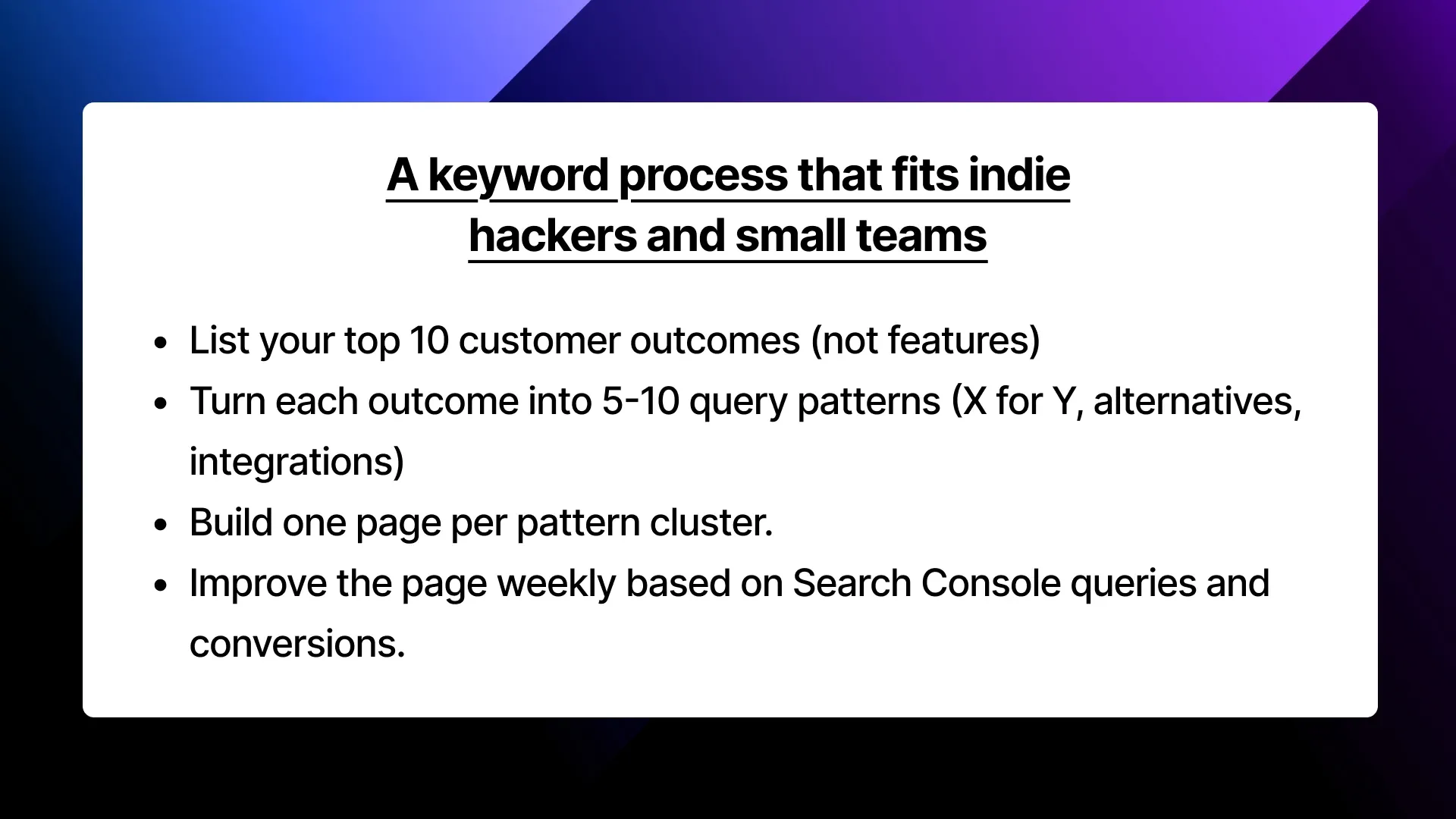
Start with intent, not volume
A keyword with 50 searches a month can beat a keyword with 5,000 searches if it matches a buyer who is ready to act.
Sort your target terms by:
- Urgency: are they actively trying to solve the problem?
- Specificity: does the query describe a clear scenario?
- Replaceability: are they comparing tools or searching for alternatives?
- Proof requirement: does the SERP demand reviews, benchmarks, or enterprise trust?
Use the SERP to define the page you need
Open the search results and answer one question: what type of page is ranking?
If the top results are product pages and comparison pages, a blog post will not win. Build the page type that fits the job-to-be-done.
A quick pattern you will see a lot:
- Informational query -> guides, checklists, definitions
- Commercial investigation -> comparisons, lists, reviews
- Transactional -> pricing, demo, trial, templates
Build pages that convert, not just rank
Ranking is not the finish line. For SaaS, the page has to do two jobs: match intent and remove doubt.
The conversion elements most SaaS pages miss
If your page is not converting, it usually lacks one of these:
- A clear promise (what changes for the user)
- A believable mechanism (how the software makes it happen)
- Proof (screenshots, metrics, logos, quotes, use cases)
- A next step that fits the visitor stage (demo vs trial vs waitlist)
Add these without bloating the page. Two to three strong proof elements beat ten generic ones.
Templates you can reuse
Use case page skeleton:
- Who it is for and the outcome
- The workflow (3-5 steps)
- The product features that enable it
- Examples (screenshots, templates, sample outputs)
- Objections and limits (honesty builds trust)
- CTA (trial or demo)
with 100+ Directory Listings
Skip the grind. We'll submit your product to top directories so you get real users, feedback, and lifetime backlinks without lifting a finger.
Content that earns trust without publishing nonstop
SaaS blogs die because they are disconnected from the product. The content that wins is useful enough that other people reference it.
Linkable assets that SaaS teams can ship quickly
You do not need to "become a media company." Build assets that reduce decision friction:
- A comparison table that stays updated
- A benchmark (speed, cost, accuracy) with methodology
- A template library that solves small workflow problems
- A calculator (ROI, time saved, cost per task)
- A public directory of tools or providers in your niche
This is where many founders accidentally unlock a second growth engine: you publish something that people cite, then your product pages inherit authority through internal linking.
Programmatic pages, done carefully
Programmatic SEO works for SaaS when:
- Each page has unique intent
- The page helps a human make a decision
- You include real examples and constraints
- You avoid thin, repetitive pages
If your programmatic pages feel like placeholders, treat them as liabilities. Google spam policies explicitly warn against manipulative patterns that degrade search quality.
SaaS SEO guide backlinks: earn authority safely
Backlinks are still a strong trust signal, but the tactic matters. There is a clean way to build early authority without falling into the "buy links and pray" trap.
What makes a backlink valuable for SaaS
- Relevance: the linking site shares your topic or audience
- Editorial intent: the link exists because it helps readers
- Real discovery: the page gets crawled and has users
- Placement: contextual links beat footers and sitewide blocks
You will hear a lot about DR. Treat it as a filtering metric, not the goal.
A safer link-building ladder for new SaaS
Sequence matters. Here is the ladder that keeps effort efficient and risk low:
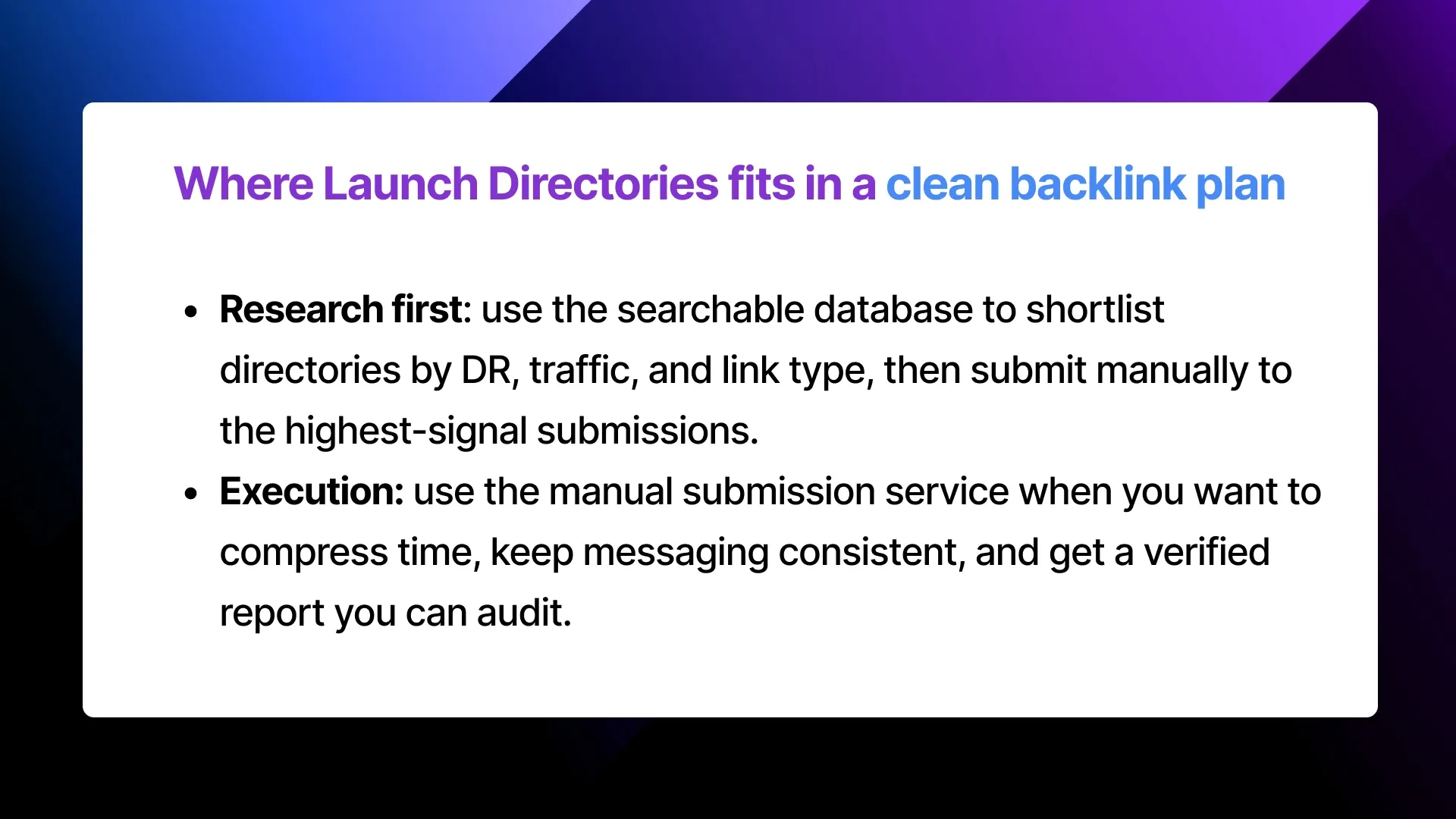
- Directory listings and launch platformsEarly on, listings help discovery and create a baseline of referring domains. The mistake is going too broad or using low-quality directories.
If directory work feels like a time sink, use a database that shows DR, traffic, and whether the link is dofollow or nofollow so you can prioritize high-signal submissions. Launch Directories is built for exactly this - filter directories by authority and niche, then submit with consistent messaging.
Partner and integration linksIf you integrate with a platform, earn a link from their directory, marketplace, or partner page. These links are both relevant and defensible.
Useful assets that attract citationsBenchmarks, templates, and directories earn links because they save people time.
Targeted outreach that respects editorsOutreach works when you lead with value, not a request. Point to a specific section their readers would benefit from.
What to avoid (and why)
Google spam policies cover behaviors that can lead to ranking drops or removal, including link schemes and scaled tactics designed to manipulate rankings.
Avoid:
- Paying for followed links on sites that sell links at scale
- "Guest post farms" with thin content and unrelated sites
- Link exchanges that exist only to trade PageRank
- Automated link blasts or private link networks
If a tactic depends on secrecy, it is not a strategy. It is a short-term gamble.
Practical application: a 30-day SaaS SEO sprint
If you only do one thing, run a sprint that ships revenue pages and strengthens authority at the same time.
Week 1 - Technical and tracking
- Set up Google Search Console and analytics with conversion events (trial, demo, signup).
- Fix obvious indexation issues: noindex tags, blocked paths, broken canonicals.
- Create a simple internal linking plan: every key page links to pricing and one next step.
Week 2 - Ship the core page stack
- Publish: 2 use case pages, 2 feature pages, 1 integration page, and a pricing page that answers objections.
- Add proof blocks: screenshots, short customer quotes, and a crisp "how it works" section on each page.
Week 3 - Add decision pages
- Publish: 2 competitor alternatives and 1 comparison page with a real table.
- Write a switching guide that makes migration feel safe (time estimate, steps, rollback plan).
Week 4 - Authority and distribution
- Submit to a curated set of launch directories relevant to your niche.
- Reach out to 10 partners or communities with a specific ask: "Add this as a resource for your users."
- Pick one linkable asset (template, calculator, benchmark) and ship it.
Track results weekly using three numbers: impressions (visibility), clicks (demand capture), and signups (business impact). Iterate on the pages that already get impressions. That is where the fastest wins hide.
Conclusion
SaaS SEO is not about publishing more. It is about building the right pages, making them easy to crawl and trust, then earning the kind of mentions that compound. Nail the technical foundation, ship a tight revenue page stack, and choose keywords where intent is clear and competition is beatable. Then build authority with selective directories, partner links, and assets people actually cite.
If you want a shortcut on the backlink side, start by filtering directories by relevance, DR, traffic, and link type, then submit with consistent positioning. Done right, this SaaS SEO guide becomes a repeatable growth system that keeps sending qualified buyers long after launch day.
with 100+ Directory Listings
Skip the grind. We'll submit your product to top directories so you get real users, feedback, and lifetime backlinks without lifting a finger.
FAQ
How long does SaaS SEO take to work?
Expect early signals in weeks, not days: impressions usually show up first, then clicks, then conversions. A new SaaS often sees meaningful movement after shipping a focused page stack and earning the first set of relevant referring domains. The fastest gains come from improving pages that already get impressions.
Do directory backlinks still help SaaS SEO?
Yes, when they are curated and relevant. Directory listings can build baseline authority and send referral traffic, especially early. The key is quality over volume: prioritize active directories in your niche, avoid spammy networks, and keep listings consistent. Pair directory links with partner links and linkable assets.
What pages should a new SaaS publish first?
Start with revenue pages, not blog posts. Publish use case pages, feature pages, one or two integrations, and a pricing page that answers objections. Then add competitor alternatives and comparisons. Blog content works best when it supports these pages and earns links, not when it tries to do the whole job alone.
What is a good DR for a new SaaS?
For a new SaaS, DR often starts near zero and moves in steps as you earn unique referring domains. Use DR as a proxy metric, not a KPI to chase. A lower-DR site can outrank higher-DR competitors on niche queries by matching intent better and building stronger internal linking.
How do you measure SaaS SEO success without vanity metrics?
Measure the funnel, not just traffic. Track: impressions and average position (visibility), clicks and CTR (demand capture), and trial/demo signups (business impact). Then segment by page type: use case pages should convert, comparisons should assist decisions, and linkable assets should earn referring domains.
Ready to build high-quality backlinks?
We'll submit your product to 100+ directories and build valuable backlinks for your SEO. Save hours of manual work so you can focus on what's important — selling and building, not submitting boring forms.