How Long Does It Take to Rank a New SaaS?
I've watched the SaaS market swell to $232.3 billion in 2024. Every founder I speak with wants their new product dominating search results immediately. But the typical SEO timeline pushes results out by 3-6 months, sometimes even a full year. That kind of wait can crush early momentum for a lean startup.
Traditional SEO strategy demands proving your site's reliability over time. It's like building a credit score; you need consistent proof. But with Google's AI Overviews, the rules shifted. Your content needs to be structured for AI agents that are actively fetching and synthesizing information.
This means you can't just publish and wait. You need your site cited inside those AI answers to remain relevant. We've identified methods to fast-track AI search visibility, bypassing some of the longer traditional waits for new SaaS platforms.
The standard SaaS SEO timeline for 2025
The typical SaaS SEO timeline sees initial movements in 3-6 months, but truly competitive keywords can take 6-12 months to rank. Don't expect overnight miracles.
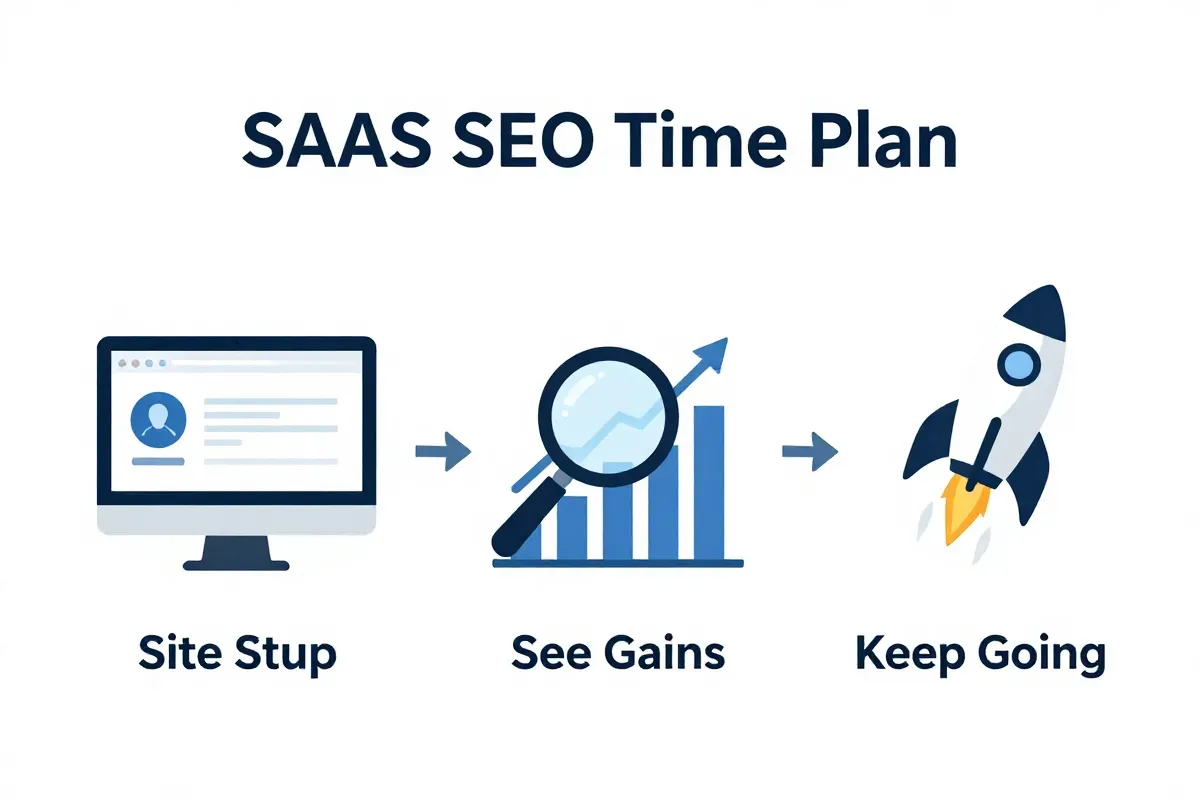
Here's a breakdown of what you'll likely see (and what we tell our clients):
- Months 1-2: This is about laying the groundwork. You’re focused on indexing your site, fixing technical SEO issues (broken links, slow load times), and ensuring Google can crawl your content efficiently. Think of it as setting the stage.
- Months 3-4: You should start to see some initial keyword movement. Maybe not first page results yet, but you'll notice some rankings climbing. This is when you double down on content and backlink building.
- Month 6 and Beyond: This is where things start to compound. Traffic grows, rankings improve, and you're building real momentum. Keep creating high-quality content and acquiring backlinks to stay ahead of the curve.
But what if you need faster results?
One way we've seen SaaS companies accelerate organic traffic growth is through strategic content placement and targeted backlink acquisition, resulting in a 500% increase in website visitors within 3 months. Of course, that's only one part of the equation.
A major problem is new websites lack authority. Our team has found that a crucial first step is to build domain authority quickly and efficiently, you can get started by checking out our guide on what is domain rating.
Now, that doesn't mean you can ignore the foundational SEO elements. You'll still need to nail your keyword research, optimize your content, and ensure your site is technically sound. It’s about doing the groundwork and layering on AI-focused strategies to rank faster.
So, what are your next steps? Audit your current site using tools to give you the best possible foundation for organic traffic growth.
How to see results in the first 90 days
Seeing results in the first 90 days is possible, and it hinges on targeting the low-hanging fruit. Forget broad, competitive keywords initially.
Instead, focus on long-tail keywords with less competition. These are longer, more specific search queries that indicate a user is further along in the buying process. Think "best accounting software for SaaS startups under $50/month" instead of just "accounting software."
How do you find these?
- Brainstorm: List out every possible variation of how your ideal customer would search for your product.
- Use keyword tools: Explore tools like Semrush or Ahrefs to identify long-tail keywords with low difficulty scores.
- Analyze your competitors: See what long-tail keywords your competitors are ranking for.
The case study where a SaaS company saw a 500% increase in website visitors in 3 months? It wasn't magic. It was aggressive content production targeting these exact types of keywords.
But just finding the keywords isn't enough. You need to produce content – fast.
Think blog posts, articles, and even short videos that directly answer the questions posed in these long-tail searches. Create content that's not just informative, but genuinely helpful. (Pro-tip: structure your content so AI agents can easily synthesize your content).
Next, make sure your new content is getting indexed by submitting it to search engines.
While waiting for Google to index, you can get initial momentum by listing your site on relevant SaaS directories. Check out our list of the best online directories for SaaS startups to find some great options. We've seen listings drive qualified traffic and build valuable backlinks faster than waiting for organic search alone.
What's the catch? It takes serious hustle.
You can't just publish one blog post and call it a day. You need a consistent content calendar and the discipline to stick to it. And, you might feel silly answering questions that seem incredibly specific. (But that specificity is the entire point).
Now, head over to Google Search Console and submit your sitemap. This ensures Google crawls and indexes your new content as quickly as possible.
Why ranking a SaaS takes longer than other industries
Ranking a SaaS product often takes longer because you're wading into a pool filled with sharks. The massive growth of SaaS revenue to over $232 billion has led to a hyper-competitive search landscape. And unfortunately, there are some misconceptions about speeding up the process.
The B2B tech space is intensely competitive. Every keyword you target, from "CRM software" to "project management tools," is already being fought over by established players with years of content and backlink building under their belts. That's precisely why new websites might take a while to rank high, you can get ahead by implementing our tips on seo for new websites.
Many new SaaS companies face what's known as the "Google Sandbox" effect. This isn't an official Google penalty, but it's a commonly observed phenomenon where new domains take longer to rank, even with solid SEO. Google needs time to assess the legitimacy and value of a new site.
And that means no shortcuts.
Thinking you can spam keywords, buy a batch of dirt-cheap backlinks from some shady website, or plaster your URL across comment sections? Google sees right through it. These tactics might provide a brief spike but ultimately will hurt your rankings.
The real hurdle is building genuine brand authority. It's about earning the trust of both Google and your target audience. This requires consistent production of high-quality content that addresses user search intent, plus earning backlinks from reputable sources in your industry.
Don't neglect the groundwork.
First, optimize your SaaS website for search engines and ensure it provides a great user experience. Then, explore relevant directories, you can start with these free SaaS directories for SEO visibility in 2025.
The impact of domain authority on ranking speed
Domain Rating (DR) is a metric, on a scale of 0 to 100, that shows the strength of a website’s backlink profile. It helps founders understand how Google perceives their site's authority.
A new domain with a DR of 0-10 faces a serious uphill battle. Think of it like trying to bench press your body weight on your first day at the gym. You need to build strength gradually. In SEO, that strength is your backlink profile.
Without a solid DR, your content will struggle to rank, even if it's exceptionally well-written. But why?
Google uses DR as a shortcut to assess credibility. It's a signal that other reputable sites vouch for your content, and a good starting point is by registering your SaaS on directories.
- A higher DR signals trustworthiness.
- A low DR signals invisibility.
Focus on building a quality backlink profile through guest posting, directory listings, and other authority-building activities. Don't fall for shady tactics like buying backlinks in bulk (Google will penalize you for it). Remember, the goal is long-term, sustainable growth, to achieve this you can check our guide on how to choose a saas seo agency.
The bigger issue? Building authority takes time. It's not an overnight process, but a consistent effort will pay off in the long run.
Okay, you've got your content calendar set. Now, don't just publish and pray.
How directory listings provide an early authority boost
Listing in startup directories lets you bypass the "new site" penalty and snag quality backlinks early. Think of it as a shortcut to building trust with Google.
New SaaS sites often sit in the shadows for months. Why? Because Google is unsure if you're a flash-in-the-pan or a long-term player. Directories help signal legitimacy. And, they drive referral traffic that converts.
How?
- Foundational Backlinks: A listing on a reputable directory like G2 or Capterra signals to Google that your site is a legitimate business.
- Faster Indexing: Google crawls directories frequently, and a link from one of these sites can help your site get indexed faster.
- Targeted Traffic: Users on directories are actively searching for solutions like yours. This equals qualified leads.
But manually submitting to dozens of directories? That's a time sink.
That's where automated submission tools can speed things up. We built LaunchDirectories to automate this process for our clients (because we were tired of doing it ourselves). It lets you submit your SaaS to multiple directories with one click.
The catch? Not all automation is created equal. Many tools spam your listing to irrelevant directories, diluting the value of your backlinks. Understanding how domain rating works is critical for tracking your SaaS growth journey. Go read more about it in our guide what is domain rating. The important thing to remember is that relevant backlinks are foundational backlinks.
Next up: nail your on-page SEO with descriptive content.
Factors that influence your ranking timeline
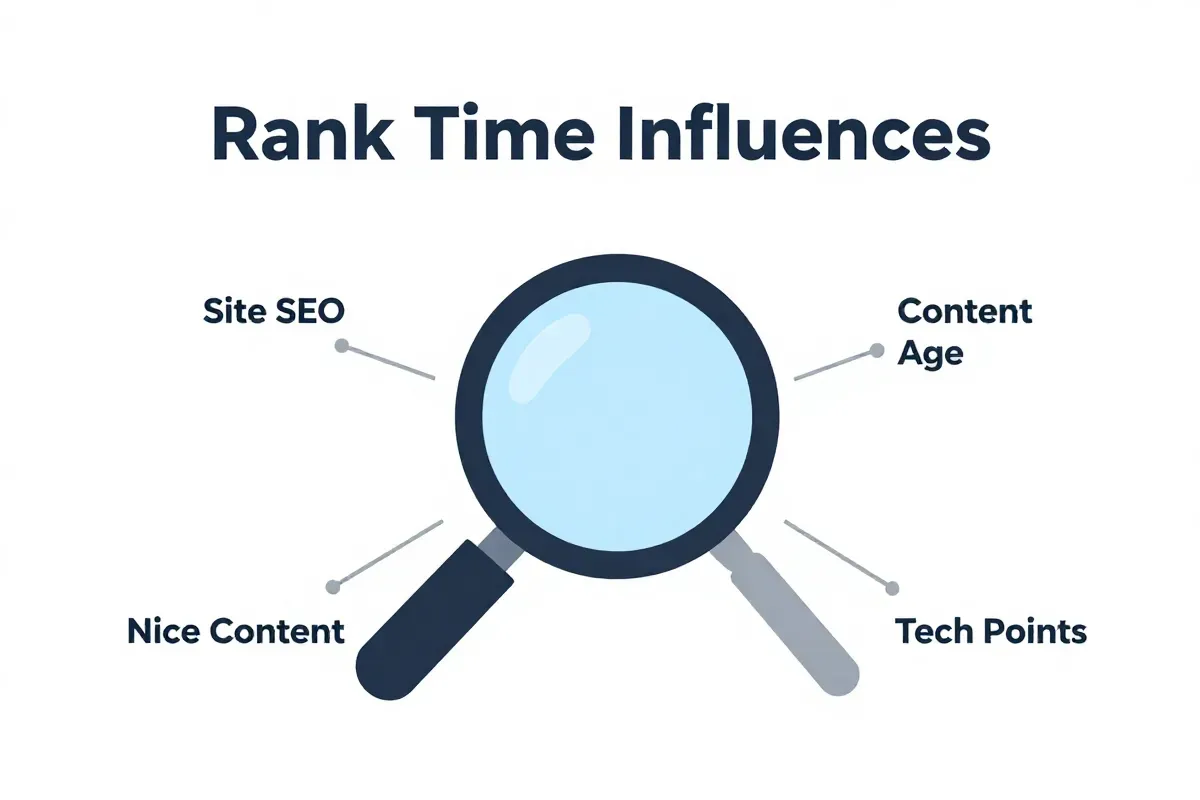
Several factors directly impact how fast your SaaS platform can climb the search rankings. Technical SEO, E-E-A-T, and content freshness each play a critical role in Google's assessment of your site. Ignore any of these, and watch your ranking timeline stretch out.
Technical SEO is non-negotiable. It's the foundation upon which all other SEO efforts are built. If Google can't crawl and index your site efficiently, it doesn't matter how great your content is; it won't rank.
Here's where most founders drop the ball:
- Site Speed: Slow loading times kill user experience and signal to Google that your site isn't worth prioritizing. Aim for load times under 3 seconds.
- Mobile-Friendliness: With the majority of searches happening on mobile devices, a non-responsive site is a death sentence.
- Schema Markup: This helps Google understand the context of your content, increasing the chances of it being featured in rich snippets and other SERP features.
E-E-A-T (Expertise, Experience, Authoritativeness, Trustworthiness) is now a major ranking factor. Google wants to ensure it's providing users with accurate and reliable information. This is where demonstrating your industry knowledge and building trust become essential. It's no longer enough to just write good content; you need to prove you know your stuff. We built LaunchDirectories to help our clients automate building foundational backlinks, this helps to develop authority and improve E-E-A-T.
How do you build E-E-A-T?
- Author Bios: Prominently display author bios with credentials and experience.
- Citations: Back up your claims with data and cite reputable sources.
- Reviews and Testimonials: Showcase positive reviews and testimonials from satisfied customers.
Content freshness is a sneaky ranking factor that many overlook. Stale content signals to Google that your site is no longer actively maintained. And that's bad.
Keep your content fresh by:
- Regular Updates: Review and update your existing content regularly to ensure it's accurate and up-to-date.
- New Content: Continuously publish new, high-quality content that addresses current trends and user needs.
- Timestamping: Make sure your content is properly timestamped so users (and Google) can see when it was last updated.
But remember that a solid backlink profile is key for any SaaS website looking to improve its Domain Rating. Don't fall for shady tactics like buying backlinks in bulk (Google will penalize you for it).
What to do next? Start by auditing your site's technical SEO. Then, develop a plan to build your E-E-A-T and keep your content fresh.
Technical SEO and site architecture
Technical SEO is the bedrock; without it, even the best content sinks. Google provides official documentation on the ranking signals that dictate how your site is evaluated, so start there.
Site speed, mobile responsiveness, and clean code directly impact how fast Google can crawl and rank your SaaS platform. Think of it as clearing the runway for Google's bots.
Poor technical SEO drains your crawl budget, the number of pages Googlebot will crawl on your site within a given timeframe. A limited crawl budget means slower indexing and delayed rankings.
Here's what to tackle:
- Optimize Site Speed: Aim for page load times under 3 seconds. Use tools like Google PageSpeed Insights to identify bottlenecks. (And don't just run the test; actually implement the recommendations.)
- Ensure Mobile Responsiveness: Your site must provide a seamless experience on all devices. Use Google's Mobile-Friendly Test to check.
- Clean Up Your Code: Minify CSS, JavaScript, and HTML. Remove unnecessary code and plugins. Use a caching plugin to improve performance.
Ignoring Core Web Vitals is like ignoring a check engine light. These metrics—Largest Contentful Paint (LCP), First Input Delay (FID), and Cumulative Layout Shift (CLS)—measure user experience, and Google uses them as ranking signals. We've seen sites jump in rankings simply by optimizing these vitals.
Now, make sure you are consistently providing high-quality content.
How directory listings provide an early authority boost
Listing in startup directories lets you bypass the "new site" penalty and snag quality backlinks early. Think of it as a shortcut to building trust with Google.
New SaaS sites often sit in the shadows for months. Why? Because Google is unsure if you're a flash-in-the-pan or a long-term player. Directories help signal legitimacy. And, they drive referral traffic that converts.
How?
- Foundational Backlinks: A listing on a reputable directory like G2 or Capterra signals to Google that your site is a legitimate business.
- Faster Indexing: Google crawls directories frequently, and a link from one of these sites can help your site get indexed faster.
- Targeted Traffic: Users on directories are actively searching for solutions like yours. This equals qualified leads.
But manually submitting to dozens of directories? That's a time sink.
That's where automated submission tools can speed things up. We built LaunchDirectories to automate this process for our clients (because we were tired of doing it ourselves). It lets you submit your SaaS to multiple directories with one click.
The catch? Not all automation is created equal. Many tools spam your listing to irrelevant directories, diluting the value of your backlinks. Understanding how domain rating works is critical for tracking your SaaS growth journey. Go read more about it in our guide what is domain rating. The important thing to remember is that relevant backlinks are foundational backlinks.
Next up: nail your on-page SEO with descriptive content.
The role of user experience in SEO conversions
Ranking high is pointless if users immediately hit the "back" button. That's why UX design (user experience design) is so tightly linked to SEO conversions.
Clear navigation and strategically placed CTAs aren't just about looking pretty; they're signals to Google that your site provides value. A high bounce rate (when someone visits a page and leaves without interacting) screams "this page sucks!" to Google.
Here's how to fix that:
- Simplify Navigation: Ditch the cryptic labels and endless dropdowns. Make it brain-dead simple for users to find what they're looking for.
- Optimize Page Speed: If your pages load slowly, users will bounce before they even see your amazing content. Go back to the technical SEO basics.
- Strategic CTAs: Guide users toward conversion goals with clear, concise calls to action. Don't just say "learn more"; tell them what they'll get.
- Mobile-First Mindset: Ensure your site is fully responsive and optimized for mobile devices. Many mobile users will abandon a site if it's not mobile-friendly.
Poor user experience isn't just a conversion killer, it's an SEO killer. By prioritizing UX design, you can improve engagement metrics, lower your bounce rate, and ultimately boost your rankings. Now, that makes sense. Consider checking out our guide on saas seo agency to help you improve your websites UX design.
So, what's next? Start testing your UX on mobile, and make needed adjustments based on the results.
Content freshness and update frequency
Content decay is real, and it will tank your rankings if ignored. Google prioritizes fresh, accurate information, and stale content sends the opposite signal. Think of your old blog posts as real estate; you need to maintain them or they'll lose value.
Regular updates prevent ranking decay and signal to AI agents that your information is current. It's not enough to just publish and forget; you need to revisit and refresh your content regularly.
How often?
- Audit your content: Identify posts that are losing traffic or ranking for fewer keywords.
- Update the content: Add new information, update statistics, and address any outdated points.
- Re-publish: Change the "last updated" date to signal to Google that the content is fresh.
But, historical optimization isn't just about adding new information. It's about improving the overall quality of your content, for example, add our tool to your website. This means fixing broken links, improving readability, and optimizing for user experience. A dead link won't help your SEO.
The bigger issue? Many SaaS companies treat content like a one-time task.
They publish a blog post, share it on social media, and then never look at it again. We see this mistake constantly in the SaaS space. This leads to content rot, where your site slowly decays over time. Do not let this happen to your new websites. Consider reading our guide on seo for new websites rank faster without wasting months.
But how can you keep your website from losing relevance?
It requires a proactive approach. Set aside time each month to review your old content and make updates. Use tools like Google Analytics and Google Search Console to identify areas for improvement.
Bottom line: content freshness is a critical ranking factor, and it's one that too many SaaS companies ignore. By prioritizing historical optimization and regularly updating your content, you can prevent ranking decay and signal to Google that your site is a valuable resource.
To ensure your website provides great user experience you should test your UX on mobile and make adjustments based on results.
Ranking for AI search and ChatGPT
Ranking in 2026 isn't just about gaming Google's old algorithm. It's about AI search optimization.
Specifically, it means making your content easily digestible for AI agents like Google AI Overviews. Fail to do this, and you'll be invisible.
Here's how to adapt:
- Structure Content for AI: Use clear headings, bullet points, and concise paragraphs. AI needs easily scannable information.
- Become a Source: Aim to be cited within AI-generated answers. This instantly boosts your credibility.
- Think Beyond Google: Explore alternative AI search engines like Perplexity and DuckDuckGo.
But how do you get cited?
One surprisingly effective method involves leveraging Reddit. Yes, Reddit. We've seen instances where targeted posts on relevant subreddits resulted in a site ranking at the top of ChatGPT results in under 72 hours.
The strategy? Post high-quality, informative content that directly answers a user's query, and then subtly link back to your site. (Don't be spammy; be helpful.)
The limitation? This is niche-dependent.
It works best in communities actively seeking information and willing to engage with helpful content. If you're in a highly competitive or regulated industry, it may be less effective.
Now, to ensure that your website provides users with the best user experience, check out our guide on how to choose a saas seo agency.
Strategies to optimize for AI digestibility
Structure your content with a hungry AI in mind. These agents are actively crawling your site to provide direct answers to user queries, so they need digestible information above all else.
The key is structured data. It's not just about slapping some headings on a page. It's about marking up your content in a way that makes it easy for AI to understand the context and relationships between different pieces of information. Think of it like providing a roadmap.
How do you do this?
- Schema Markup: Implement schema markup to provide search engines with structured data about your content. This helps them understand the meaning of your content and display it in rich snippets and other SERP features.
- Clear Headings: Use clear, descriptive headings and subheadings to break up your content and make it easier to scan. H2s and H3s are your friends.
- Bullet Points and Lists: Use bullet points and numbered lists to present information in a concise, easy-to-read format. Perfect for summarization.
But, LLM optimization isn't just about technical markup. It's about the way you write.
These agents need information fast, so be direct. Avoid fluff and get straight to the point, which also means using shorter sentences. (Remember those AI parameters?)
The limitation? Over-optimizing for AI can make your content sound robotic. You need to strike a balance between AI digestibility and human readability. Don't write for the bots only.
This is where E-E-A-T comes back into play. Google's algorithm still favors high-quality content that's written by experts and backed by evidence. So, prioritize creating informative, engaging content that provides value to your audience.
Remember that SaaS SEO combines Technical SEO, On-page SEO, Off-page SEO, and GEO optimization for AI visibility. You can optimize your website for AI digestibility. Next, focus on what Google wants most: user experience.
Comparing SEO tools to track your SaaS progress
A crucial step in monitoring your SaaS progress is selecting the right SEO tools. Many options exist, each with its own strengths and weaknesses.
Two names dominate the SaaS SEO software conversation: Ahrefs and SE Ranking. Ahrefs is the industry standard, prized for its massive backlink index and data depth. But its complexity can overwhelm new users, and the price point makes it less accessible for early-stage startups. SE Ranking, however, strikes a balance. Users report its interface as more intuitive, and its pricing is often more attractive for lean teams.
Here's a quick rundown:
- Ahrefs: Industry-leading backlink data, comprehensive keyword research, but a steeper learning curve.
- SE Ranking: User-friendly interface, all-in-one SEO platform, and a more budget-friendly option.
Is Ahrefs overkill for tracking initial growth? Possibly.
Many founders find SE Ranking surprisingly snappy for daily monitoring and keyword tracking. The learning curve is shallower, which means less time wrestling with the tool and more time acting on insights. And while Ahrefs' backlink data is undeniably vast, SE Ranking provides enough detail to spot opportunities and track progress in the early months.
Don't fall into the trap of thinking you need the most powerful tool from day one. Start with what you can realistically manage. Speaking of growing organically, a solid first step is to build domain authority quickly and efficiently; start with our guide on what is domain rating. Once you outgrow it, consider choosing a more comprehensive tool to grow.
Now, to improve user experience on your website, make the necessary adjustments based on your findings from mobile devices.
with 100+ Directory Listings
Skip the grind. We'll submit your product to top directories so you get real users, feedback, and lifetime backlinks without lifting a finger.
Common questions about SaaS ranking speed
Ranking factors for SaaS aren't always clear-cut. Understanding the nuances can save you months of wasted effort.
Common questions about SaaS ranking speed
Why does ranking take so long? SaaS operates in a hyper-competitive digital landscape, with many established players vying for the same keywords. Plus, Google needs time to assess a new site's value. So, patience, young Padawan.
Is there an FAQ about SEO ranking?
Yes, and here's a rapid-fire round:
- How long for informational content? Expect to see movement within 90 days if targeting long-tail keywords with low competition and structuring your content for AI digestibility.
- How long for commercial keywords? Brace yourself. Ranking for keywords with buyer intent (e.g., "best CRM for SaaS") typically takes 6-12 months, or longer, especially for new domains.
- Can I buy my way to the top? Short answer? No. Buying backlinks is a black-hat tactic that can result in a Google penalty. You might see a temporary bump, but it's not worth the risk. Think long-term sustainable growth.
The real issue? There are many misconceptions about how SEO works for SaaS. The biggest is that you can simply build it and they will come. Not quite. The other is getting a large language model tool to create your content, the result is thin content that lacks true expertise.
Is AI ruining SEO?
Not exactly. But it changes the game. It's no longer enough to write blog posts; you need to ensure AI agents can easily understand and synthesize your content. Structure, accuracy, and E-E-A-T matter more than ever.
Remember, that SaaS SEO combines Technical SEO, On-page SEO, Off-page SEO, and GEO optimization for AI visibility. By implementing these strategies you can bypass some of the longer traditional waits for new SaaS platforms.
Now, take a good look at your site's mobile UX. Are you happy with what you see?
How long does it take to rank for high-intent keywords?
Ranking for "best CRM software" takes time, expect 12 months or more. These commercial keywords, also known as buyer keywords, signal that the searcher is ready to spend money. And Google knows it.
The ranking competition for high-intent keywords is brutal. You're not just battling other SaaS companies; you're up against comparison sites, review sites, and even established media outlets that have built authority over years. Informational keywords like "how to manage customer relationships," on the other hand, face less resistance.
Why the difference?
- Commercial Intent: Keywords with commercial intent are far more valuable. The higher the potential revenue, the more competition you'll face.
- Established Players: Big brands have a head start. They've invested heavily in SEO and content for years.
- Content Depth: Ranking for buyer keywords requires in-depth, high-quality content that directly addresses user needs and provides clear solutions.
The bigger issue? Many SaaS companies chase buyer keywords too early. They neglect the foundational work of building authority and trust.
What should you do?
- Target Long-Tail Keywords: Focus on specific, less competitive keywords.
- Build Authority: Create high-quality content, build backlinks, and establish E-E-A-T (Expertise, Experience, Authoritativeness, Trustworthiness).
- Be Patient: SEO takes time. It's a marathon, not a sprint.
And while waiting for organic traffic, you can get some love from listing your site on relevant SaaS directories. You can find some great options on our best online directories for SaaS startups.
Next up: find out which tools to use to track your SaaS progress.
Can you rank a SaaS without a blog?
Without a blog, your SaaS ranking efforts face an uphill battle; a content strategy is generally a linchpin for SEO.
But the game isn't entirely over. New websites need a specific framework to rank faster without wasting months on the wrong activities, and building authority early is key. This is especially true when focusing on ranking for zero-volume keywords that your competitors aren't thinking about.
But what's the best strategy to tackle SEO without a blog?
- Focus on Programmatic SEO: Generate landing pages for hyper-specific, niche queries.
- Aggressively Build Backlinks: Focus on high-quality backlinks from relevant sources.
- Prioritize Technical SEO: Ensure your site is technically sound and provides a great user experience.
The catch? It's like building a house without a foundation.
A consistent stream of valuable content helps establish your expertise and attracts organic traffic. Without it, you're relying solely on link equity, which can be a risky strategy. Think of it as a shortcut that can backfire.
Instead, new SaaS websites need a specific framework to rank faster without wasting months on the wrong activities. That is where we come in, build those foundational backlinks by listing your SaaS to the most important directories and see results.
What's next? To ensure your website provides the best user experience, make sure that it runs smoothly across devices.
Ready to build high-quality backlinks?
We'll submit your product to 100+ directories and build valuable backlinks for your SEO. Save hours of manual work so you can focus on what's important — selling and building, not submitting boring forms.