


Thinking of outsourcing it instead? We compared 15 SaaS SEO agencies by published price, minimum term and focus.
What is SaaS SEO?
SaaS SEO is search engine optimization built specifically for software-as-a-service businesses. If your product page sits on page 5 of Google while a competitor's mediocre blog post ranks on page 1, the answer usually comes down to two things: domain authority and content strategy. SaaS SEO addresses both, but in a way that's fundamentally different from SEO for e-commerce or local businesses.
The difference starts with the buyer journey. When someone searches for "best CRM software," they won't pull out their credit card immediately. They'll read comparison articles, check alternatives, watch demos, run a free trial, and maybe after weeks or months make a purchase decision. SaaS SEO accounts for this entire journey, creating content that meets potential customers at every stage: from the moment they realize they have a problem, through their research phase, all the way to the moment they're comparing your product against competitors.
The math makes this powerful. A single well-ranking page can generate thousands of free trial signups over its lifetime. With average SaaS customer lifetime values ranging from $2,000 to $50,000+, one #1 ranking for a high-intent keyword can be worth millions in revenue. Unlike paid ads, that value compounds year after year without additional spend. HubSpot generates over 7 million organic visits per month from educational content that funnels readers into their product. Zapier drives 16 million monthly visitors through programmatic SEO pages. Ahrefs built their entire growth engine on search.
These companies didn't outspend their competitors on Google Ads. They outranked them by following the principles we cover in this guide.
SaaS SEO vs Traditional SEO
If you've run SEO for e-commerce or local businesses before, SaaS SEO will feel different in almost every dimension. The sales cycle is longer, often 14 to 90+ days with multiple stakeholders. The customer value is dramatically higher, which means you can afford to invest more per keyword. And the technical landscape is more complex, with JavaScript-heavy frontends and authenticated content that can trip up crawlers.
| Dimension | Traditional SEO | SaaS SEO |
|---|---|---|
| Sales cycle | Immediate to short | 14-90+ days, multiple touchpoints |
| Decision makers | 1 person | 2-7 stakeholders (B2B) |
| Customer value | $10-500 one-time | $2,000-50,000+ LTV |
| Content approach | Product pages + blog | Full-funnel + comparison + programmatic |
| Conversion goal | Purchase / lead form | Free trial / demo request / signup |
| Technical complexity | Standard HTML sites | JS-heavy apps, auth walls, dynamic content |
| Link building | Guest posts, citations | Directories, digital PR, integrations, free tools |
| ROI timeline | 1-3 months | 3-9 months (but compounds dramatically) |
The most important difference: SaaS SEO isn't just about driving traffic. It's about building a pipeline of qualified prospects who discover your product through search, educate themselves through your content, and ultimately choose you over competitors. Every piece of content has a specific job in that journey.
Why SaaS Companies Need SEO
The economics of paid acquisition get worse every year. Google Ads CPCs in SaaS verticals regularly exceed $5 to $15 per click, and competitive keywords like "CRM software" can reach $40+ per click. Your competitors are bidding on the same keywords, pushing prices higher and squeezing margins tighter.
SEO offers a fundamentally different economic model. Instead of renting traffic, you build an asset that appreciates over time. The numbers: B2B SaaS companies that invest in SEO see an average ROI of 702%. Organic customer acquisition costs average $205 compared to $341 for paid channels. SEO leads convert from MQL to SQL at 51%, nearly double the 26% rate from PPC. And most SaaS companies break even on their SEO investment within 7 months.
The real power is in the compounding effect. A blog post you write today generates leads next month, next year, and three years from now. As your content library grows and domain authority increases, each new piece of content ranks faster and drives more traffic. This flywheel effect is impossible to replicate with paid channels. If you are early-stage and watching every dollar, start with our practical guide to SEO for startups on a budget.
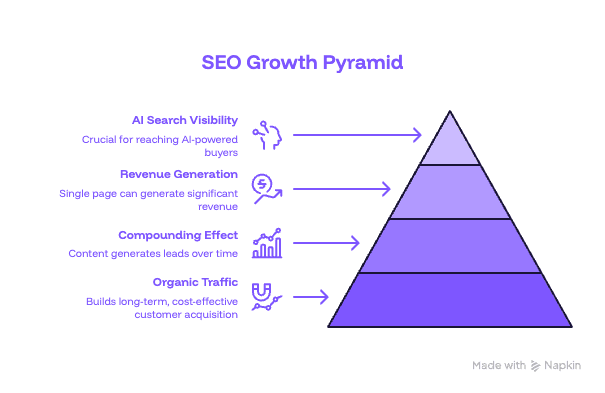
Consider the math on a single page: if your SaaS has a $5,000 LTV and a 3% trial-to-paid conversion rate, a page generating 1,000 monthly organic visitors with a 5% signup rate produces 50 signups per month. That's 1.5 paying customers, or $7,500 in monthly recurring revenue from one article. Over three years, that single page generates $270,000 in revenue.
The shift toward AI-powered search makes this even more critical. 94% of B2B buying groups now use large language models during their purchase journey. If your SaaS doesn't appear in organic results and isn't present on platforms that AI tools scrape for recommendations, you're invisible to a growing segment of buyers.
Keyword Research for SaaS: The Foundation-First Framework
Most SaaS companies approach keyword research backwards. They open Ahrefs, type their category name, sort by search volume, and start targeting the biggest keywords they can find. Three months later, they're still on page 8 wondering what went wrong.
The problem isn't the content. It's the strategy. You can't rank for "project management software" (keyword difficulty 85+) when your domain rating is 5. You need to build up to it. That's the Foundation-First Framework: match your keyword targeting to your current domain authority, then scale as you grow stronger.
Think of your keyword universe as a pyramid with four layers. At the bottom are long-tail and integration terms with low difficulty (KD 0-20) that even a brand-new domain can rank for. Things like "[your tool] for freelancers," "[integration] + [your category]," or "free invoice template for agencies." These won't drive massive volume individually, but they start generating traffic immediately and prove to Google that your domain deserves attention.
The next layer is comparison and alternative terms like "[competitor] alternatives" and "best [category] for [use case]." These typically have keyword difficulties of 15 to 40 and require a domain rating of at least 15. What makes them special is conversion rate: people searching these terms are actively evaluating products. They convert at 5-7%, making them the highest-converting content type in SaaS.
Above that sit solution terms like "how to automate [workflow]" and "best way to track [metric]." These middle-of-funnel keywords require DR 30+ but attract people actively exploring solutions. At the top are category terms, the high-volume keywords that only domains with DR 50+ can realistically compete for.
The critical insight: climb the pyramid from the bottom. Start with Level 1 and 2 keywords while building domain authority through directory submissions. As your DR grows, you naturally qualify to compete for more competitive terms.
Where to find the best SaaS keywords: The richest keyword ideas come from your customers, not SEO tools. Mine your sales call transcripts for exact language prospects use. Read G2 and Capterra reviews of competitors for pain points in buyer language. Browse Reddit threads about your category. Run Jobs-to-Be-Done interviews asking what customers were trying to accomplish before they found you. Every one of these sources maps directly to search queries you should target.
Content Strategy by Funnel Stage
That 3,000-word blog post on "10 Tips for Better Team Productivity" won't move the needle. It might rank, but people reading it are nowhere near a buying decision. They clicked during a coffee break and moved on.
The fix: create content from the bottom of the funnel up, not the top down.
Start with bottom-of-funnel (BOFU) content. Comparison pages, alternative pages, "best of" lists, case studies with results. People searching "Notion alternatives" or "Monday vs Asana" have already decided to buy something. They're choosing what. BOFU content converts at 5-7%, which is five to seven times higher than educational content. Create 5 to 10 of these pages before you write a single blog post.
Next, build middle-of-funnel (MOFU) content. "How to [solve problem]" guides, category explainers, buyer's guides, templates. People reading this know they have a problem but haven't settled on a solution category. MOFU converts at 2-4% and targets a much larger audience. This is where you establish yourself as the trusted expert.
Finally, scale with top-of-funnel (TOFU) content after your BOFU and MOFU foundations are solid. Industry trends, educational posts, free tools, thought leadership. These convert at just 0.5-1%, but they build topical authority that makes everything else rank better. HubSpot's 7 million monthly organic visits come primarily from TOFU content, but that content works because it feeds into MOFU and BOFU pages that actually convert.
The bottom-up math: One comparison page generating 500 visitors per month often produces more revenue than a blog post with 10,000 visitors. That's a direct consequence of the 5-7x conversion rate difference. If you have limited resources, BOFU content gives you the highest return per hour invested.
Building Domain Authority: The Cold-Start Solution
Everything above runs into the same wall for new SaaS companies: without domain authority, none of it works. You can write the best comparison page on the internet, but if your domain rating is 3 and your competitors are at 60, Google won't show your page. Pages ranking #1 have 3.8x more backlinks than pages in positions #2-10. Authority isn't optional.
This creates a cold-start problem. Your content sits invisible on page 5+. Nobody finds it, so nobody links to it. Nobody links to it, so authority stays low. Authority stays low, so content stays invisible.
The fastest and cheapest way to break this cycle is through strategic directory submissions. Compared to digital PR ($5,000+ per campaign), guest posting ($200-500 per article), or agency retainers ($5,000-15,000/month), directories give you backlinks from high-DR sites (50 to 90+) for a one-time cost of $99-199. No other link-building method delivers this ratio of authority gained per dollar spent. Getting your SaaS listed on 100+ directories rapidly builds a diverse backlink profile that signals legitimacy to Google. Each listing creates a backlink from an established, trusted domain. The cumulative effect: most companies see their domain rating jump from 0 to 25-35 within the first three to four weeks.
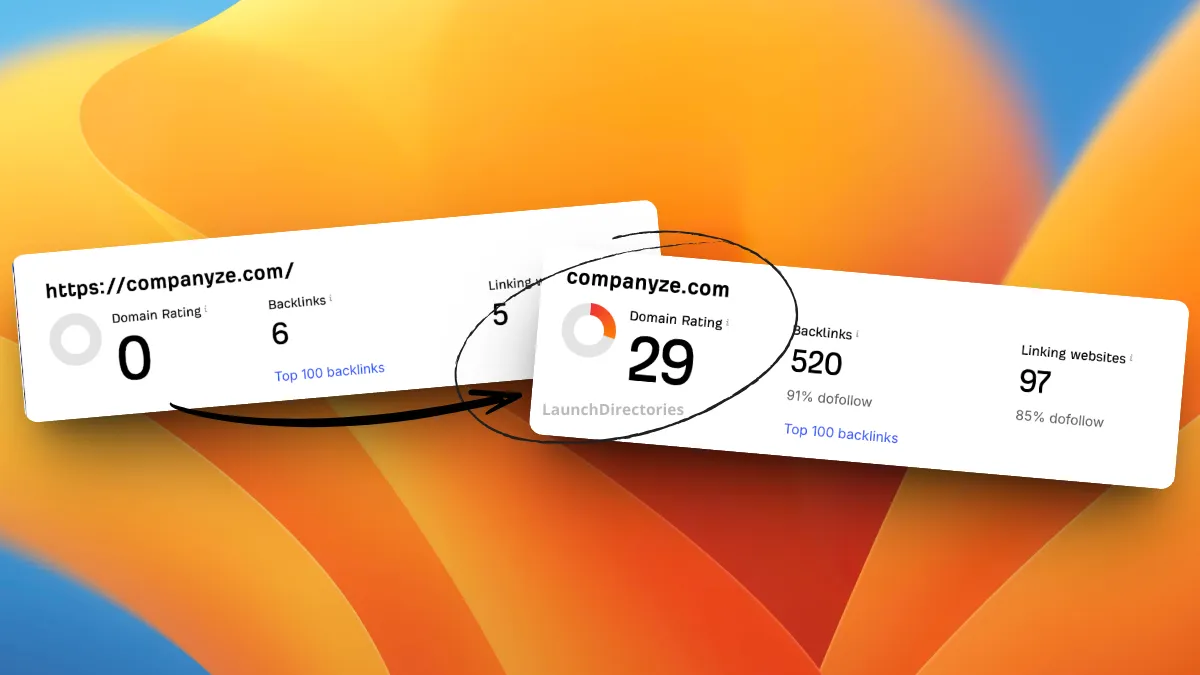
Real domain rating growth from one of our customers. DR 0 to 29, with 520 backlinks and 97 referring domains after directory submissions. See our pricing →
What makes directory submissions effective for SaaS is the quality of signal they send. Google values backlink diversity: 100 links from 100 different domains is far more powerful than 100 links from a single domain. Directory submissions naturally produce this diversity. They also create a varied anchor text profile (brand name, URL, product description) that looks organic. And increasingly, directories serve as a source of truth for AI tools like ChatGPT, Claude, and Perplexity, which crawl these platforms when generating product recommendations.
The timeline is fast compared to other link-building strategies. Submissions complete within the first week or two. Google crawls and indexes new links over weeks three and four. By month two, the domain rating improvement is visible in Ahrefs. By months three to four, your content starts moving from deep pages to page 1-2 for target keywords.
Full disclosure: LaunchDirectories is our service. We built it after spending 70+ hours doing manual directory submissions for our own SaaS and realizing others face the same tedious process. The +25 DR average comes from actual customer data across 100+ submissions.
Technical SEO for SaaS
SaaS products face technical SEO challenges that most websites don't. Your product is a web application, likely built with React or Vue, and the same technology that makes your app powerful can make your marketing site invisible to search engines.
The most important architectural decision is to separate your marketing site from your app. Landing pages, blog, and documentation should be server-rendered or statically generated (Next.js is ideal). Your actual application can use whatever technology you want because it doesn't need to be crawled. The common pattern: yoursite.com for marketing (Next.js), app.yoursite.com for the product (React SPA), docs.yoursite.com for documentation.
Once separated, noindex all app pages. Your dashboard, settings, and authenticated content waste crawl budget and create duplicate content issues. Add noindex, nofollow to every app route, or block the entire /app/ path in robots.txt.
Core Web Vitals matter as a tiebreaker, not a primary ranking factor. Aim for LCP under 2.5 seconds (preload fonts, avoid massive hero images), INP under 200ms (minimize JavaScript on marketing pages), and CLS under 0.1 (set explicit width/height on images). Keep URL structure flat and descriptive: /features/[name], /compare/[competitor]-alternative, /blog/[slug].
Invest in internal linking. Every important page should be reachable within three clicks from your homepage. Use a topic cluster model: a pillar page links to supporting content, each supporting page links back. This distributes page authority and sends clear topical relevance signals to Google.
Quick technical checklist: XML sitemap submitted to Search Console. Robots.txt blocks /app and /dashboard. Canonical tags on all public pages. HTTPS everywhere. Mobile-responsive marketing pages. JSON-LD schema on key pages (SoftwareApplication for product, FAQPage on content, Article on blog posts). These basics take an afternoon and prevent weeks of debugging.
Programmatic SEO for SaaS
Programmatic SEO produces outsized results when it works. The concept: build a template and populate it with structured data to generate hundreds or thousands of pages, each targeting a specific long-tail keyword. Zapier's integration pages ("Connect Slack with Google Sheets," "Connect Trello with Gmail") generate over 16 million monthly visitors.
It works when your SaaS has structured data that maps naturally to search queries. If you have 200 integrations, that's potentially 40,000 combination pages. If you offer templates, each can have its own landing page targeting "free [type] template for [use case]" keywords. If your product serves multiple industries, create use-case pages for each vertical with tailored messaging. Notion's template gallery is a masterclass in this approach.
The biggest pitfall is thin content. Google penalizes pages that exist purely for SEO without providing genuine value. Each page needs unique, useful content beyond swapping a variable name. Validate search demand before generating thousands of pages; index bloat from pages nobody searches for hurts rankings by wasting crawl budget. And every programmatic page needs proper internal linking. Don't create an orphaned island of auto-generated content.
Comparison & Alternative Pages Strategy
Comparison and alternative pages are the highest-converting content type in SaaS SEO, and most companies underinvest in them. When someone searches "Notion alternatives" or "Asana vs Monday," they've already decided to buy a tool in your category. They're choosing, not browsing. These pages convert at 5-7% to signup or demo, compared to about 1% for blog posts.
Four types every SaaS should have. 1:1 comparison pages (/compare/competitor-vs-you) with feature matrix, pricing comparison, and honest assessment of where each tool excels. Alternative pages (/compare/competitor-alternatives) listing 5-10 alternatives with your product featured prominently. "Best of" lists as genuine roundups of top tools including yourself. And a comparison hub page (/compare) linking to all comparison content, creating an internal linking hub that distributes authority.
Real Example: Buy Me a Coffee vs Patreon
Look at how Buy Me a Coffee built their alternative page targeting "Patreon alternatives." This is one of the best examples of a SaaS comparison page done right:
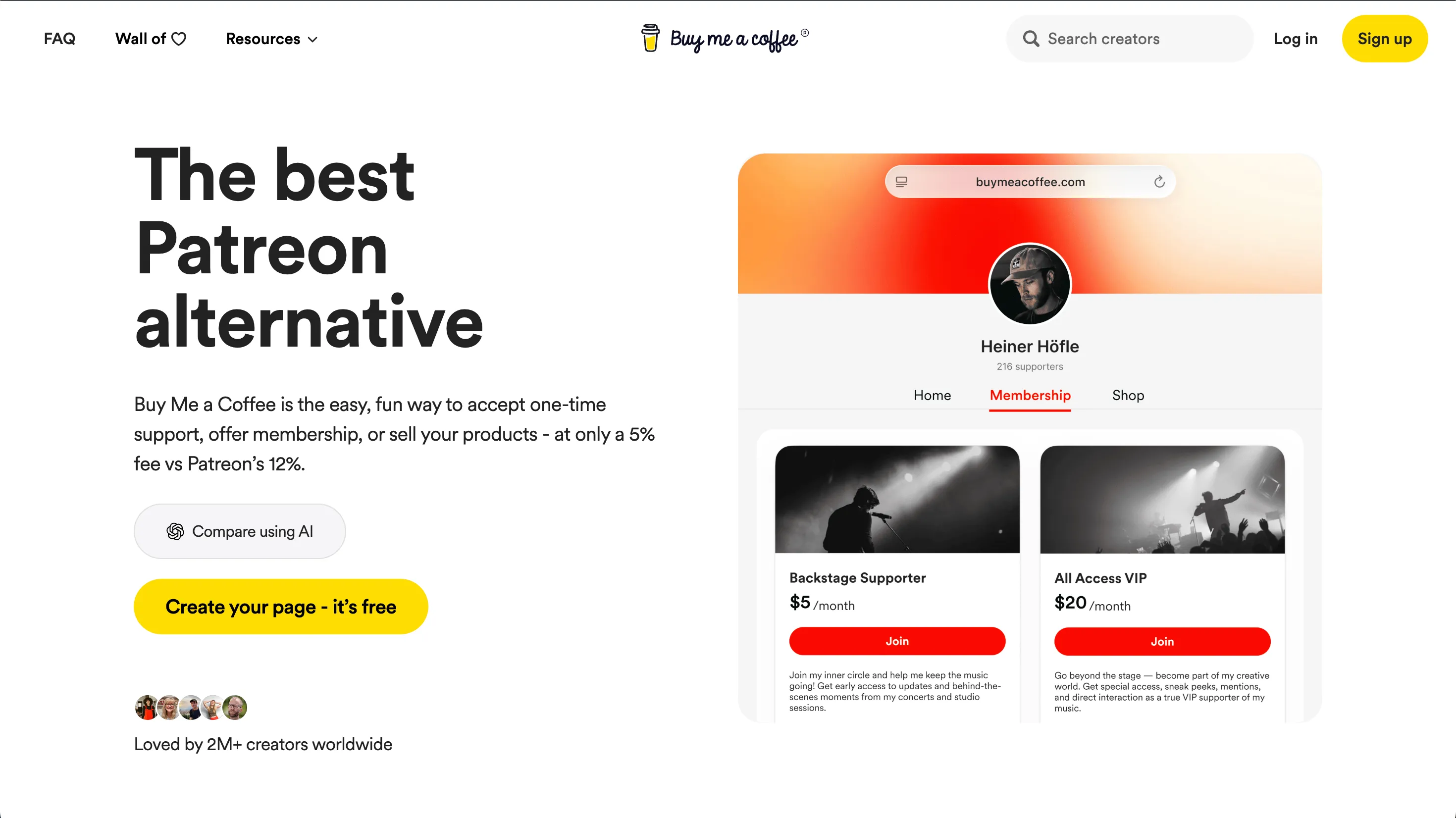
Click to view full size. Buy Me a Coffee's alternative page, a textbook example of comparison page SEO.
Buy Me a Coffee's comparison page unveils the reasons why creators are making the switch from Patreon. The architecture of the page focuses on benefits and resonates with creators seeking an alternative to Patreon's complexities.
The storytelling approach takes centre stage and amplifies the impact of each benefit. Instead of a dry feature list, they walk the reader through real pain points and show how their product solves them. It's a great way to enhance the advantages Buy Me a Coffee offers over Patreon without coming across as aggressive or salesy.
The design integrates authentic testimonials from creators who have already made the transition. These testimonials serve as powerful validation and resonate with prospects on a personal level. When a creator reads that someone in their niche switched and saw better results, the decision becomes much easier.
You can replicate this for your SaaS. Pick your top 3-5 competitors. For each one, create a page at /compare/competitor-vs-yourproduct and an alternatives page at /competitor-alternative. Include a real feature matrix, be honest about trade-offs, add customer quotes from people who evaluated both tools, and make the CTA contextual ("Try us free for 14 days, no credit card, switch in 5 minutes").
The most important advice: be genuinely honest. Acknowledge where competitors are better. Readers can smell marketing spin. The pages that convert best help readers self-select: "If you need X, go with Competitor A. If you need Y, we're the better choice." This honesty dramatically increases conversions because readers trust your recommendation.
AI Search & GEO: The New SaaS SEO Frontier
94% of B2B buying groups now use large language models (ChatGPT, Claude, Perplexity, Copilot) during their purchase journey. They ask AI "what's the best project management tool for a 20-person startup?" and make decisions based on the answers. Meanwhile, Google's AI Overviews reduce traditional click-through rates by up to 61% on affected queries.
Traditional SEO isn't dead, but SaaS companies need to add Generative Engine Optimization (GEO) to their strategy. The goal: make your content easy for AI models to find, understand, and cite.
The most impactful GEO tactic is being present where AI tools look for information. These models pull from directories, documentation sites, review platforms, and publicly accessible web pages. Being listed on 100+ directories increases the surface area that AI tools can find you on. About 73% of marketers believe that backlinks directly influence AI search results, and the logic holds: when ChatGPT recommends a product, it draws from sources that reference and link to that product.
Structure your content for extraction. AI models favor concise, definitive statements, so place clear "X is Y" definitions early in articles. Include specific statistics (pages with cited numbers receive 22-40% more GEO visibility). Implement JSON-LD structured data. And put your most important information in the first 30% of each page, since 44% of ChatGPT citations come from that section.
How AI Agents Actually "See" Your Website
AI agents don't experience your website the way humans do. According to Google's research on AI agent UX, they process your site through three distinct layers: screenshots (visual layout, color hierarchy, element sizes), raw HTML (DOM structure and element relationships), and the accessibility tree (roles, names, and states of interactive elements). Understanding all three is critical for SaaS companies that want to be visible in AI-powered search.
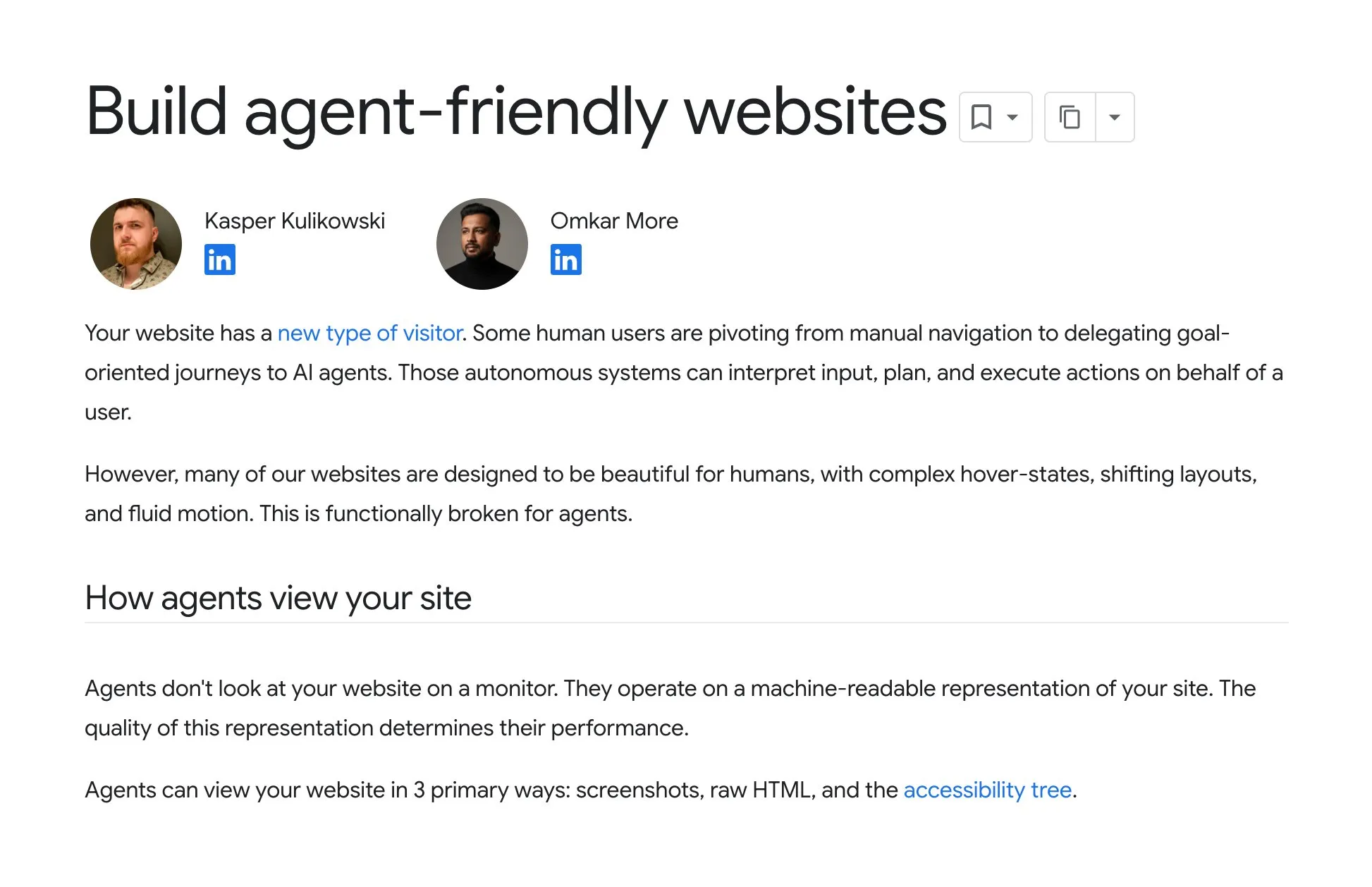
When an AI agent takes a screenshot of your page, it analyzes visual layout, color contrast, font sizes, and how prominent each element is. If your key content is buried below the fold, hidden behind tabs, or obscured by cookie banners and pop-ups, the agent may never process it. Visual hierarchy matters just as much for AI as it does for human visitors.
The raw HTML layer is where most SaaS sites fail. AI agents parse your DOM structure to understand what your page is about and how elements relate to each other. Clean, semantic HTML makes this easy. Messy markup with deeply nested divs, inline styles, and non-standard components creates noise that obscures your actual content. Use <button> for actions instead of <div onClick>. Use <nav>, <main>, <article>, and <section> instead of generic divs everywhere. Add labels to all form inputs so AI understands what data you're collecting.
The third layer, the accessibility tree, is perhaps the most overlooked. AI agents read the same tree that screen readers use: the roles, names, and states of every interactive element on your page. If your site is accessible, it's also more legible to AI. Make sure your layout is stable with no shifting elements, remove ghost overlays that hide interactive components, and ensure every clickable element has a clear, descriptive label. The overlap between accessibility best practices and AI-readiness is nearly complete.
SaaS products built with React, Vue, or Angular are especially vulnerable here. Heavy JavaScript rendering, client-side routing, and dynamic content loading can make your marketing pages partially invisible to AI agents. Server-side rendering or static generation for your public pages is not optional anymore.
Make Your SaaS Visible to Google and AI Search
We manually submit your SaaS to 100+ curated directories. You get backlinks, domain authority, and presence across the sources AI models pull from. Real human submissions, 80-95% acceptance rates, results in days.
Link Building Beyond Directories
Directory submissions give you the first 100+ backlinks and a solid domain authority foundation. To rank for genuinely competitive keywords, you need to layer additional strategies on top. Think of directories as the base layer; everything else builds on that foundation.
The highest-impact strategy for SaaS is digital PR and data stories. Create original research (survey customers, analyze product data, compile industry benchmarks) and pitch findings to journalists. A well-executed data study can earn 50 to 200+ editorial backlinks from TechCrunch, Forbes, and niche blogs. The investment is significant, but the payoff compounds for years.
Free tools and calculators work extremely well. Ahrefs' free backlink checker, HubSpot's Website Grader, and CoSchedule's Headline Analyzer each earn thousands of backlinks because people naturally link to useful tools. Build something valuable at the intersection of your product category and audience needs. Create it once, earn links indefinitely.
Don't overlook integration partner pages. If your SaaS integrates with Stripe, Slack, HubSpot, or Shopify, getting listed on their partner directories provides backlinks from extremely high-DR domains. Plus, these links drive qualified referral traffic.
Guest posts and HARO/Connectively responses round out the strategy. For guest posting, quality over quantity: five articles on relevant, high-authority publications outperform fifty posts on random blogs. For journalist queries, focus on topics where you can provide genuine expertise and proprietary data.
Measuring SaaS SEO Success
Most SaaS teams measure SEO wrong. They obsess over keyword rankings and organic traffic, which are directional indicators but ultimately vanity metrics. Rankings don't pay bills. Revenue pays bills. Your measurement framework should connect every metric back to pipeline and customers.
The north star metric is organic pipeline per content piece. Know which specific pages generate demos and signups, not just which get traffic. A page with 200 visits producing 10 demo requests is more valuable than one with 10,000 visits producing 5. Set up first-touch attribution in your CRM and track organic signups as your primary KPI.
Beyond that, monitor organic CAC (total SEO investment divided by organic customers, compared monthly against paid channels), non-branded organic traffic (filter brand searches in Search Console to see true SEO growth), domain rating trajectory (aim for DR 30+ by month three, 50+ within a year), and BOFU keyword positions (track comparison page rankings separately from informational content).
Review monthly. If comparison pages convert at 6% but educational posts at 0.3%, that tells you where to invest. If one content cluster drives 70% of organic pipeline, double down on related topics. Data-driven SEO beats gut-feel SEO every time.
SaaS SEO: Month-by-Month Timeline
Here's an honest timeline for a new SaaS starting from zero: no content, no backlinks, no domain authority. Results vary by niche and competition, but this is a reliable baseline.
Month 1: Foundation. Submit to 100+ directories (or use a service to handle this in 4-6 days). Set up Search Console and GA4. Fix technical basics (sitemap, robots.txt, schema). Conduct keyword research for your first 50-100 targets. Write 3-5 BOFU comparison and alternative pages. Expect DR to climb from 0 to 20-30 as directory links get indexed. No significant organic traffic yet.
Months 2-3: Content sprint. Publish 5-10 more BOFU pages and 5-10 MOFU articles. Optimize product and feature pages. Start guest post outreach (2-3 per month). Build internal links. Expect DR 25-35, first long-tail keywords on page 2-3, initial trickle of 100-500 visits per month. First organic signups may appear.
Months 4-6: Compounding begins. Publish 3-4 articles per week. Refresh underperforming content. Launch a free tool as a link magnet. Build topic clusters. Start programmatic SEO if data supports it. Expect DR 35-45, multiple page 1 rankings for long-tail keywords, 1,000-5,000 organic visits, consistent stream of organic signups.
Months 7-12: Full compounding. Double down on clusters driving pipeline. Launch digital PR with original research. Optimize conversion paths. Target more competitive keywords. Expect DR 45-55, page 1 rankings for medium-competition terms, 5,000-20,000+ monthly organic visits. SEO becomes a reliable pipeline channel. Month 7 is the average break-even point.
Frequently Asked Questions
Start Growing Your SaaS Organic Traffic
Begin with the foundation: directory submissions that build your domain authority. Then layer content strategy on top. The compounding starts the day you begin.
Plans from $99. Average +25 DR increase. 4-6 day delivery. 100+ happy customers.