


What is Domain Rating?
Domain Rating (DR) is a metric developed by Ahrefs that scores a website's backlink profile strength on a scale from 0 to 100. It is calculated based on the quantity and quality of unique referring domains linking to your site. A brand-new website starts at DR 0. Sites like Google, Facebook, and Wikipedia sit at DR 95-99.
The scale is logarithmic: going from DR 10 to 20 requires a handful of backlinks, but going from DR 70 to 80 requires exponentially more. This is why the first 30 points of DR are relatively easy to gain through directory submissions, while pushing past DR 60 demands sustained, multi-channel link building.
DR is based entirely on backlinks. It does not factor in content quality, traffic, technical SEO, or any other on-page element. Publishing 500 blog posts without acquiring any backlinks will not move your DR by a single point. The only way to increase it is to get more websites to link to you.
It is also worth noting that DR is not a Google metric. Google does not use it in their ranking algorithm. However, the underlying signals DR measures (quality and quantity of backlinks from unique domains) are among Google's most important ranking factors. DR is a useful proxy for how competitive your site is in search. For a deeper comparison, see our guide on Domain Rating vs Domain Authority.
Why Domain Rating Matters for Ranking in Google
If your site has a DR of 5, you are not going to rank for anything with competition. It does not matter how good your content is or how well-optimized your pages are. Without backlinks, Google has no reason to trust your site over the hundreds of others targeting the same keywords.
The correlation between DR and rankings is well-documented. Ahrefs analyzed millions of search results and found that pages from higher-DR sites consistently outrank pages from lower-DR sites, even when the lower-DR page has better on-page optimization. This does not mean DR causes rankings directly. It means the backlinks that produce a high DR are the same backlinks that help you rank.
Here is a rough guide to what you can achieve at different DR levels:
| Domain Rating | What You Can Rank For | How to Get There |
|---|---|---|
| DR 0-10 | Almost nothing with competition | Brand new site, no backlinks yet |
| DR 10-30 | Long-tail, low-competition keywords | 20-50 directory submissions |
| DR 30-50 | Medium-difficulty keywords in your niche | 100+ directories + guest posts |
| DR 50-70 | Competitive keywords, most niches | Sustained link building over 6+ months |
| DR 70+ | Highly competitive keywords | Major brand with strong PR and partnerships |
For most startups, the jump from DR 0 to DR 30 is the most impactful. It takes your site from invisible to competitive for long-tail keywords where your potential customers are actually searching. If you are working with a tight budget, our guide to SEO for startups covers what to do, what to skip, and what is worth paying for.
1. Submit to High-DR Directories
This is the fastest method. Submit your website to startup and business directories that have high Domain Ratings themselves. Start with the top 10 directories by Domain Rating. Each approved listing creates a backlink from a unique referring domain, which is exactly what Ahrefs counts when calculating your DR.
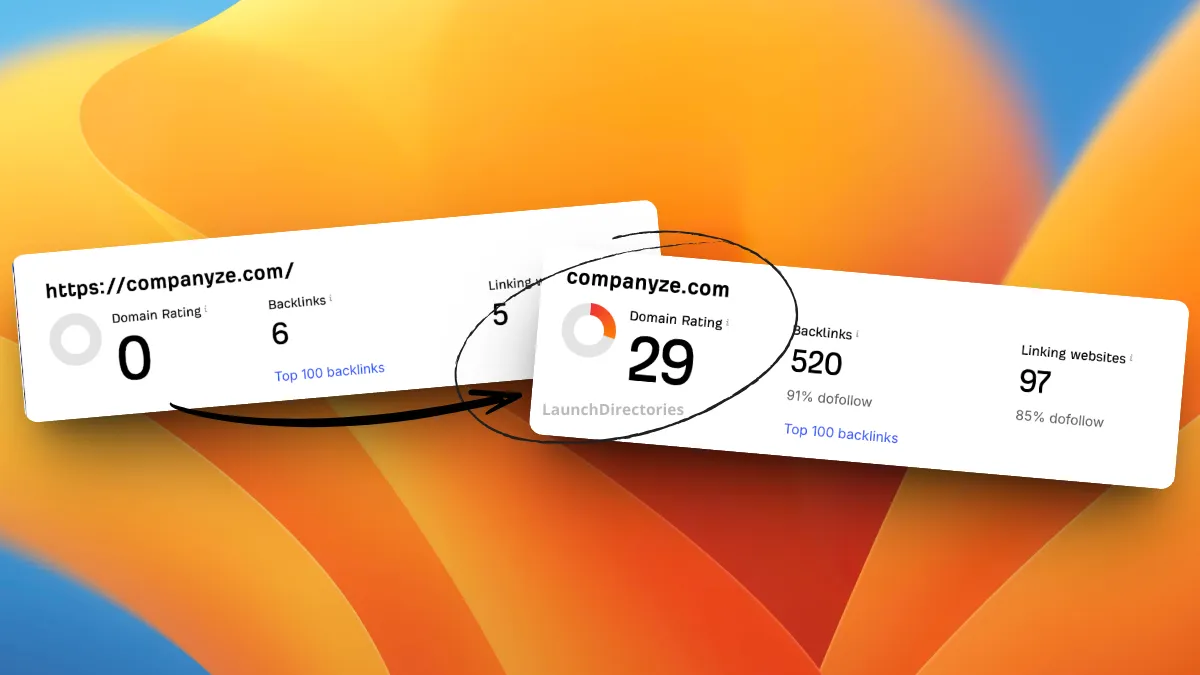
The math is straightforward: if you submit to 100 directories and 80 accept you (a typical acceptance rate for quality products), you gain 80 new referring domains. For a site starting at DR 0, that alone can push you to DR 25-35 within weeks as Ahrefs indexes the new links.
Not all directories are equal. A backlink from a DR 90 directory like Product Hunt carries far more weight than one from a DR 15 directory nobody has heard of. Prioritize directories with DR 50+ for maximum impact. Our top directories ranked by Domain Rating is a good starting point.
One thing to note: dofollow vs nofollow matters less than people think for DR specifically. Ahrefs counts both dofollow and nofollow links in their DR calculation. However, dofollow links are more valuable for actual Google rankings. Check which directories provide dofollow links in our directory rankings.
The catch is that submitting to 100+ directories manually takes 40-60 hours. Each directory has its own submission form, category system, and requirements. Some need screenshots, others need a specific description length, a few require a founder story. This is why services like ours at LaunchDirectories exist: we handle the submissions for you across 100+ curated directories, writing unique descriptions for each one. You get the backlinks and DR growth without spending weeks on forms.
2. Guest Post on Relevant Blogs
Guest posting means writing articles for other websites in exchange for a backlink to your site, usually in the author bio or naturally within the content. It is one of the oldest link building methods and still works well when done correctly.
The key is targeting the right blogs. A guest post on a DR 60+ blog in your industry carries real weight. A guest post on a DR 10 blog that accepts anyone adds almost nothing. Look for blogs with engaged audiences, editorial standards, and genuine traffic. If a blog publishes 20 guest posts a day from random authors, it is a link farm and not worth your time.
Finding opportunities: search Google for "[your niche] + write for us" or "[your niche] + guest post guidelines." Use Ahrefs Content Explorer to find blogs that accept contributions. Pitch topics that genuinely help their audience rather than thinly disguised sales pitches. The article needs to stand on its own. If the editor would reject it without the backlink, your pitch needs work.
3. Create Linkable Assets
A linkable asset is anything on your site that other websites want to reference and link to. The best examples: free tools, calculators, original research, comprehensive guides, templates, or interactive visualizations. These attract backlinks passively because they provide genuine value that content creators need to reference.
Ahrefs built their entire growth on this principle. Their free backlink checker and website authority checker generate millions of visits and thousands of backlinks because people reference them in articles about SEO. Canva's free design tools earn them backlinks from every "best free design tools" listicle on the internet.
You do not need to build something as ambitious as a free tool. Even publishing original survey data, industry benchmarks, or a well-researched statistics page can attract consistent backlinks. Journalists and bloggers are always looking for data to cite. If you are the source, you get the link.
4. Digital PR and Journalist Outreach
Digital PR gets your brand mentioned (and linked) in news publications, industry blogs, and roundup articles. A single mention in TechCrunch (DR 93) or Forbes (DR 95) can move your DR more than 50 low-quality directory submissions combined.
The most accessible way to start is through platforms like HARO (Help a Reporter Out) and Connectively. Journalists post queries looking for expert sources. You respond with a relevant quote or insight, and if they use it, you get a backlink from their publication. Set up alerts for queries matching your expertise and respond quickly. Speed matters because journalists often use the first good response.
Beyond HARO, monitor for opportunities to comment on industry news, provide data for trend articles, or offer founder perspectives on emerging topics. The more visible you are as a source, the more journalists will come to you directly.
5. Build Relationships and Integration Partnerships
Networking with other founders, bloggers, and creators in your space leads to natural mentions and backlinks over time. This is not about cold-emailing strangers asking for links. It is about being genuinely active in your community and building relationships where linking to each other happens naturally.
For SaaS companies, integration partnerships are particularly powerful. When you build an integration with another product, they typically link to you from their integrations page, which is often a high-authority page on their site. Zapier, Slack, HubSpot, and similar platforms all maintain integration directories that link to partner products. If your product can integrate with theirs, the backlink from their DR 80-90+ domain is a significant win.
Participating in podcast interviews, webinars, and online events also generates backlinks from show notes and event pages. These links are editorially placed and come from unique referring domains, exactly what moves your DR.
6. Broken Link Building
Broken link building means finding dead links on other websites and offering your content as a replacement. When a blog links to a resource that no longer exists (returns a 404), the webmaster has a problem: a broken user experience. You solve that problem by providing a working alternative.
The process: use Ahrefs or the free "Check My Links" Chrome extension to scan pages in your niche for broken outbound links. When you find one, check what the dead page was about using the Wayback Machine. If you have similar content (or can create it), email the webmaster and suggest your page as a replacement.
The success rate is typically 5-15%, which sounds low until you consider that each success earns you a contextual backlink from a page that already had link equity. Focus on high-DR sites for maximum impact. Resource pages with many outbound links are the best targets because they tend to accumulate broken links faster.
7. Get Listed on Resource Pages
Resource pages are curated lists of tools, articles, or companies in a specific niche. Universities, industry associations, and established blogs maintain them. A link from a university's resource page (typically DR 70-90+) carries serious authority.
Search Google for "[your niche] + resources," "[your niche] + useful links," or "[your niche] + recommended tools." Look for pages that list products or content similar to yours but do not include you yet. Reach out to the page maintainer with a short email explaining why your product or content would be a valuable addition for their audience.
This works best when you genuinely belong on the list. If your product is a project management tool and you are pitching to be added to a "best project management tools" resource page, the pitch writes itself. If you are stretching to make your product relevant to the page topic, your email will be ignored.
8. Reclaim Unlinked Brand Mentions
If someone mentions your brand or product in an article without linking to you, that is a missed backlink. The article already acknowledges you exist. Turning that mention into a hyperlink is often as simple as a polite email.
Use Ahrefs Content Explorer to search for your brand name and filter for pages that do not link to your domain. Set up Google Alerts for your brand name to catch new mentions as they happen. When you find an unlinked mention, email the author with a short, friendly message: "Thanks for mentioning [product name] in your article. Would you mind adding a link so readers can find us easily?"
This method works best for brands with existing visibility. If your product is brand new, you probably do not have many unlinked mentions yet. Come back to this strategy once you have been active for a few months and have built some awareness through the other methods above.
Realistic Timeline: How Fast Can You Increase DR?
The speed of DR growth depends on your starting point and how aggressively you build links. Here is what we typically see with founders who use our directory submission service combined with their own link building efforts:
Weeks 1-2: Directory submissions start getting indexed by Ahrefs. Your DR climbs from 0 to somewhere in the 10-15 range as the first batch of referring domains is detected. You will start to see your site appearing for branded searches and very low-competition queries.
Weeks 3-4: More directories are crawled and indexed. DR typically reaches the 25-35 range. At this point, your site has enough authority to start ranking for long-tail keywords in your niche. This is when content marketing starts to pay off, because your blog posts now have the domain authority to actually compete.
Months 2-3: If you supplement directory submissions with guest posts and digital PR, DR can reach 40-50. Content you publish now ranks faster because Google recognizes your domain as increasingly trustworthy. Medium-difficulty keywords become achievable.
Months 4-6: Sustained link building across multiple channels. DR 50-60 is achievable for sites that consistently acquire quality backlinks. At this level, you are competitive for most keywords in your niche and your content marketing flywheel is turning.
Beyond 6 months: Pushing past DR 60 requires significant effort: digital PR placements, major partnerships, viral content, or sustained guest posting at scale. This is where the logarithmic nature of DR becomes very real. Each additional point requires substantially more links than the one before it.
Common Mistakes That Waste Your Time
Buying cheap backlinks from Fiverr. Those "500 backlinks for $10" packages are spam links from PBNs (private blog networks) and link farms. They might temporarily inflate your DR, but Google can detect and penalize these. More importantly, the domains linking to you have no real authority, so the DR boost is minimal and short-lived. Some of these services even get your site manually penalized.
Obsessing over DR instead of building a real business. DR is a means to an end, not the end itself. The goal is to rank in Google and get customers. A DR 40 site with excellent content targeting the right keywords will outperform a DR 60 site with thin content and no strategy. Use DR as a health metric, not as your north star.
Ignoring link quality and only counting quantity. Ten backlinks from DR 70+ sites with relevant audiences will move your DR (and your rankings) more than 100 links from DR 5 spam sites. Always prioritize quality over quantity.
Only building links and ignoring content. Backlinks get you authority. Content gives search engines something to rank. You need both. If you build 100 backlinks but only have a homepage and a pricing page, there is nothing for Google to rank for long-tail keywords. Combine link building with consistent content creation for the best results.
DIY Directory Submissions vs Using a Service
You can absolutely do directory submissions yourself. Every directory on our ranked list is publicly accessible and you can submit to each one manually. The question is whether your time is better spent elsewhere.
Here is what DIY looks like in practice: you find a directory, create an account, fill out their specific submission form (each one is different), write a description tailored to their audience, upload screenshots in their required format, select categories, and wait for approval. Then you repeat that process 100+ times. Most founders who try it get through 10-15 directories before it drops off their priority list.
A submission service handles all of that. At LaunchDirectories, we manually submit your product to 100+ curated directories. We write a unique description for each one (reusing the same text gets you rejected on quality directories), upload your screenshots in the right formats, and track which submissions are approved. Most clients see their DR go from 0 to 25-35 within a few weeks as the backlinks get indexed.
| DIY Submissions | LaunchDirectories Service | |
|---|---|---|
| Time investment | 40-60 hours | 30 minutes (you fill out one form) |
| Directories covered | As many as you have patience for | 100+ curated directories |
| Description quality | Depends on your copywriting | Unique description per directory |
| Acceptance rate | Varies widely | 80-95% (we know what each directory expects) |
| Cost | Free (but your time has a cost) | From $99 |
| Expected DR result | DR 15-30 (if you do enough) | DR 25-35 from DR 0 |
Both approaches work. The DIY route makes sense if you have more time than money and enjoy the process. The service route makes sense if you want results quickly and would rather spend your time on product development, content creation, or the other link building methods described in this guide.
Want to Jump-Start Your Domain Rating?
We submit your startup to 100+ directories manually. Most clients go from DR 0 to DR 25-35 within weeks. No bots, no spam, 80-95% acceptance rates.