What is Domain Rating?
Domain Rating (DR) is an Ahrefs metric that scores a website's backlink profile strength on a logarithmic scale from 0 to 100. Unlike PageRank, which evaluates individual pages, DR looks at the entire domain. It considers how many unique websites link to it and how strong those linking sites are. A single backlink from TechCrunch (DR 93) carries far more weight than dozens of links from unknown blogs.
For SaaS founders, DR is a useful competitive benchmark. If your site sits at DR 15 and your main competitor is at DR 55, you know you need to be strategic about which keywords you go after. Early gains come fast: a few dozen directory submissions can push you from DR 0 to 20. But each 10-point jump after that demands exponentially more effort.
How is Domain Rating calculated?
Ahrefs calculates DR based on two main inputs: the number of unique referring domains linking to your site, and the DR scores of those linking domains. The formula uses a logarithmic scale, which means that each point becomes harder to earn as you climb. Going from DR 10 to DR 20 might take 30 new referring domains. Going from DR 50 to DR 60 could require hundreds.
A few things the algorithm does not consider: your content quality, on-page SEO, traffic volume, or social media presence. DR is strictly a backlink metric. You could have the best-written blog in your niche, but if nobody links to your domain, your DR stays at zero.
It's also worth noting that DR is a relative metric. Ahrefs periodically recalibrates scores across its entire index. This means your DR can drop even if you haven't lost any links, simply because other sites gained links faster. Think of it like a ranking within a pool of websites rather than an absolute measurement.
Why DR matters for startups
When you're launching a SaaS product, you're competing for organic search traffic against established players who have been building backlinks for years. DR gives you a quick way to gauge that gap. If you're targeting a keyword and every result on page one has DR 50+, you know that content quality alone probably won't be enough. You'll need to invest in link building alongside your content strategy.
DR is also commonly used when evaluating link building opportunities. If a blog offers you a guest post spot, checking their DR tells you roughly how much SEO value that backlink will pass. A link from a DR 70 publication helps your rankings far more than one from a DR 10 personal blog.
What is a Good Domain Rating?
There's no universal "good" number. It depends on your niche and who you're competing against. Here are practical benchmarks:
| DR Range | What It Means | Typical Sites |
|---|---|---|
| 0-20 | New or very small sites | Fresh startups, personal blogs, new SaaS products |
| 20-40 | Growing authority | Established startups, niche SaaS tools, small agencies |
| 40-60 | Solid authority | Well-known SaaS companies, popular blogs |
| 60-80 | Strong authority | Major SaaS brands (Notion, Figma), large publications |
| 80-100 | Elite authority | Google, GitHub, Wikipedia, Reddit, Amazon |
A freshly launched SaaS at DR 10 to 20 is completely normal. With consistent link building through directory submissions, guest posts, and press coverage, reaching DR 30 to 40 within a year is realistic. Most competitive SaaS companies settle between DR 50 and 70 over time.
Don't chase DR as an end goal, though. A DR 35 site with 50 links from relevant industry blogs will often outrank a DR 50 site built on random, unrelated directories. Link quality and relevance matter as much as the number.
DR benchmarks by industry
What counts as a "good" DR also varies by vertical. B2B SaaS companies tend to have lower DRs than media sites, because media sites naturally attract more backlinks through content. A project management tool at DR 45 is doing well. A tech news blog at DR 45 is below average for its category.
Here's what we typically see across different sectors:
- Early-stage SaaS (pre-Series A): DR 5 to 25. Most founders are focused on product, not SEO, so backlink profiles are thin.
- Growth-stage SaaS (Series A/B): DR 30 to 55. These companies usually have a marketing team actively building links and producing content.
- Enterprise SaaS: DR 60 to 80. Years of press coverage, integrations, and partnerships create deep backlink profiles.
- Developer tools and open source: DR 40 to 70. GitHub repos, documentation sites, and community discussions generate natural links.
- Agencies and consultancies: DR 20 to 45. Most links come from client portfolios, case studies, and industry directories.
The takeaway: compare your DR to direct competitors in your space, not to sites in completely different categories. A DR 30 SaaS beating DR 25 competitors on relevant keywords is in a strong position.
Domain Rating vs Domain Authority
Domain Rating (Ahrefs) and Domain Authority (Moz) both use a 0-100 scale, but they measure differently. DR focuses purely on backlink profile strength. DA also factors in spam scores and uses a separate crawl index.
| Feature | Domain Rating (DR) | Domain Authority (DA) |
|---|---|---|
| Provider | Ahrefs | Moz |
| Based on | Backlink profile strength only | Backlinks + spam score + other factors |
| Update frequency | Continuously (near real-time) | Monthly |
| Free checker | Yes (this tool) | Yes (MozBar, Moz Link Explorer) |
| Used by Google? | No | No |
A site can easily show DR 60 and DA 40, or the reverse. Each tool crawls the web differently. Neither metric is an official Google ranking factor, but both correlate with ranking ability. In the startup community, Ahrefs DR is the more commonly used standard. When someone on X says "we're at DR 45," they mean Ahrefs.
Which metric should you track?
For most SaaS founders, tracking one is enough. Pick whichever tool you already use. If you have an Ahrefs subscription, track DR. If you use Moz, track DA. The absolute number matters less than the trend over time.
Where this gets practical: when you're evaluating potential link building opportunities, use the same metric consistently. If you decide a guest post is worth pursuing only from sites with DR 40+, stick with DR for all evaluations. Mixing DR and DA in the same analysis leads to inconsistent decisions because the scores rarely align. If you prefer Moz DA, we also maintain a ranking of the best startup directories sorted by Moz Domain Authority.
Why Domain Rating Drops (and What to Do)
Seeing your DR drop can be alarming, but it's usually explainable. Here are the most common reasons:
- Lost backlinks. Sites that linked to you removed the link, or the linking page went offline. This is the most common cause. Check your "Lost" referring domains report in Ahrefs to identify which links disappeared.
- Index recalibration. Ahrefs periodically recalculates DR across its entire database. When millions of new sites enter the index and build links, existing scores can shift down even without any changes on your end.
- Link devaluation. Ahrefs may recrawl a linking site and determine it has less authority than previously estimated. If that site's DR drops, the value of their link to you drops too.
- Referring domain consolidation. If several sites that linked to you merge or redirect to a single domain, your unique referring domain count goes down.
What to do about it: small fluctuations of 1 to 3 points are normal and usually correct themselves. If you see a drop of 5+ points, check your backlink profile for lost links. For links that were removed, consider reaching out to the site owner. For natural index recalibration, focus on acquiring new links to offset the shift.
How to Improve Your Domain Rating
DR is purely a backlink metric. No amount of on-page SEO or content optimization will move it. You need more high-quality backlinks from unique referring domains. Here are the methods that work, ordered by speed of results:
Submit to directories
The fastest path to early authority. Each directory listing creates a backlink from a unique referring domain, and since Ahrefs weighs unique referring domains heavily in its DR calculation, directories are one of the most efficient ways to grow your score quickly.
There are hundreds of directories out there, but they're not all worth your time. The ones that actually move the needle fall into a few categories:
- SaaS directories like SaaSHub, SaaSWorthy, and GetApp. These list software products by category and are often the first place potential customers look when comparing tools. Most have DR 50+ and provide dofollow backlinks.
- AI directories like There's An AI For That, AI Tool Directory, and Futurepedia. If your product uses AI in any way, these directories have exploded in popularity and many carry DR 60+. They're also a real source of early traffic.
- Startup launchpads like Product Hunt, BetaList, and Launching Next. These are designed specifically for product launches and tend to have very high domain ratings (Product Hunt is DR 91). Beyond the backlink, they can also drive a meaningful wave of early users.
- General business directories like Crunchbase, G2, Capterra, and AngelList. These are trusted platforms with DR 80+ that also serve as social proof for potential investors and customers.
- Niche and industry directories specific to your vertical. A fintech startup should be listed on fintech-focused directories. A developer tool belongs on lists curated for developers. These links carry extra weight because of topical relevance.
At LaunchDirectories, we curate and maintain a database of the best directories across all these categories. We track which directories accept submissions, which ones provide dofollow links, and what their current domain ratings are. Our submission service handles the entire process for you: we submit your product to 100+ vetted directories so you can stay focused on building your product.
Submitting to 50 to 100 directories can move you from single digits to DR 20 to 30 within weeks. Here's a real example:
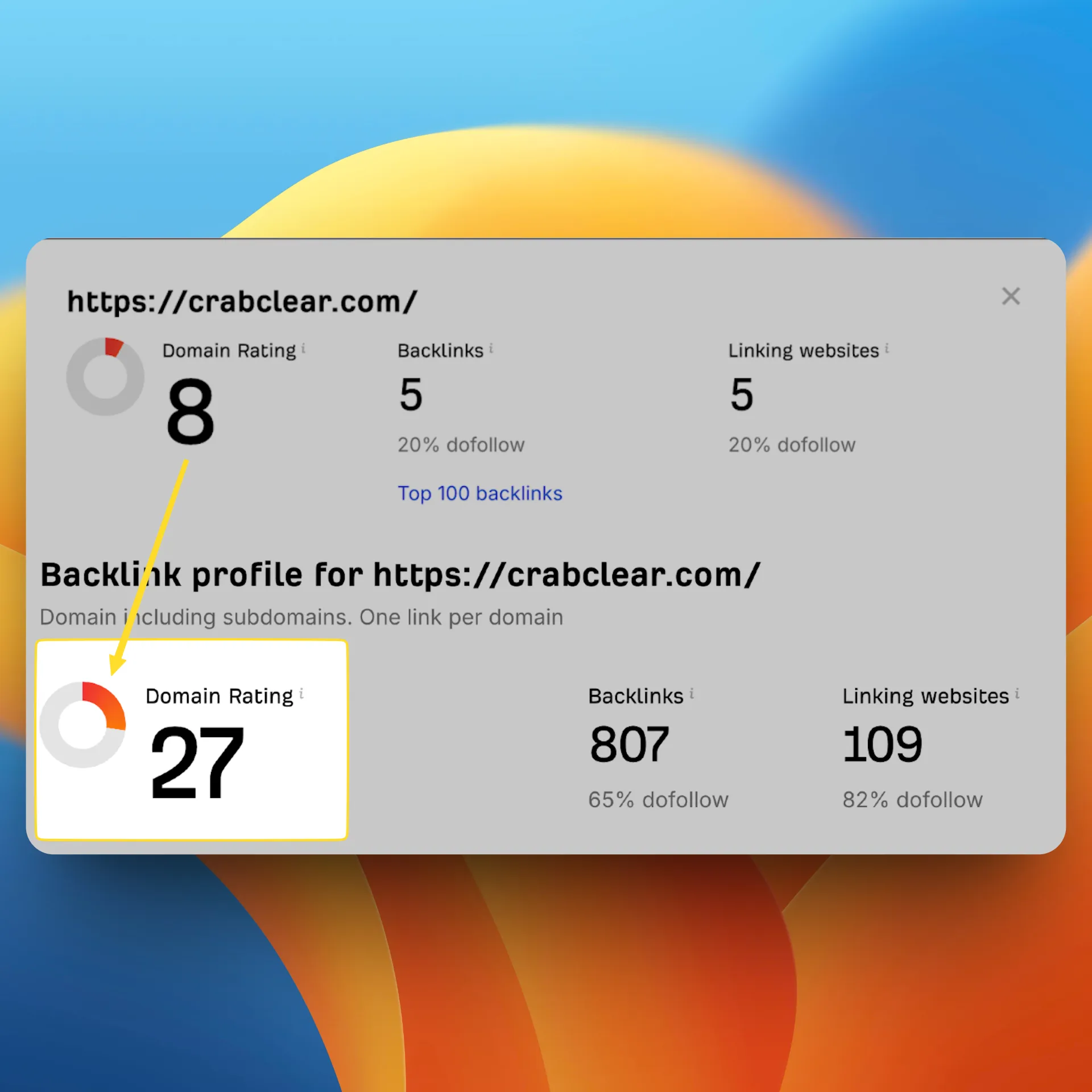
One of our customers started at DR 8 with just 5 backlinks. After we submitted their product to 100+ directories, they climbed to DR 27 with 807 backlinks from 109 unique referring domains.
That kind of growth is typical when you go from a handful of links to broad directory coverage. The key is getting listed on many unique domains, not just a few big ones.
👉 Try our submission serviceOne thing to keep in mind: not all directory backlinks are equal. A dofollow link from a DR 70 directory passes significantly more value than a nofollow link from a DR 20 directory. When choosing where to submit, prioritize directories with higher DR and dofollow links. You can check any directory's DR using the tool above, and we maintain a curated list of dofollow directories and free startup directories to help you find the best ones.
Create linkable assets
Free tools, calculators, templates, and original research attract backlinks organically. Other creators reference them in blog posts and roundups. This DR checker is itself an example. Build something useful for your audience and the links follow.
What makes a good linkable asset for a SaaS company? Think about what your target customers search for but can't easily find. Industry benchmarks, salary calculators, ROI estimators, comparison matrices, or curated resource lists all work well. The key is making something specific enough to be genuinely useful, not just another generic blog post.
Guest post on relevant blogs
Write for established publications in your niche (DR 40+). One link from a relevant DR 60 industry blog outweighs 20 links from unrelated DR 30 sites. Focus on publications your target customers actually read.
A practical approach: search for "[your niche] + write for us" or "[your niche] + guest post" in Google. Filter the results by DR using this tool or Ahrefs. Pitch topics where you have genuine expertise rather than generic content. Editors respond better to pitches backed by real data or unique experience from building your product.
Get press coverage
Launch announcements, founder interviews, and data-driven stories can earn links from high-DR news sites. A single mention on TechCrunch (DR 93) or Product Hunt (DR 91) can noticeably move your score. Even niche industry publications with DR 50 to 60 can make a meaningful difference.
Reclaim unlinked brand mentions
Use Ahrefs Content Explorer to find sites that mention your product without linking to you. Since they already know your brand, the conversion rate on link requests is high. Most SaaS companies with moderate brand recognition can pick up 5 to 15 new referring domains per month this way.
Build integrations and partnerships
If your SaaS integrates with other tools, each integration partner typically links to you from their integrations or marketplace page. These tend to be high-DR domains (Zapier is DR 91, Slack is DR 91, HubSpot is DR 93). Even a simple listing on an integration marketplace creates a quality backlink. The more integrations you build, the more natural backlinks you accumulate.
Timeline: A new SaaS site can reach DR 20 to 30 in 2 to 4 months of active link building. DR 40 to 50 usually takes 6 to 12 months. After that, progress slows because each point demands more effort than the last. Consistency beats intensity: ten quality backlinks per month, sustained over a year, outperforms 100 low-quality links in a burst.
Common Mistakes When Building Domain Rating
Not all backlinks help your DR equally, and some strategies can actually waste your time or hurt your site. Here are the mistakes we see founders make most often:
Buying cheap backlinks
Services that offer "500 backlinks for $50" almost always deliver links from low-quality PBNs (private blog networks) or spammy comment sections. These links provide little DR value because the linking sites themselves have low DR. Worse, Google can detect unnatural link patterns and penalize your site, damaging your organic rankings.
Focusing on total backlinks instead of referring domains
Getting 100 links from the same website counts as just one referring domain in Ahrefs' DR calculation. Founders sometimes celebrate getting multiple blog posts linking to them from a single publication, but for DR purposes, only the first link from that domain matters. Spread your link building across as many unique domains as possible.
Ignoring link relevance
A backlink from a cooking blog won't help your developer tools SaaS rank for technical keywords, even if that cooking blog has DR 60. Google uses topical relevance as a ranking signal. For DR specifically, any referring domain counts, but for actual SEO results, you want links from sites in your space. Prioritize relevance over raw DR when choosing where to invest your link building effort.
Not tracking your progress
Many founders do a burst of link building, check their DR once, and then forget about it. DR changes are gradual. Set a monthly reminder to check your score using this tool and track the trend in a spreadsheet. Also monitor your referring domains count, as that's the primary driver of DR growth. If your referring domains are climbing but DR is flat, the new links may be coming from low-DR sources.