I was reviewing our 2025 client acquisition data last week. The numbers confirm what every bootstrapped founder already feels: paid channels are a money pit for micro-SaaS. Our analysis shows customer acquisition costs (CAC) for B2B SaaS via paid channels can exceed $700.
That cost simply isn't sustainable when your micro-SaaS business is aiming for $1,000 to $20,000 a month in annual recurring revenue (ARR). You can't outspend venture-backed competitors. Your budget is tighter.
And that's the core challenge. For a micro-SaaS founder, marketing isn't just about growth; it's about survival. You need free or low-cost strategies.
This isn't about generic SEO advice. It's about a practical, founder-friendly approach. It’s a playbook built for small teams and solo operators, focusing on organic traffic as a bedrock for growth.
We're moving beyond vague notions here. We're getting into specific, actionable steps to lower your CAC and build real credibility, even without a massive budget. This allows you to actually improve search rankings and earn user trust.
(By the way, if you're looking for a comprehensive blueprint, check out our guide on A Practical Startup SEO Playbook for more depth.)
Because SEO isn't just a channel. It’s your long-term differentiator in a crowded market.
Why SEO beats paid ads for bootstrapped apps
SEO provides a better long-term return when your marketing budget is razor-thin. For many micro-SaaS ventures aiming for $1,000 to $20,000 ARR, burning cash on paid ads is a quick way to run out of runway.
The core problem? Sustainable growth. While paid ads can offer an initial boost, they demand constant investment. According to this article, B2B SaaS customer acquisition costs via paid channels can exceed $700. Can you really afford to drop that much just to land a single customer when you're just starting?
SEO, on the other hand, is an investment in a long-term asset. Content you create today can drive traffic and generate leads for months, even years, to come.
And the best part? The effect compounds over time. The more high-quality, relevant content you publish, the more your website becomes an authority in your niche. Over time, you rely less on daily ad spend and more on organic user acquisition.
Consider directory submissions to niche-relevant sites as a starting point. This can provide helpful backlinks for SEO and distribution. (And, by the way, our guide to Your Guide To Saas Growth Through Directory Submissions covers this in depth.)
Next Step: Identify three keywords relevant to your micro-SaaS. Then, build a content calendar around those keywords to start building that long-term SEO asset.
Micro-SaaS vs traditional SaaS SEO
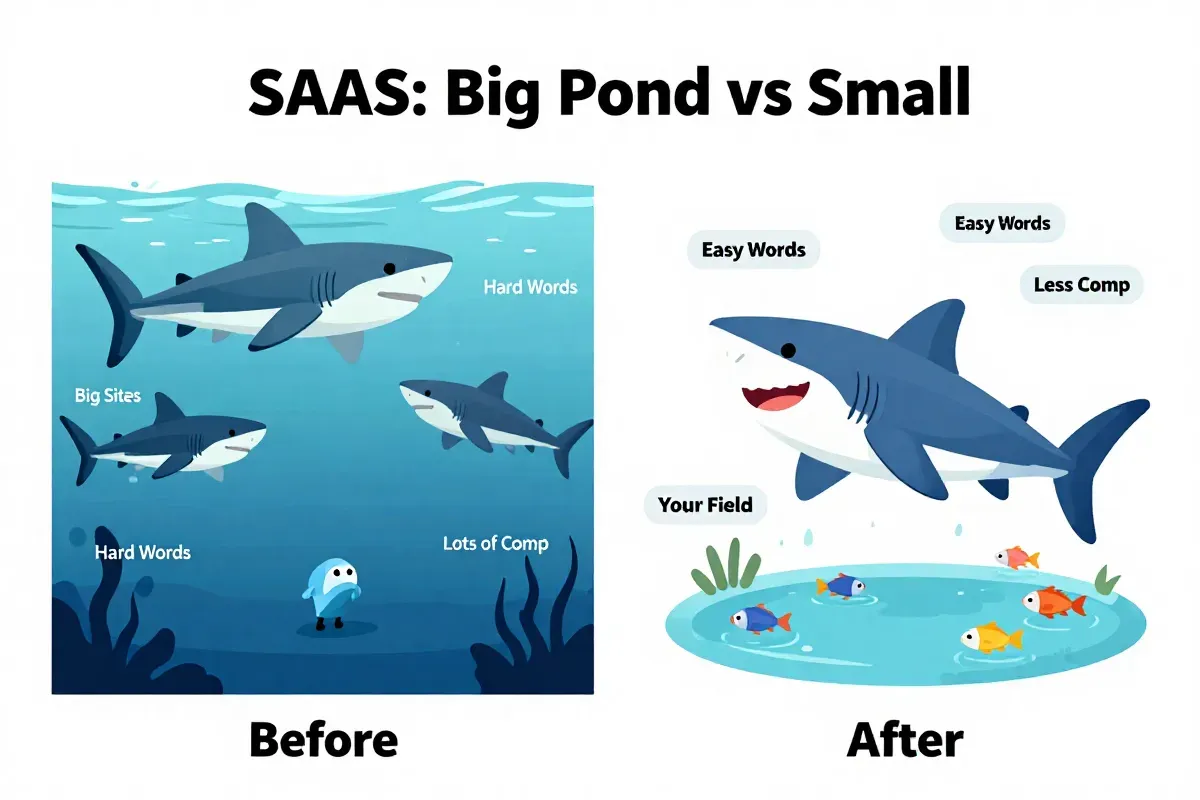
Micro-SaaS SEO focuses on being a big fish in a small pond. Instead of competing for broad terms against giants like Salesforce or HubSpot, you target a sub-niche where you can truly dominate.
Think of it this way: traditional SaaS SEO often means chasing high-volume keywords. You're trying to rank for terms like "CRM software" or "project management tools." This puts you head-to-head with companies that have massive marketing budgets. Micro-SaaS SEO is different. Find a market gap, a specific problem that isn't being adequately addressed by the big players.
For instance, instead of targeting "CRM software," maybe you focus on "CRM for landscape architects." Or, instead of "project management tools," try "project management for indie game developers." That focus lets you tailor your content and offerings to a specific audience. This is how you win users.
Consider directory listings that target your specific niche to establish authority. These help you in SEO and distribution.
Start with competitor analysis. What keywords are the big SaaS companies not targeting? Where are the gaps in their content? Those gaps are your opportunity.
How to find a profitable sub-niche
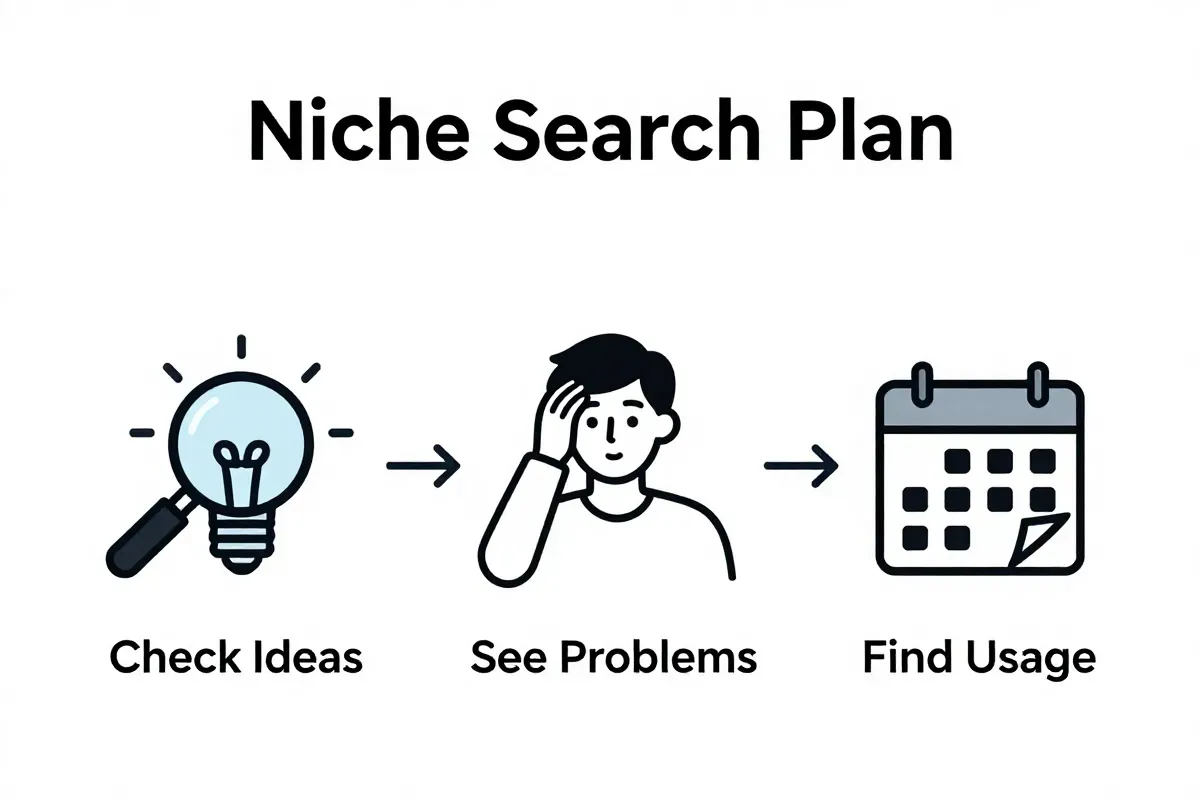
Finding a profitable sub-niche hinges on identifying unmet needs, and it's about more than just keyword research. Target a niche that bigger companies ignore.
Think urgent problem-solving and daily usage.
Here’s how to zero in:
- Brainstorm: List broad niches related to your expertise (e.g., project management).
- Sub-niche down: For each, identify specific user groups with unique needs (e.g., project management for AI safety researchers).
- Validate demand: Check keyword search volumes for these sub-niches using tools like Ahrefs or Semrush. (But more on the nuance of keyword difficulty in a moment).
- Assess competition: Are the top results dominated by large companies, or are there smaller players you could outrank?
- Evaluate problem urgency: Does your solution solve a pressing problem for this group, something they'd pay for today?
- Consider usage frequency: Is it something they'd use daily, weekly, or just once? (Daily use = higher retention).
Keyword difficulty (KD) is deceptive. A low KD score doesn't guarantee easy ranking. It just means fewer sites are actively targeting that keyword. It doesn’t account for domain authority or content quality. A better approach is to manually analyze the top 10 results. Are they optimized, comprehensive, and from authoritative sites? If so, move on.
And this is vital: market validation doesn't always come from search volume. Sometimes, a niche is profitable even if the search volume is low. Why? Because the problem is acute and the users are actively seeking solutions elsewhere (forums, social media, word-of-mouth).
Retention is vital. Your micro-SaaS product should aim for daily use by customers to solve urgent problems.
Next, don't just rely on keyword tools to validate your niche. Talk to potential customers. Join relevant online communities. Run surveys. A few in-depth conversations can provide far more valuable insights than any keyword report.
Finally, create comparison and alternatives pages on your domain to tie everything together. This will help users to find what they need from your SaaS.
Now, once you've got your niche locked down, you might consider checking out our guide to 12 Best Free SaaS Directories For SEO Visibility In 2025 to enhance your product's visibility.
Steps to identify high-intent low-volume keywords
Finding the right keywords can be the difference between crickets and conversions. You want keywords that signal a user is ready to buy, not just browse.
Here's how to find those gems:
- Focus on long-tail keywords: These are longer, more specific phrases that indicate a clear intent. Instead of "email marketing," try "email marketing software for e-commerce startups."
- Analyze search intent: Understand what the user is really trying to accomplish. Are they looking for information, a product to buy, or a specific solution? A keyword like "buy standing desk converter" has clear transactional intent.
- Prioritize conversion rate over volume: A keyword with 50 monthly searches that converts at 10% is far more valuable than one with 5,000 searches converting at 0.1%.
The key is to put yourself in the customer's shoes. What would they type into Google right before making a purchase? Those are the keywords you want.
This fails because most founders only look at volume. They chase after terms with thousands of searches, without considering the buyer intent. A high search volume doesn't always equal high-quality leads. Consistent content creation (e.g., one article per day) is more effective than sporadic bursts of high-volume publishing.
Think of it as building a relationship. Would you rather have a thousand casual acquaintances or a few close friends who truly understand your value?
Target those low-volume, high-intent keywords, and you'll attract customers who are ready to invest in your micro-SaaS. And consider that Retention is a critical metric; micro-SaaS products should aim for daily use by customers to solve urgent problems.
Next, don't make the mistake of only doing keyword research once. User language evolves fast. Revisit your keyword strategy every quarter to make sure you're still targeting the phrases that matter most. In 2026, it's important to optimize for voice search and AI tools.
Finally, if you want to make sure your directory listings and SEO are handled by experts, consider choosing a SaaS SEO agency that delivers.
Cheap SEO tools for founders
You don't need to spend a fortune to get solid SEO insights. Many tools offer free tiers or affordable plans perfect for micro-SaaS founders on a tight budget.
Here are a few options to consider:
- Ubersuggest: This tool is a strong choice for keyword research and competitor analysis. While the free version has limitations, the paid plan starts at around $29/month and offers more in-depth data, including keyword suggestions, content ideas, and backlink analysis. It's enough for most founders.
- Keywords Everywhere: This is a browser extension that shows search volume, CPC, and competition data directly in Google search results. It operates on a credit system, and purchasing $10 worth of credits can last for months, making it super affordable for occasional keyword research.
- Rank Math: If you're using WordPress, this SEO plugin is a must-have. The free version includes features like keyword tracking, on-page optimization suggestions, and schema markup. The paid version (starting at $59/year) offers even more advanced features, but the free version is often sufficient for getting started.
But don't just jump into the first tool you find. A common trap is using keyword tools to check your keyword rankings daily. That's a waste of time.
Focus instead on identifying keywords your competitors aren't targeting. Then, create content that's 10x better than anything else out there. That’s how you earn trust.
Next step? Don't just collect data. Analyze it. What keywords are driving the most valuable traffic? Which pages have the highest conversion rates? Use that information to refine your SEO strategy and focus on what's working.
Keyword research tools and monthly pricing
Keyword research tools don't need to break the bank. The right SEO tool stack balances cost and insights, fitting a micro-SaaS budget.
Consider these options and their current subscription costs:
- Ubersuggest: A solid all-rounder. The free version is limited, but a paid plan is roughly $29 per month. It offers keyword suggestions, content ideas, and backlink analysis. Enough for most founders to start.
- Keywords Everywhere: Browser extension showing search volume directly in Google. Credits-based. A $10 purchase can last months. Ideal for occasional research.
- Rank Math: WordPress SEO plugin. The free version is surprisingly robust (keyword tracking, on-page optimization, schema markup). Paid plans start at $59 per year. Great for beginners.
But blindly subscribing to everything is a waste. A common mistake? Founders obsessively check keyword rankings daily. Stop it.
The bigger issue? Many neglect Keywords Everywhere, dismissing it as "too simple." This is wrong. Because its real-time data directly in search results offers a fast way to gauge keyword competitiveness on the fly.
Before you commit to a tool, ask:
- What problems do I actually need to solve? (Keyword research? Rank tracking? Backlink analysis?)
- Can I get away with a free version or a limited trial?
- How much time will I really spend using this tool each week? (If it's less than an hour, it's probably not worth paying for.)
Don't get bogged down in subscription costs. The goal is to find a focused SEO tool stack to find your key metrics without overspending.
Next, don't underestimate the value of free resources. Google Search Console offers valuable data on your website's performance, including keyword rankings, click-through rates, and indexing issues. Use this data to identify opportunities to improve your SEO. Link building for SaaS helps establish authority, gain organic traffic, and increase revenue.
AI content strategy for small teams
AI-generated content doesn’t have to be a minefield. The key is human oversight (and knowing the catches).
The fear of an "AI penalty" is real. Google's algorithms are getting better at spotting low-effort, AI-generated content. But that doesn't mean you can't use LLMs to draft content.
Here's how to thread the needle:
- Use AI for Ideation: Prompt LLMs like GPT-4 or Gemini 1.5 Pro for topic ideas, outlines, and initial drafts.
- Add Unique Insights: The AI gives you a starting point, not the finish line. Add your own expertise, data, and opinions to make the content truly original.
- Optimize for E-E-A-T: Demonstrate Experience, Expertise, Authoritativeness, and Trustworthiness. Share personal stories, cite credible sources, and be transparent about your process.
- Fact-Check Everything: LLMs are notorious for making things up. Verify every claim with reliable sources.
- Add Value: Focus on delivering "information gain." Don't just rehash existing content; offer new perspectives, data, or actionable advice.
The bigger issue? Most founders think “editing” means fixing typos. No. Editing means injecting your unique perspective and ensuring accuracy.
Creating shorts on TikTok and YT helps feed language to LLMs (Large Language Models). Think of it as training them on your specific sub-niche, so they understand the nuances of your industry.
Next step? Don't publish anything without a human review. The final product should be a blend of AI efficiency and human expertise.

Why consistent publishing beats high volume
Search engines favor consistency over sporadic bursts. It’s better to publish one high-quality article every day than ten mediocre articles once a month.
Here’s why:
- Regular Indexing: Search engine crawlers prioritize sites with fresh content. A consistent publishing schedule signals that your website is active and relevant, which leads to more frequent indexing.
- Audience Engagement: Consistent content keeps your audience engaged and coming back for more. The more they visit and interact with your content, the more your website becomes an authority in their eyes (and Google's).
- Algorithm Training: Regularly publishing relevant content trains search engine algorithms to better understand your niche and the types of content you provide.
But what if you're a solo founder wearing fifteen different hats? "One article per day" sounds impossible.
The trick is to batch your content creation. Dedicate one or two days a week to writing and scheduling content in advance. This allows you to maintain a consistent publishing schedule without burning out. And re-purpose existing content. Turn blog posts into social media updates, videos, or even podcast episodes.
The bigger issue? Founders often get caught up in the quantity of content, not the quality. Focus on providing genuine value to your audience. It’s also key to check out our guide to Saas Seo Agency Choose One That Delivers.
Next, don't underestimate the power of automation. Schedule your content in advance using tools like Buffer or Hootsuite. This allows you to maintain a consistent publishing schedule even when you're busy with other tasks.
How to build authority without a PR budget
Backlink strategy doesn’t require expensive agencies or celebrity endorsements. For most micro-SaaS ventures, a focused, DIY approach yields better results at a fraction of the cost.
The first layer of authority building? Directory submissions. Ironic, right? Because they're often overlooked or dismissed as "too basic."
It’s not just about getting your name out there. It’s about building a foundational backlink strategy that search engines recognize. Each submission, especially to niche-relevant directories, acts as a vote of confidence for your website.
Consider it digital social proof. These directory listings act as citations, validating your existence and relevance in your specific industry. And while a single directory link won't send you to the top of Google, a network of these links establishes a base level of domain authority that you can build upon.
But quantity isn't king. One submission to a relevant directory is worth ten to generic business listing sites.
Here's the catch. Most founders blast their listings everywhere without filtering by niche or quality. It's better to submit to 5-10 highly relevant directories than to spam 100 irrelevant ones. We built our platform specifically to solve the directory submission problem, we analyze each directory for relevance to your niche. This means you get higher-quality backlinks that actually improve your domain rating.
Next, don't just submit and forget. Regularly check your listings for accuracy. Ensure your information is up-to-date and that your links are still working. As your startup grows, focus on improving your social proof.
Using directory submissions for early momentum
Directory submissions are more than just a backlink; they're a source of direct referral traffic. Think of it as getting a nod from a respected colleague.
But here's the thing: manually listing your app in the best free SaaS directories is tedious work. It takes time that you, as a founder, probably don't have.
That's where automation becomes strategic. It's not about blasting your listing to every corner of the internet. (And, by the way, our guide to 12 Best Free SaaS Directories For SEO Visibility In 2025 will help you find the right directories for your startup.)
We built our tool to handle this entire process. Our platform helps you find niche-relevant directories, automating the submission process so you can focus on product development, and those other hundred things on your to-do list.
- Automated submission cuts the process from 40+ hours to just a few.
- Each manual submission requires filling 15-20 fields, waiting for page loads, and handling CAPTCHAs.
- Our tool handles all of this while you focus on building.
The ROI is clear; those saved hours could be spent on customer development or product iteration.
And it works. Our clients see a lift in referral traffic within the first month of using our platform, which translates into qualified leads and early adopters. The real power of directories is that you gain customers, and domain authority.
Next step? Don't treat directory submissions as a one-time task. Regularly update your listings and monitor your referral traffic to optimize your strategy over time.
with 100+ Directory Listings
Skip the grind. We'll submit your product to top directories so you get real users, feedback, and lifetime backlinks without lifting a finger.
Creating comparison and alternatives pages
Pages targeting "[Competitor] alternatives" grab users actively seeking a change. These people are primed to switch, frustrated by existing solutions, and ready to try something new.
Here's how to convert that intent into paying customers:
- Honest Comparisons: Don't just trash the competition. Acknowledge their strengths, then highlight where your micro-SaaS provides a better or more cost-effective solution.
- Focus on Specific Pain Points: What problems does your target audience face with the big players? (e.g., complexity, high cost, lack of niche features). Address those issues head-on.
- Highlight Your Unique Value Proposition: What makes your micro-SaaS different? Is it simpler, cheaper, more specialized, or easier to use? Make that clear.
- Provide Social Proof: Include testimonials, case studies, and reviews that demonstrate the value of your product.
The catch? Most founders write "comparison" pages that are thinly veiled sales pitches. That blows up in your face. Be objective, transparent, and focus on helping users make an informed decision.
The real win is capturing "bottom of the funnel" traffic. These are users who have already researched their options and are ready to buy. An alternatives page that clearly articulates your value proposition can be the deciding factor. And by being consistent in publishing relevant content, you can properly train search engine algorithms to better understand your niche and the types of content you provide.
Next, don't neglect the visual aspect. Use comparison tables to highlight key differences between your micro-SaaS and the competition. Make it easy for users to quickly see the benefits of switching.
Real results from micro-SaaS founders
Real SEO results are about measurable growth over time, not overnight miracles. The following case studies aren't about vanity metrics; they're about real revenue gains for bootstrapped businesses.
Here are a few examples based on anonymized client data:
- Case Study 1: CRM for Dog Walkers. This micro-SaaS targeted a very specific niche.
- Month 1: Basic SEO setup (keyword research, on-page optimization, directory submissions) resulted in around 500 unique visitors.
- Month 3: Started ranking for long-tail keywords like "dog walking client management software." Resulted in around 2,000 unique visitors.
- Month 6: Compounding growth and focus on high-intent keywords such as"best crm software for dog walkers free". Resulted in roughly $6,000 in ARR.
- Case Study 2: Inventory Management for Etsy Sellers. Focused on a mix of informational and transactional content.
- Month 1: Content calendar creation and initial content output (blog posts, directory listings).
- Month 3: "Best inventory app for Etsy" started ranking, but more importantly, focused on content that showed use of the product.
- Month 6: Roughly $8,000 ARR thanks to SEO driving consistent traffic to the site.
The real key? Consistency and focus. These founders didn't chase after every shiny new SEO tactic. They picked a strategy and stuck with it, optimizing as they went.
And don't underestimate the power of a well-defined niche. These micro-SaaS businesses thrived because they targeted a specific audience with specific needs.
But here's a warning: don't expect instant results. SEO is a long-term game, not a get-rich-quick scheme. If you're looking for overnight success, look elsewhere. Also, consider that in 2026, it's important to optimize for voice search and AI tools.
Next, start by tracking your key metrics: organic traffic, keyword rankings, and conversion rates. Monitor your progress, make adjustments as needed, and stay patient. Over time, you'll start to see the results you're looking for. Also, check out our guide on how to improve search rankings with a practical startup SEO playbook.
Common questions about micro-SaaS ranking
Forget the old domain age myth. A new domain can rank in 2026, but it needs a focused strategy.
Think of it like planting a tree: you don’t need decades; you need the right soil (niche), sunlight (relevant content), and water (consistent effort). Don't get discouraged by those claiming "domain age is king." It's a factor, sure, but relevance and user experience win the day.
Here are some common ranking questions I see:
- Does voice search SEO really matter? Yes, but not how you think. People phrase voice queries differently, so focus on conversational language and natural phrasing in your content. Think "how to" questions and long-tail keywords.
- Can I ignore AI answer engines like Perplexity? Nope. Optimize for them. Structure your content to provide direct, concise answers to common questions. They’re not just pulling snippets, they're evaluating your expertise.
- Is a new domain doomed to SEO obscurity? Only if you treat it like a generic billboard. Niche down, create valuable content, and build authority in that specific area. It’s about being a big fish in a small, well-defined pond.
The key is to understand how search is evolving. The bigger opportunity? Carving out your own space by focusing on a sub-niche and answering questions in a clear, concise, and human way.
Next, forget about chasing every SEO trend. Pick a strategy, stick with it, and focus on providing genuine value to your target audience. That's how you build a sustainable, long-term SEO presence, even with a brand new domain.
Ready to build high-quality backlinks?
We'll submit your product to 100+ directories and build valuable backlinks for your SEO. Save hours of manual work so you can focus on what's important — selling and building, not submitting boring forms.