Only 1.74% of newly published pages rank in Google’s top 10 within a year. That is not a writing problem. It is usually an engineering problem: pages are hard to crawl, slow to render, duplicated by parameters, or isolated from internal links that pass authority.
If you are responsible for shipping the product, seo for developers is about building a site Google can reliably discover, understand, and trust, without turning your roadmap into a content treadmill.
You will leave with a practical checklist: crawlability basics that prevent invisible pages, performance fixes that move Core Web Vitals, an information architecture that scales with your routes, and a clean way to earn backlinks that look natural.
What is SEO for developers?
SEO for developers is the practice of making your website technically easy to crawl, render, and index, while shaping routes, templates, and metadata so each page matches a real search intent. It lives in code: links, HTTP, rendering, performance budgets, canonicals, structured data, and automation.
Here is the mental model that keeps teams focused:
| Layer | Your job in code | What “good” looks like |
|---|---|---|
| Discovery | Internal links, sitemaps, robots rules | New pages get crawled without manual requests |
| Understanding | Titles, headings, schema, clean HTML | Google can summarize the page correctly |
| Experience | Speed, stability, mobile behavior | Pages load fast and do not jump around |
| Trust | Backlinks, mentions, consistent branding | You can compete against older incumbents |
A developer-friendly SEO plan also has one rule: ship fewer pages, but make each page reachable, fast, and unambiguous.
Crawlability first: give Google clean URLs
If Google cannot crawl your links, everything else is wasted. This is where modern stacks accidentally break SEO, especially with client-side routing and “link-looking” components.
Make links crawlable (and stop hiding URLs behind events)
Google’s guidance is blunt: it reliably crawls links when they are actual elements with an href. It does not reliably extract URLs from elements that behave like links via JavaScript events or custom attributes.
Common dev mistakes that silently kill crawling:
- Buttons or spans used as links (, )
- Framework-specific attributes instead of href (for example routerLink)
- Navigation rendered only after client hydration (blank HTML on first response)
- Infinite scroll category pages with no paginated URLs
Stop accidental “soft 404s” and auth redirects
Developers often return a 200 with a “Not Found” UI, or redirect everything to /login. Both can tank indexing.
Checklist:
- Return real 404 for missing pages, real 410 for permanently removed pages.
- Avoid redirect chains (A -> B -> C). Use one hop.
- If a page requires auth, do not expose it as indexable. Use noindex and remove it from the public sitemap.
- For marketing pages, never gate content behind JS auth checks.

Canonicals and duplicates: the scaling problem
As soon as you add filters, sorts, and tracking parameters, you create duplicates.
What to do:
- Pick one canonical URL per content entity.
- For faceted navigation, decide which combinations deserve indexable pages.
- Keep parameter pages crawlable for users, but usually not indexable for Google.
- Ensure rel="canonical" matches the final URL users land on (no mismatch with redirects).
A real edge case: if your app generates the canonical tag from the request URL, but you redirect http -> https or www -> non-www, you can accidentally canonicalize to a non-final URL. That shows up as “Duplicate, Google chose different canonical” in Search Console.
Sitemaps are not magic, but they are leverage
Sitemaps help discovery, especially for large sites or fresh pages that are not well linked yet. Use them as a source of truth for what you want indexed:
- Include only canonical, indexable URLs that return 200.
- Update lastmod when meaningful content changes.
- Split into multiple sitemaps if you have scale, or create sitemap indexes.
If you are shipping programmatic pages, treat sitemap generation as part of the deployment pipeline, not a one-time task.
JavaScript, rendering, and speed: the dev levers that matter
Modern SEO is not “turn off JavaScript”. It is “ship HTML that stands on its own, then enhance”.
SSR, SSG, and hydration: pick your battles
You have three main rendering strategies:
- SSG (static): best for stable marketing pages, docs, and directories. Fast and cacheable.
- SSR (server): best for pages that need fresh data and still must be indexable.
- CSR-only (client): fine for authenticated app dashboards, not fine for pages you want to rank.
The failure mode is predictable: a route looks like a marketing page but renders nothing meaningful until hydration. Google can index JS, but you are adding complexity and delay for no benefit.
A simple rule: if a page is meant to acquire users, it should render meaningful HTML on first response.
Performance budgets you can actually enforce
Core Web Vitals are not a mystery. They are the outcome of a few engineering decisions:
- Image discipline: responsive images, explicit width/height, modern formats, lazy-load below the fold.
- Font discipline: avoid huge font files, use preload only for what matters, and prevent layout shifts.
- JS discipline: keep the critical route thin. Split, defer, and delete unused dependencies.
A developer trick that pays off: create a “SEO route budget” and fail PRs that exceed it.
Example budget:
- Main route JS< 170 KB compressed
- Hero image< 200 KB
- No more than 2 third-party scripts on marketing pages
Caching is an SEO feature
Fast pages get crawled more efficiently and convert better. Treat caching as part of SEO:
- Use CDN caching for static assets and SSG routes.
- Cache SSR responses when content is not truly per-user.
- Avoid cache-busting query params on internal links.
If you run a directory or docs site, SSG + CDN often outperforms every other approach.
International and multi-tenant gotchas
If you serve different content by locale, subdomain, or tenant:
- Ensure each variant has a stable URL.
- Do not rely on geo-detection alone for content selection.
- Avoid rendering different HTML to crawlers vs users.
And if you operate staging environments on public URLs, block them properly. Many teams accidentally let staging get indexed, then wonder why canonicalization is a mess.
Information architecture that scales with your codebase

Build pages that map to real developer searches
Developers search differently. They want:
- Alternatives and comparisons: “X vs Y”, “X alternative”
- Integration tutorials: “how to connect X to Y”
- Error-driven queries: exact error messages, stack traces, fix steps
- Reference pages: “API rate limit”, “webhook signature”, “SDK example”
If you build a tool, your highest-converting pages often look like documentation, not marketing.
A practical route map:
- /use-cases/
- /integrations/
- /compare/
- /docs/
- /blog/
Internal linking: the architecture that Google actually follows
Internal linking is where dev teams win because it is deterministic.
Patterns that work:
- Every blog post links to at least one product page and one relevant doc page.
- Every doc page links “up” to a hub page and “sideways” to related docs.
- Every programmatic page links to a curated subset of other pages (not an infinite tag cloud).
Avoid the classic trap: a lot of pages exist, but only the nav can reach them, and the nav is a JS component that is not crawlable.
Pagination and faceted navigation without SEO chaos
Directories and catalogs are SEO gold, but only if you avoid duplicate traps.
Rules that keep you safe:
- Paginate with clean URLs (?page=2 is fine if canonicalized correctly, but /page/2 is often cleaner).
- Do not index every filter permutation.
- If filters create genuinely unique intent (for example “open source rust logging library”), promote that combination into a dedicated landing page with a stable canonical.
On-page SEO you can automate
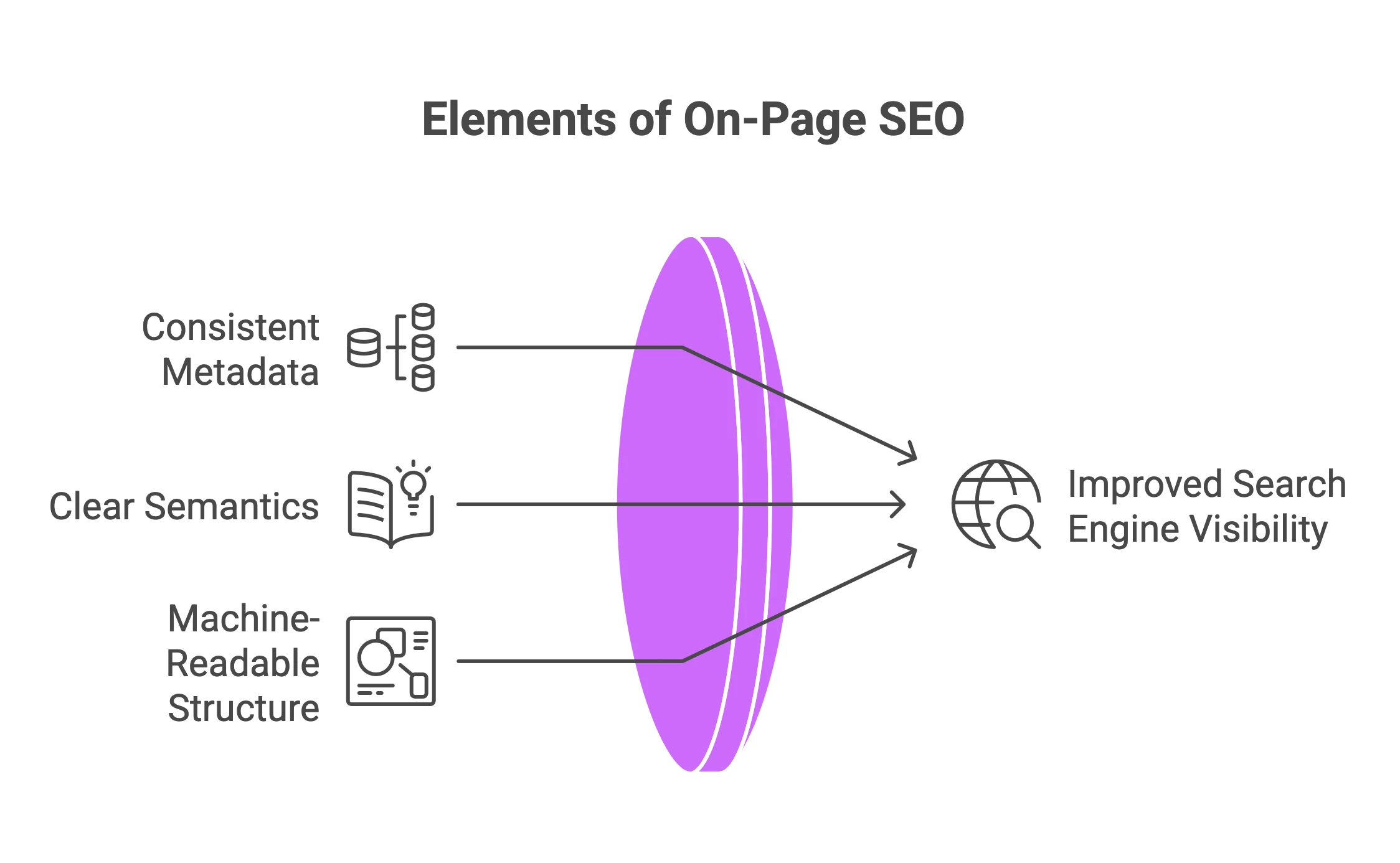
On-page SEO is not “writing fluff”. It is consistent metadata, clear semantics, and machine-readable structure.
Titles and descriptions: generate, then curate
You can automate 80% of metadata with templates, then hand-tune your money pages.
Good title formula for dev pages:
Primary intent + product type + differentiator
Examples:
“Webhook Testing Tool for Stripe and GitHub”
“Rust Rate Limiter Library (Token Bucket)”
Description formula:
- What it does, who it’s for, and the next step (install, try, read docs).
Avoid keyword stuffing. If it reads weird to you, it reads weird to users.
Semantic HTML that survives JS and CSS changes
A clean document outline does more than satisfy SEO checklists. It helps accessibility and prevents future regressions.
Minimum standards:
- One H1 per page.
- H2s that map to sections users expect.
- Real lists for steps.
- Real tables for comparisons.
If your component library makes headings optional, enforce them with lint rules for marketing routes.
Structured data: use it where it matches reality
Structured data is not decoration. Use it only when the page genuinely fits the schema type.
Common wins for SaaS and dev tools:
- Organization (site-wide)
- SoftwareApplication (product pages)
- Article (blog posts)
- FAQPage (only if the Q&A is actually on the page)
Example JSON-LD for a software tool page:
{ "@context": "https://schema.org", "@type": "SoftwareApplication", "name": "Your Dev Tool", "applicationCategory": "DeveloperApplication", "operatingSystem": "Web", "offers": { "@type": "Offer", "price": "0", "priceCurrency": "USD" } } Fix the “indexing but not ranking” mismatch
If Search Console shows a page indexed but it never moves:
- The page might not satisfy the query intent.
- The page might be too similar to another page (cannibalization).
- Internal links might be too weak (no authority flowing to it).
- The page might be slow and not competitive.
Engineers love this part because it is a debugging workflow, not a creative writing exercise.
Links and authority: developer-friendly backlink building
You do not need spam. You need credible mentions from places your audience already trusts.
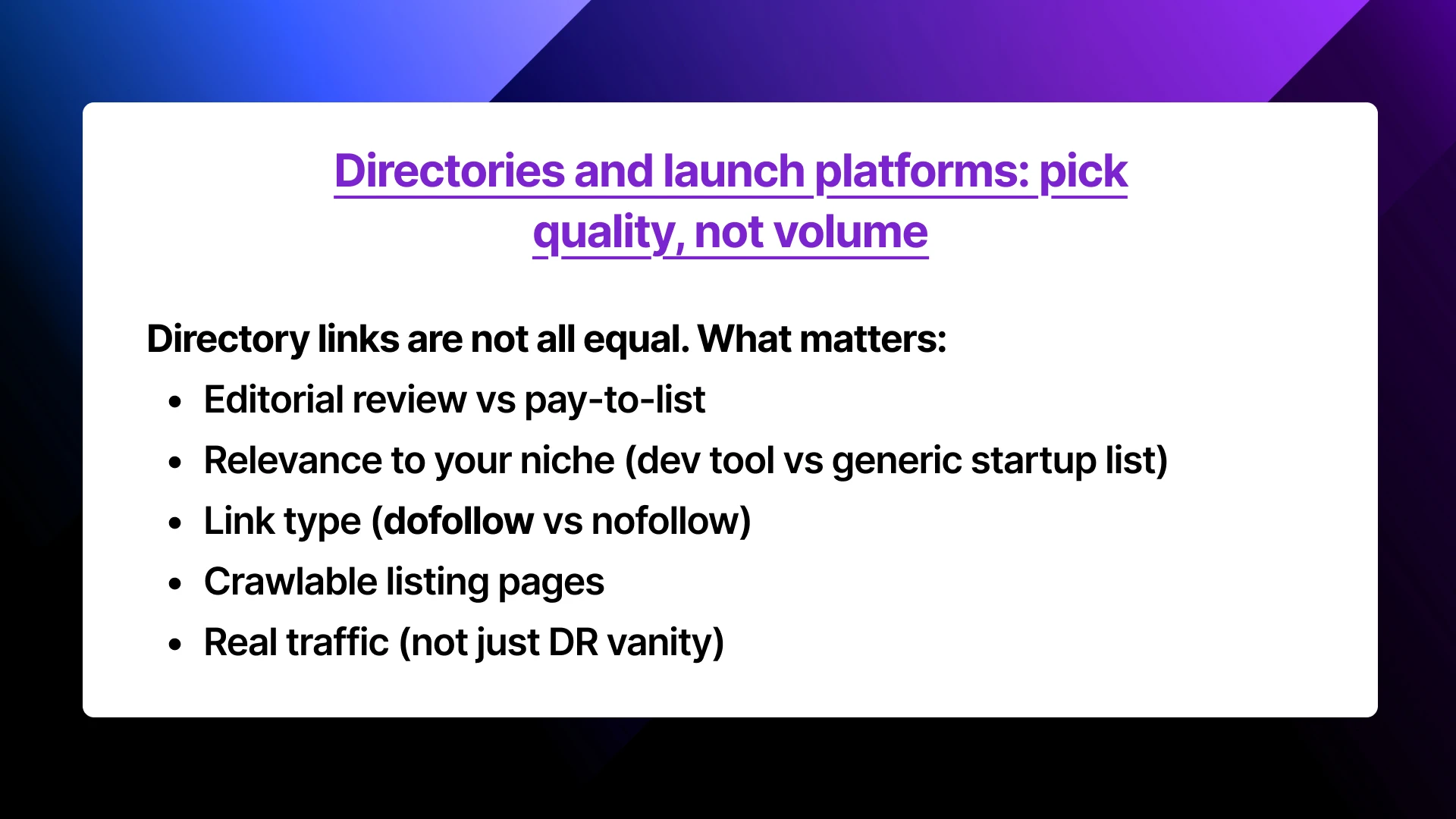
Launch Directories is built around this exact idea: a curated database of 100+ startup directories and launch platforms with DR, traffic, and link type data, so you can pick placements that fit your product.

Start with links that compound
Developer-friendly link sources:
- Open-source repos and ecosystem pages
- Integration partners (list your tool in their “partners” or “apps” page)
- Community directories and launch platforms
- Engineering write-ups that get referenced
- Templates, examples, and benchmarks others cite
A useful mindset: build one “linkable asset” per quarter. For dev tools, that can be:
- A CLI that solves a narrow problem
- A public benchmark page (with methodology)
- A compatibility matrix
- A migration guide that is better than the competitor’s docs
Manual submissions are also operationally expensive. In Launch Directories’ own case study, they call out that a single directory submission can take 15-30 minutes once you account for accounts, formatting, and follow-ups.
If you want to avoid spending a week doing submissions, Launch Directories offers a done-for-you directory submission service and niche-specific backlink packages (for example developer tools) that focus on consistent execution and reporting.
The “clean backlink profile” developers accidentally break
A healthy link profile is usually a mix:
- Home page links (brand mentions)
- Deep links (docs, integrations, comparisons)
- A mix of dofollow and nofollow
- Links from different site types (directories, blogs, communities)
The mistake is over-optimizing anchors or building links only to the home page. If you have great docs, link to them. That is what real mentions look like.
Practical application: a 14-day SEO sprint for developers
This is a sprint you can run without pausing product development. The goal is simple: ship technical fixes that unlock crawling, then create a small set of pages that deserve to rank.
Days 1-2: Crawl and index hygiene
- Run a crawl (Screaming Frog or similar) and export: 4xx, 5xx, redirect chains, duplicate titles.
- Fix top issues: real 404s, one-hop redirects, remove accidental noindex.
- Generate a clean sitemap containing only canonical 200 pages.
Days 3-5: Rendering and performance
- Identify your top 5 acquisition routes (home, pricing, key landing pages, docs hub).
- Ensure each renders meaningful HTML before hydration.
- Cut route weight: remove one heavy dependency, lazy-load non-critical components, compress hero assets.
Days 6-9: Architecture and internal links
- Create one hub page per theme (use cases, integrations, docs).
- Add contextual links from hubs to supporting pages.
- Add “related” modules on docs and blog posts (curated, not infinite).
Days 10-12: On-page automation
- Implement a title + description template per route type.
- Add Organization schema site-wide.
- Add SoftwareApplication schema to your product page (only if accurate).
Days 13-14: Authority and distribution
- List 20-30 realistic directory or launch placements that match your niche.
- Submit manually, or use a service if time is the constraint.
- Track backlinks and indexing changes in Search Console weekly.
You are done when: (1) your key pages are crawlable via HTML links, (2) your sitemap is clean, (3) performance is competitive, and (4) you have a predictable way to earn links.
Conclusion
SEO for developers is not a marketing side quest. It is engineering discipline applied to discovery and trust: crawlable links, clean canonicals, fast rendering, and pages that map to real developer intent. When those pieces are in place, content stops feeling like roulette and starts compounding.
If you want a faster path to authority, use a curated directory database to choose placements intelligently, or outsource submissions so you can keep shipping. That is how seo for developers turns into signups.
with 100+ Directory Listings
Skip the grind. We'll submit your product to top directories so you get real users, feedback, and lifetime backlinks without lifting a finger.
FAQ
How is SEO for developers different from regular SEO?
Developers control the parts that usually block growth: crawlable links, rendering strategy, performance budgets, canonicalization, and automation. Traditional SEO often starts with keywords and content. Developer SEO starts with “can Google reliably fetch, render, and understand this page?” then scales content through templates and routes.
Do I need server-side rendering for SEO?
Not always, but pages meant to rank should return meaningful HTML on the first response. SSG is ideal for docs and marketing pages. SSR works when you need freshness. Pure client-side rendering is risky for acquisition pages because content can be delayed or inconsistent for crawlers and users.
What are the fastest technical SEO wins for a new product?
Fix crawlability and duplication first: real internal links, a clean sitemap, correct status codes, and sane canonicals. Then improve speed on your top landing pages. These changes often unlock indexing and ranking faster than publishing more content with broken foundations.
How do developers build backlinks without spamming?
Build things worth citing: open-source utilities, benchmarks, templates, integration guides, and clear docs. Then distribute through credible ecosystems: directories and launch platforms in your niche, partner marketplaces, and community resources. Aim for a natural mix of home page and deep links.
Should I submit my SaaS to directories for SEO?
Yes, if you choose quality placements and keep your listings consistent. Directories can build early authority and referral traffic, especially when your domain is new. The key is relevance, editorial standards, and tracking which listings actually earn links and users over time.
Ready to build high-quality backlinks?
We'll submit your product to 100+ directories and build valuable backlinks for your SEO. Save hours of manual work so you can focus on what's important — selling and building, not submitting boring forms.