Most sites do not have a writing problem - they have a discovery problem: pages are hard to crawl, unclear about who they serve, and disconnected from places that create trust.
If you want to increase website traffic, focus on compounding loops: make your best pages easy to find, hard to ignore, and connected to sources of referral traffic and backlinks. The tactics below are built for founders and small teams who want predictable progress, not one-day spikes.
Increase Website Traffic With Visitors Who Convert
Increasing website traffic is not just about getting more sessions. It is about bringing more of the right people to the right pages from repeatable channels like search and referrals, then guiding them to a clear next step. The outcome you want is measurable movement in signups, demos, trials, or revenue. If traffic climbs but those actions do not, you are attracting attention, not demand.
Most traffic problems fall into one of three buckets:
- Demand capture: people are searching, but you are not visible or not clickable
- Demand creation: your category is new, so you need distribution and education
- Trust deficit: your page is relevant, but it is not “credible enough” to win
A quick channel map to pick the right lever:
| Channel | Best for | Time to impact | What to watch |
|---|---|---|---|
| Organic search | Compounding traffic on problems, comparisons, and alternatives | 4-12+ weeks | Impressions, clicks, top pages |
| Directories + launch platforms | Early discovery + foundational backlinks | 3-21 days | Referrals, indexation, referring domains |
| Partnerships | Access to a warmed audience | 1-6 weeks | Assisted conversions |
| Community + social | Testing positioning and earning attention | Same day to 4 weeks | Clicks and replies |
| Paid | Predictable volume when unit economics work | Same day | CAC and payback |

Set a baseline that prevents fake wins
Traffic grows in bursts and plateaus. A launch spike is fun, but it is not a system. Set a baseline so you can tell what is compounding.
Your minimal tracking stack
- Google Search Console: what queries show you, what gets clicked, what is not indexed
- Analytics (GA4 or similar): what visitors do after the click
- One simple sheet: landing page, traffic source, conversion rate, notes
The only three numbers to check weekly
- Search Console clicks (non-branded matters most early)
- Top landing pages by conversions (not by sessions)
- New referring domains and top referral sources
How to increase website traffic by removing technical friction
The fastest way to increase website traffic is often to stop leaking it. If Google cannot crawl and index your pages, content work turns into a writing hobby. Google’s crawling and indexing documentation is clear: make your content discoverable, renderable, and consistently accessible.
Focus on four bottlenecks that show up constantly on early-stage sites:
1) Indexing blockers
Common culprits:
- Noindex in templates
- Wrong canonicals
- Redirect chains after a migration
- JS rendering problems on key pages
Quick test: inspect your money page in Search Console and confirm it is indexable and crawled.
2) Orphan pages and weak internal links
If your blog posts do not link to your use cases or pricing, you are wasting authority:
- Add a “Use cases” section in the navigation
- Link every post to one relevant product page
- Build 2-3 hub pages that link to all related articles
3) Slow pages that kill conversions
Speed is not just a ranking conversation. It is a conversion conversation. Compress images, remove heavy third-party scripts from key pages, and keep the page stable on mobile.
4) Broken paths
404s on your demo, pricing, or docs pages quietly bleed trust and rankings. Set up 404 monitoring and a weekly “top 20 pages” check.
If time is tight, fix technical issues on pages that already have impressions. Those are closest to becoming traffic.
How to increase website traffic with pages that earn clicks
Rankings are not the finish line. Clicks are. Backlinko’s CTR research found the #1 result gets 27.6% of clicks, and the curve drops fast as you move down. Small improvements near the top can beat publishing ten new posts.
Start from the SERP, not from a keyword list
Open the results and ask: what job is the searcher hiring this page to do?
Most SaaS searches fall into four intents:
- Problem: “how to fix X”
- Category: “best [category] software”
- Comparison: “[competitor] alternative” and “X vs Y”
- Action: “pricing,” “template,” “calculator,” “API”

Make your snippet hard to ignore
Pages stall on page 1 because the snippet is weak.
A practical upgrade checklist:
- Put the outcome in the title (not the feature)
- Add “who it is for” in the first 2 lines
- Use a short list near the top (easy to scan)
- Add FAQs that answer obvious follow-ups
Lead with proof, not adjectives
Proof that works:
- One specific result or metric (even small, but real)
- Screenshots that show the product in action
- A short workflow example (“here is how a team uses it”)
Turn your site into a traffic router
The easiest traffic to waste is the traffic you already have. Your site should route each visit to a next step that matches intent.
1) Create destination pages
Most sites stop at “Home, Features, Pricing, Blog.” Add pages that match how people search:
- Use case pages (by role or situation)
- Alternatives and comparisons (honest ones win)
- Integration pages once you have real partners
2) Build one topic cluster that ties to revenue
Pick one core topic. Build:
- 1 hub page
- 5-8 supporting articles
- 2-3 comparisons once you have credibility
This gives Google a clear map of what you own, and gives visitors a clear path through your site.
3) Replace generic CTAs
Instead of “Get started,” try:
- “See how it works for [use case]”
- “Compare us to [competitor]”
- “View pricing for teams like yours”
When routing improves, traffic and conversion lift together.
Borrow other people’s audiences without begging
Early-stage traffic is often a distribution problem. You need places where your buyers already browse, not just more posts.
A healthy mix:
- 3-5 launch platforms for spikes and feedback
- 10-15 niche directories with real indexing
- 2 communities where you can contribute weekly
- 5 partner targets where your tool fits their workflow
Launch Directories is built around that workflow. Its Searchable Directory Database covers 100+ startup directories and launch platforms, with DR (Domain Rating), traffic estimates, and dofollow vs nofollow link types so you can prioritize faster.
Backlinks that increase website traffic without looking spammy
Backlinks are a ranking lever and a discovery lever. The best links do three things: pass trust, send referral traffic, and connect your product to a category.
Use these three link typesfirst:
1) Foundational links
High-quality directories and marketplaces help new domains get crawled and trusted.
A realistic first month for a new or low-authority site:
- 10-20 relevant referring domains
- 10-30 directory or launch listings approved
- 1-3 editorial mentions (resource pages, community roundups)
2) Editorial links from usefulness
One underrated link magnet for founders: build a small niche directory in your space (tools, templates, providers). If it is genuinely useful, people cite it naturally. A boilerplate like Dirstarter can help you ship the first version fast, then you earn links while you iterate.
Earned links also come from assets people reference:
- Original data (small is fine if it is real)
- A free tool or calculator
- A benchmark or teardown
- A fair comparison page
3) Product-led links via integrations
Integrations create natural reasons to link: partner pages, integration directories, joint announcements.

Practical application: a 14-day traffic sprint
Day 1: Set your baseline. Verify Search Console, submit your sitemap, and record clicks, impressions, and your top 10 landing pages.
Day 2-3: Remove technical blockers. Fix noindex mistakes, broken canonicals, and 404s on important pages. Add internal links from your homepage and top posts to your top 2 conversion pages.
Day 4-6: Upgrade pages that already have impressions. Pick 3 pages sitting in positions 4-20 and improve them:
- Rewrite the first 200 words to match intent and add a clear definition
- Add a short list and 2-3 subheadings that mirror what searchers ask
- Add proof: screenshots, numbers, a mini-case
Day 7-9: Ship one destination page. Create a use case or comparison page you can confidently send people to, and link to it from your navigation.
Day 10-12: Run distribution in parallel. Submit to 5-10 quality directories or launch platforms, and share the destination page in 2 communities where you can answer questions, not just drop a link.
Day 13-14: Publish one linkable asset. A checklist, template, or small tool is enough. Pitch it to 5 people who maintain resource pages or newsletters in your niche. If you are unsure what counts as “safe” link building in your industry, a one-off SEO backlink strategy consulting session with a specialist can save you from expensive detours.
This sprint is successful if you see faster indexing, more impressions on upgraded pages, and at least one referral source sending engaged visitors. Repeat monthly and your traffic stops depending on launch days.
Conclusion
To increase website traffic, build a system that compounds: remove discovery friction, publish a small set of pages that earn clicks, and stack trust signals that make your site easier to recommend. Start where you are closest to wins: pages already getting impressions. Improve their snippet, add proof, and route visitors to clear destination pages like use cases, comparisons, and pricing.
Then add a steady layer of distribution. A handful of reputable directory listings, partner mentions, and linkable assets will beat a once-a-year “launch day.” If you want to accelerate the directory part, a curated directory database and a done-for-you submission service can save days of research and form-filling.

FAQ
How can I increase website traffic fast?
Fix indexing and internal linking first so search engines can find your best pages. Then upgrade pages that already have impressions by improving the title, the opening, and the snippet structure. Finally, run a short burst of distribution through a few quality directories and communities.
What is the best way to increase website traffic for a new website?
For a new site, focus on technical basics (indexable pages, clean structure), one tight topic cluster tied to revenue, and foundational backlinks from reputable directories and marketplaces. New domains rarely win on volume. They win by being specific, consistent, and easy to crawl.
Do directory listings really increase website traffic?
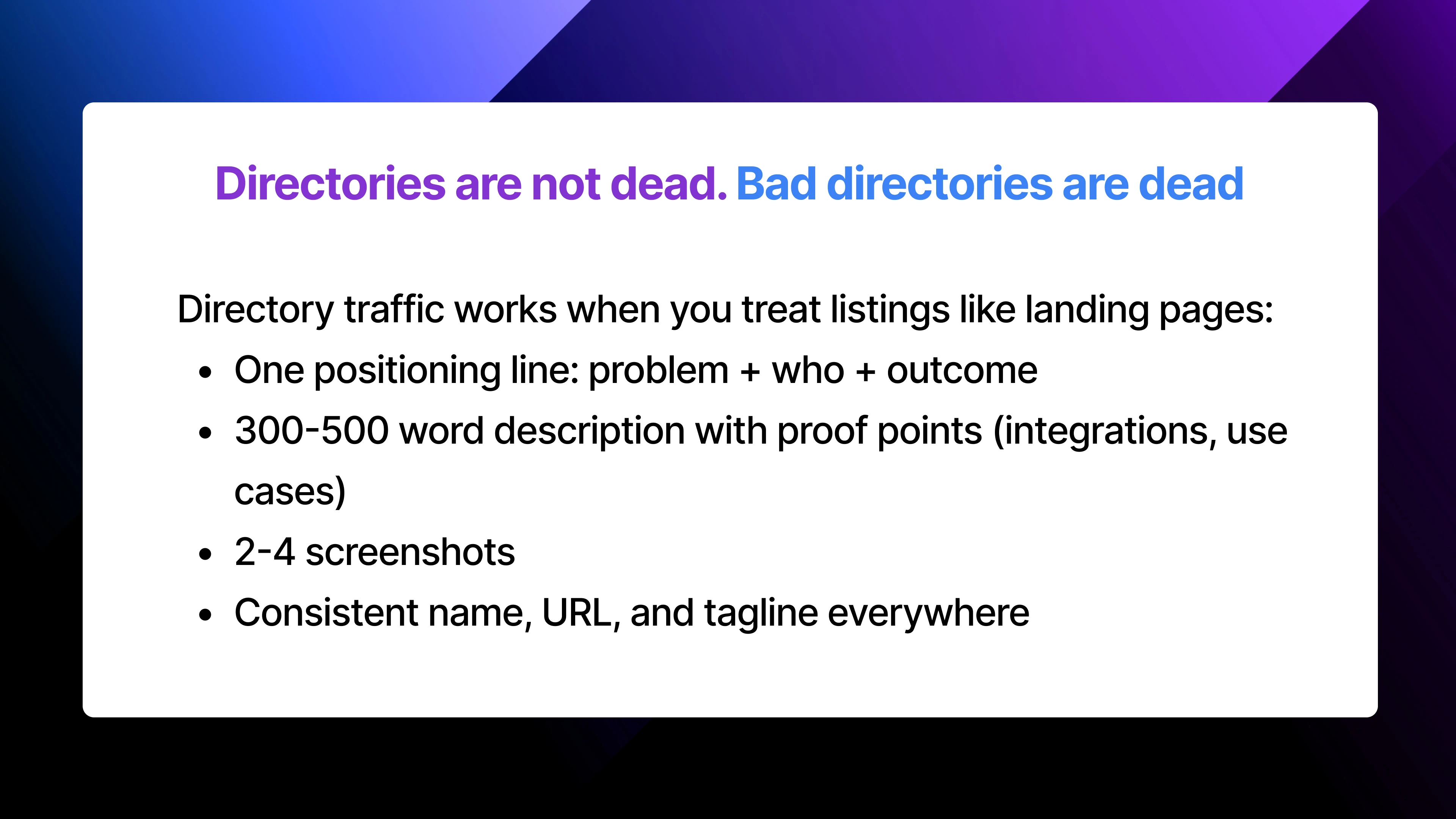
Yes, when the directories are reputable and your listing is complete. Referral traffic can be modest, but listings speed up crawling, add trust signals, and send high-intent visitors who are already browsing for solutions. Treat each listing like a mini-landing page and keep details consistent.
How long does it take to see results from SEO?
You often see early movement in 2-6 weeks after fixing indexing issues and improving pages already getting impressions. Competitive queries take longer because authority compounds over months. The fastest wins usually come from pages ranking on page 1-2 that need better structure and proof.
Ready to build high-quality backlinks?
We'll submit your product to 100+ directories and build valuable backlinks for your SEO. Save hours of manual work so you can focus on what's important — selling and building, not submitting boring forms.