Dofollow links are specific HTML attributes instructing search engine crawlers to pass PageRank and 'link juice' from the linking domain to your site, directly boosting your website's authority, organic search rankings, and overall SEO performance by signaling trust and relevance.
Key Characteristics:
Primary Goal: Pass link equity (PageRank) to the linked page.
Search Engine Interpretation: Viewed as a vote of confidence from one site to another.
Direct Impact: Essential for improving organic search rankings and Domain Rating (DR).
Technical Default: Standard links are dofollow unless explicitly marked as
nofollow,ugc, orsponsored.
You hear endless chatter about backlinks, but the real challenge for founders isn't just getting links; it's acquiring high-quality dofollow links that truly move the needle without resorting to spammy tactics like manipulative guest posting. Most "link building" advice either feels risky or delivers minimal impact.
By the end of this guide, you will master effective, white-hat link building strategies, confidently earning authoritative dofollow links naturally, without ever engaging in outdated, low-value guest posting schemes.
Understanding Dofollow vs Nofollow Links

Dofollow and nofollow links are fundamental technical attributes that dictate how search engines like Google interpret the relationship and authority transfer between linked pages. You need to understand these distinctions because they directly impact how much search engine authority your site gains from backlinks.
A dofollow link is the standard hyperlink type. It actively passes "link equity" or ranking power from the linking site to your page. Think of it as a direct, explicit endorsement.
This link equity helps improve your page's authority and visibility in search results. Acquiring these is crucial for SEO.
Conversely, a nofollow link includes a rel="nofollow" attribute, signaling to search engines not to endorse the target page or pass link equity. Search engines generally don't crawl these links or factor them into ranking calculations in the same way.
This attribute was initially introduced by Google in 2005 to combat comment spam and manipulate search rankings.
But, Google updated its stance in 2019, stating that nofollow attributes are now treated as "hints" rather than strict directives. This means they might still be crawled or contribute some indirect value. Around the same time, Google also introduced rel="sponsored" for paid placements and rel="ugc" for user-generated content (like forum comments), providing more granular classification for link types.
Here's a quick breakdown of their core differences:
Feature | Dofollow Link | Nofollow Link ( |
|---|---|---|
Link Equity | Passes link equity and ranking signals. | Generally does not pass link equity (it's a hint). |
SEO Impact | Direct positive impact on rankings and authority. | Minimal to indirect SEO impact. |
Purpose | Endorsement, content relevance, authority transfer. | Prevent spam, avoid unintended endorsements. |
Attributes | Standard hyperlink (no special |
|
Understanding this distinction is the first step towards building an effective, ethical link strategy that genuinely enhances your site's standing with search engines.
Why Organic Link Building is Essential
Organic link building is the bedrock of sustainable SEO, providing a natural, lasting boost to your search engine rankings and brand authority. It directly counters the short-term, often risky, gains of transactional link schemes or low-quality guest posting.
When other high-authority sites genuinely link to your content because it offers unique value, Google sees a powerful signal of trust. These dofollow links act as authentic endorsements. They tell search engines your site is a credible source in its niche.
We advocate for organic link building because it focuses on earning links, not just acquiring them. This means creating exceptional content that naturally attracts attention. Think research, unique data, or problem-solving guides.
This approach builds enduring brand authority. It isn't about gaming the system; it's about becoming a recognized expert.
Consider the alternatives:
Paid placements often violate Google's guidelines, leading to penalties.
Low-quality guest posting might yield links, but from irrelevant or spammy domains. These links offer little to no SEO value. In fact, they can harm your site's reputation.
True organic link building emphasizes real relationships and shared value. This leads to high-quality backlinks from relevant, reputable websites. It builds trust not just with search engines, but with your actual audience.
Focusing on these organic link building tips helps you sidestep the constant algorithm updates designed to penalize manipulative tactics. It's a proactive defense for your site's long-term health. Because, fundamentally, it delivers what search engines want: genuinely helpful, authoritative content for their users.
Modern Search and AI Visibility for Backlinks
Consistent brand mentions and high-quality dofollow links directly fuel your LLM visibility and strengthen brand reputation across modern AI-powered search environments. AI search engines like ChatGPT, Gemini, or Perplexity now significantly influence discoverability, often synthesizing information from across the web.
These advanced systems don't just follow links; they build intricate knowledge graphs around entities. Your brand becomes a recognized entity when consistently mentioned by authoritative sources. This is where organic, dofollow backlinks become critical.
Each time a reputable site links to your content using your brand name, it’s a powerful signal. It confirms to AI that your brand is an established authority within its niche. This contributes to a robust digital footprint that AI models can easily parse.
AI search engines prioritize content from brands they deem trustworthy and frequently cited. We've seen this directly in how Perplexity or Gemini pull specific snippets and summaries. They favor content backed by a strong web of natural mentions and links.
Building a consistent, positive brand reputation through organic backlinks ensures AI models confidently surface your solutions. It's about establishing undeniable entity authority. This translates into your content appearing in AI-generated answers, summaries, and recommendations.
You should consider leveraging brand monitoring tools to track these crucial mentions and links. This helps you understand how your brand is perceived and referenced across the internet, providing insights into your AI search engine footprint. It allows us to identify where your brand holds the most weight.
Broken Link Building: An Untapped Opportunity
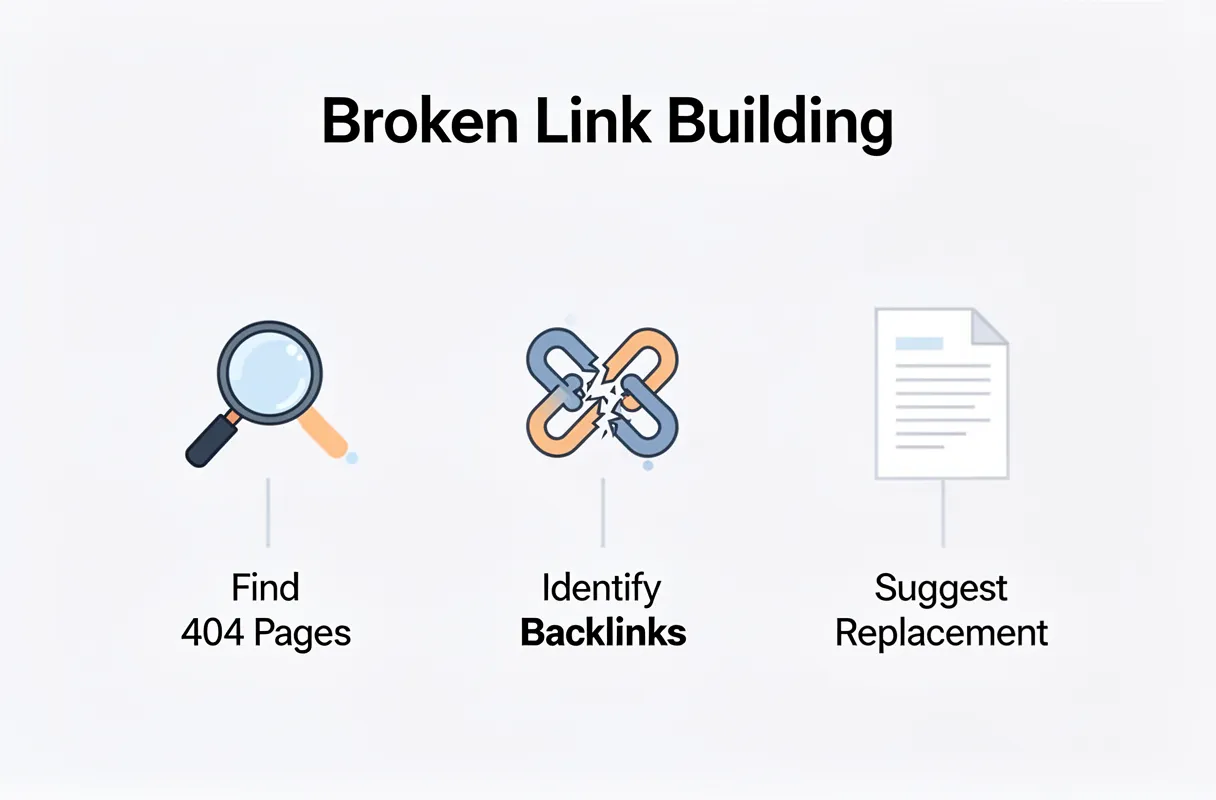
Broken link building, often called dead link building, identifies existing 404 pages on other websites that still attract backlinks, then suggests your own relevant, working content as a replacement. This strategy is a highly effective way to acquire high-quality dofollow links, improving your own site's authority and search ranking. You are not just asking for a link; you are providing a solution to a genuine problem for the linking site's audience.
This method thrives on reciprocal value. A website owner wants their visitors to have a good experience, which means no dead ends or 404 pages. When you point out a broken link and offer superior, up-to-date content as a fix, you deliver a real service. This makes outreach far more successful than cold requests.
The process involves a few key steps:
Pinpoint Dead Pages: You need to find websites in your niche or competitor sites with broken pages. These are pages that return a 404 error when clicked.
Verify Existing Backlinks: Not all 404s are valuable. The goal is to find broken pages that still have backlinks pointing to them from other reputable sources. (This indicates strong past authority).
Craft Superior Content: Develop content on your own site that directly replaces or significantly improves upon the original broken page's topic. This content must be genuinely valuable and relevant.
Initiate Helpful Outreach: Contact the website owner or editor who is linking to the dead page. Politely inform them of the broken link and offer your new, high-quality content as a seamless replacement. You can learn more about perfecting this outreach method by reviewing comprehensive guides on broken link building strategy.
Track and Follow Up: Monitor your outreach and follow up courteously if you don't receive an initial response. Persistence often pays off.
You are acting as a helpful digital samaritan, not just a link-seeker. This builds goodwill and positions your brand as an industry expert. When done correctly, broken link building delivers highly relevant backlinks that pass significant authority to your domain, signaling to search engines like Google and new AI LLMs that your content is a trusted source.
Finding Broken Link Opportunities
Finding broken link opportunities starts with actively auditing high-authority websites within your niche and those of direct competitors for pages that return a 404 error. This strategic audit focuses on recovering lost link equity from sites already trusted by search engines.
Your niche research should pinpoint influential industry blogs, resource aggregators, and established competitor sites. These authoritative domains, accumulated over years, often develop dead links over time. You are essentially looking for digital decay.
Manually scan individual pages for broken internal or external links. A quick browser extension can help identify immediate "dead end" signals on a single URL, highlighting potential issues fast.
Focus on pages that were likely to attract backlinks in the first place. Think old news articles, archived resource lists, outdated software reviews, or comprehensive guides that haven't been maintained. These are prime candidates.
These forgotten pages represent existing authority that can be redirected. You are looking for where link equity is literally leaking from an authoritative source.
Always prioritize broken links where your content offers a direct, superior, and relevant replacement. This relevance is crucial for successful outreach and establishing your expertise (and it just makes sense).
Tools for Identifying Dead Links
Identifying dead links, often called 404s, requires more than just manual clicks; you need specialized tools to scale your broken link building efforts. While a basic browser extension offers a quick scan, serious outreach demands more comprehensive website crawlers.
The Check My Links Chrome Extension is a solid starting point for a quick audit of a single webpage. It rapidly scans for broken internal and external links, highlighting them so you can see potential opportunities immediately. It's fast, but limited to one page at a time.
For deeper analysis across an entire domain, you need dedicated broken link checker tools or full-fledged website crawlers. These tools automate the process, discovering dead links that manual checks would miss.
Here are the essential tools we recommend for efficiently finding dead links:
Ahrefs Site Explorer: Our go-to for identifying broken outbound links from competitor sites or niche authorities.
Navigate to "Broken Backlinks" within a target domain's profile.
You'll see a list of pages linking to 404s, along with their Domain Rating (DR).
This provides context, showing which sites link out to expired content. It's a huge time-saver.
Semrush Site Audit: This tool crawls your specified website, reporting on all technical SEO issues, including broken internal and external links.
It identifies server response codes like 404 (Not Found) or 410 (Gone).
The audit categorizes errors, allowing you to prioritize which broken links to pursue.
But remember, it's primarily for on-site broken links; you'll need its "Backlink Analytics" for external opportunities.
Screaming Frog SEO Spider: A desktop-based website crawler that performs a thorough technical audit.
You can set it to crawl any site and identify broken links by filtering for client errors (4xx).
It's highly customizable, letting you export detailed reports for analysis.
This tool is incredibly powerful for identifying a site's internal broken links. However, it takes more expertise to set up and configure effectively.
Dr. Link Check: This web-based service specifically focuses on broken link identification, offering a streamlined process without the full SEO suite of Ahrefs or Semrush.
It crawls a specified website, checking both internal and external links.
Reports highlight the exact location of broken links, simplifying the fix.
Good for quick, standalone link audits, but lacks comprehensive backlink data.
Using these tools, you move past guesswork and directly identify specific 404 errors with existing link equity. Your goal is to find targets where the broken link is relevant to content you already have.
The next step after identifying these dead links is to verify the opportunity. Because not every broken link is worth pursuing.
Crafting Effective Broken Link Outreach Emails
Crafting effective broken link outreach emails requires a strategic blend of personalization, clarity, and a genuine offer of help. Your goal isn't to demand a backlink, but to gently point out a problem and present your content as an ideal solution.
These emails are your direct line to website owners, so they must be concise and immediately convey value. You want them to open, read, and act.
The Anatomy of an Effective Outreach Email
Every successful broken link outreach email follows a clear, logical structure. You need to quickly establish rapport and make your proposition clear without being pushy.
Subject Line: This is your open rate's gatekeeper. Make it specific, benefit-oriented, or a direct offer of help. Avoid anything generic or salesy.
Introduction: Introduce yourself briefly, mention you were browsing their site, and get straight to the point about the broken link.
The Broken Link: Clearly state the URL with the 404 error and the page it was found on. Explain why it's problematic (e.g., user experience, SEO equity).
Your Solution: Offer your relevant content as a high-quality replacement. Explain briefly why your content is a good fit.
Low-Friction Ask: Make it incredibly easy for them to update the link.
Professional Closing: Thank them for their time.
Subject Lines That Get Opened
Your subject line must pique curiosity or signal immediate value. Think of what would make you open an email from someone you don't know.
"Broken Link on Your Page (Quick Fix)"
"Heads Up: Dead Link Found on [Page Title]"
"Suggestion for Your Resource Page (Broken Link)"
"Quick Note About [Website Name] – Broken Link Alert"
These are direct. They don't try to trick anyone.
Personalization: Beyond Just a Name
Personalization is non-negotiable for link reclamation success. Don't just swap out [Name]; show you've actually visited their site.
Mention a specific piece of their content you enjoyed (not the broken one). Referencing their brand's mission or a recent article builds immediate trust. This shows you're not just running a script.
Presenting Your Content as the Solution
When you suggest your content, frame it as a helpful resource for their audience, not just a link for you. Highlight a specific benefit.
"I noticed a broken link on your 'Essential SaaS Tools' article. The link to
[Broken URL]returns a 404. We recently published an article, '10 Must-Have SaaS Productivity Hacks for Founders,' that covers similar ground but with updated examples and a focus on AI integrations. It might be a great fit for your readers."
This positions your content as a valuable, timely update.
The Low-Friction Ask
You need to make the next step effortless. Don't ask them to create new content or conduct research. Offer them a direct link to your suggested replacement.
"If you find it useful, perhaps consider swapping the broken link with our updated resource:
[Your URL]. No pressure at all, just a friendly suggestion."
You want to minimize the mental effort required on their end. A simple copy-paste should be the goal.
Remember, the best outreach email templates are simply frameworks. You must infuse each one with genuine personalization and a helpful, non-demanding tone. Your goal is to be a resource, not a burden.
Turning Unlinked Brand Mentions into Dofollow Links
Turning unlinked brand mentions into dofollow links is a direct, high-ROI link reclamation strategy. It means finding instances where your brand, products, or content appear online without a hyperlink back to your site, then requesting the publisher add one.
This isn't just about SEO signals. Consistent brand mentions across credible sources are increasingly vital for LLM visibility in 2026, influencing how frequently your brand appears in AI-generated answers, recommendations, and search results. It signals authority.
Here's how you turn those mentions into powerful backlinks:
Spotting the Opportunity (Briefly): Your first move is to identify these unlinked brand mentions. This requires consistent brand monitoring, often using specialized tools. (More on identifying with precision in the next section.)
Qualify and Prioritize: Not every mention is worth pursuing. Prioritize mentions on high-authority, relevant sites with strong domain ratings (DR). Focus on articles where a link adds genuine value to the reader. Don't chase every blog comment.
Craft a Value-Driven Ask: Your outreach isn't about you; it's about them. Frame your request as an improvement for their audience. Explain how adding a link makes their content more helpful, accurate, or complete.
Find the Right Contact: Avoid generic info@ emails. Use tools like Hunter.io or LinkedIn Sales Navigator to find the article's author, editor, or marketing manager. A direct email cuts through noise.
Send a Concise Email: Your initial message should be polite, direct, and brief. Mention the specific page, highlight the unlinked mention, and suggest where a dofollow link would naturally fit. (We'll cover outreach specifics soon.)
Follow Up Tactfully: Many initial emails go unread. Send a single, polite follow-up within 5-7 business days. If no response, move on. Persistence is key, but so is respecting people's time.
Your ultimate goal is to build genuine relationships. Each successful link reclamation isn't just a backlink; it's a small win for your brand's reputation and its discoverability within the modern AI search ecosystem.
Identifying Your Unlinked Mentions with Precision
Identifying unlinked brand mentions requires a systematic approach, combining robust brand mention tools with targeted manual methods. This precision ensures you don't miss opportunities to gain valuable backlinks, which are crucial for both SEO performance and your brand's LLM visibility in 2026.
Modern brand monitoring tools are indispensable for tracking your brand across the entire internet. They help manage your reputation, spot marketing opportunities, and directly improve how often your brand appears in AI-generated answers and recommendations. Some advanced platforms even track mentions within specific AI search environments.
Leveraging Dedicated Brand Monitoring Tools
You can't rely on luck. A dedicated media monitoring service or an SEO suite feature provides real-time alerts.
Google Alerts: A free, foundational tool. Set up alerts for your brand name, product names, key personnel, and even common misspellings. (It's not perfect, but it's a starting point.)
Mention: This tool tracks mentions across social media, blogs, news sites, and forums. It's particularly strong for real-time monitoring and competitive analysis.
Awario: Similar to Mention, Awario scans web and social sources, offering sentiment analysis and reach metrics for each mention. It also helps identify influencers discussing your niche.
SEMrush Brand Monitoring/Ahrefs Content Explorer: These powerful SEO suites include features specifically designed to find unlinked mentions. They scan massive databases of content and let you filter results to identify exact phrases without corresponding hyperlinks. We often find hundreds of potential backlinks for clients using these tools. (Our platform helps streamline the outreach process once identified.)
These tools go beyond simple keyword tracking. They understand context, filtering out irrelevant noise to present actual discussions about your brand. This saves immense manual effort.
Strategic Manual Searches for Deeper Insights
While tools automate much of the grunt work, manual searches provide an extra layer of precision, catching mentions automation might miss. This is especially true for niche forums or newer platforms.
Google Search Operators: Use specific queries like
"Your Brand Name" -site:yourdomain.com -link:yourdomain.comto find mentions on other sites that don't already link to you. You can also addintext:"Your Brand Name"for more precise results.Social Media Listening: Beyond dedicated tools, manually checking platforms like LinkedIn, Reddit, and industry-specific Slack communities can reveal conversations. Many high-value mentions start in these closed groups.
Image Searches: A reverse image search on your product images or logos can reveal unauthorized use or uncredited mentions. Tools like Google Images or TinEye are effective here.
Podcast Transcripts & YouTube Captions: Many brands are mentioned verbally in audio or video content without a corresponding text link. Services that transcribe multimedia can help you find these mentions.
Remember, the goal isn't just volume; it's about identifying high-quality, relevant mentions where a dofollow link would naturally fit. (We'll cover outreach specifics soon.)
Crafting Your Outreach for Unlinked Mentions
Converting unlinked brand mentions into dofollow links relies on strategic, respectful outreach. You need to present a clear benefit to the publisher, not just ask for a favor.
The Anatomy of an Effective Outreach Email
Crafting your message requires precision. Every email should feel personal and valuable, minimizing the effort required from the recipient.
Identify the Unlinked Mention: Pinpoint the exact URL where your brand is mentioned without a link. (This is where your monitoring efforts pay off.)
Research the Contact: Find the right person – typically an editor, content manager, or author of the article. Generic "info@" emails rarely get responses.
Personalized Subject Line: Make it specific and intriguing. Avoid generic lines like "Link Request."
Good: "Quick question about your article on [Topic] – [Your Brand Name] mention"
Better: "[Their Article Title] – Loved your point on [Specific Detail]"
Value-Driven Opening: Start by genuinely complimenting their content. Show you’ve actually read it. Then, clearly state why you’re reaching out, referencing the specific mention.
"I recently read your excellent article, '[Article Title],' and particularly appreciated your insights on [specific point]. We were thrilled to see [Your Brand Name] mentioned in the section about [topic of mention]."
The Gentle Ask: Don't demand. Suggest how adding a link benefits their readers. Frame it as providing more value or additional context.
"To provide even more context for your readers, would you consider adding a link to our [relevant page/resource] where you mentioned us? It's a [brief description of value, e.g., in-depth guide, latest report]."
Keep the ask brief and direct.
Make It Easy: Include the exact URL of their article and the proposed link to your site. This cuts down on their work.
"Your article: [Their URL]"
"Our suggested link: [Your URL]"
Professional Closing: Thank them for their time. A simple, polite closing works best.
Building genuine relationship building is the core here. You're not spamming; you're connecting content.
Outreach Best Practices
Your goal is to be helpful and non-intrusive.
Be Concise: Editors are busy. Get to the point quickly. (This means no more than five sentences per paragraph.)
Highlight Value: Always emphasize what's in it for their audience, not just your SEO. Will your link provide more information, a useful tool, or deeper analysis?
Polite Follow-Up: Send one polite follow-up email about a week later if you don't hear back. A second follow-up is generally the limit; anything more can seem pushy.
Test and Iterate: Monitor your open and response rates. Adjust your subject lines and email copy based on what works. We often see that personalized emails get triple the response rate compared to generic templates.
Don't Over-Automate: While tools can streamline finding contacts, the email itself must sound human. A generic email instantly signals "bot," and those get deleted.
This isn't just about scoring a link; it's about forging connections within your industry. Focus on the human interaction. Next, we'll look at finding strategic resource pages, which require a similar, value-first mindset.
Strategic Resource Page Link Building
Strategic resource page link building focuses on getting your exceptional content listed on curated collections of industry-specific resources. It's a method we use for clients to acquire predictable, high-authority dofollow links.
This approach isn't about spamming; it's about adding genuine value to existing resource hubs. You find sites already linking to relevant content and offer them something even better. We find this strategy consistently yields high-quality niche resources without the guesswork of other methods.
Success hinges on two key components:
Identifying relevant pages: These are often "best resources," "useful links," or "recommended tools" sections on established websites.
Having a strong linkable asset: Your content needs to be truly comprehensive, unique, or more up-to-date than what's already listed.
We advise founders to think of their best guides, tools, or research pieces as potential linkable assets. Does your article on SaaS churn reduction strategies offer unique insights? Is your free SEO checklist for startups more detailed than others?
The goal is to provide a piece that enhances the resource page for its own audience. This means the resource page links you secure will naturally be relevant and impactful. It creates a win-win scenario, which is crucial for sustainable SEO.
This strategy builds directly on the human-centric approach we discussed previously. You're offering something valuable, not just asking for a link. Next, we'll dive into the specifics of how to find these crucial resource pages.
Finding Relevant Resource Pages
Finding valuable resource pages for backlinks begins with targeted search queries and strategic competitor analysis. You need to identify pages that genuinely curate high-quality content for their audience, not just generic link lists.
Start with specific Google search operators to uncover these curated lists. These operators help you narrow down millions of results to just the pages looking for resources.
Using Advanced Search Operators
Google's advanced search operators are your secret weapon here. They cut through the noise, showing you exactly what other sites consider valuable. You're looking for pages dedicated to listing "best resources" or "recommended links" within your niche.
Here are the essential search operators you'll use:
intitle:"resources" [your niche]: This finds pages with "resources" in their title, explicitly focused on a collection. Try "intitle:resources SaaS tools" for example.inurl:links [your niche]: This targets pages where "links" appears directly in the URL structure. It often indicates a curated list."best [your niche] websites": Quote marks ensure an exact phrase match. This helps discover curated lists of top sites in your industry."[your niche] recommended reading": Many blogs or industry sites compile reading lists. These are prime targets.inurl:blog intitle:links [your niche]: Combine operators to find resource pages specifically within blog sections. This often indicates more recently updated lists.site:[competitor.com] intext:"resources": Look for resource pages on a competitor's site that they link to. This reveals their link strategy.
You can combine these. For instance, intitle:"resource page" "AI marketing tools" will show pages titled "resource page" that discuss AI marketing tools.
Leveraging Competitor Analysis
Your competitors' backlink profiles are a treasure trove. They’ve already done some of the legwork. You should analyze where your top-ranking competitors are getting their links.
Use tools like Ahrefs, SEMrush, or Moz. Look for domains that link to multiple competitors on the same page. Those are almost certainly resource pages. They list several related sites.
Filter by "dofollow" links, of course. (Focusing on resource pages means looking for quality endorsements.) But remember, it's not just about stealing their links; it's about finding patterns. What kinds of resource pages value your competitors' content?
Identifying these high-value resource pages is only the first step. The real work begins with a tailored, compelling pitch that makes your content indispensable.
Pitching Your Content for Resource Pages
A tailored pitch that makes your content indispensable clearly articulates its unique value proposition for the resource page owner's specific audience. Your goal isn't just to get a link; it’s to offer genuinely valuable content that enhances their existing resources.
Before any content pitching, thoroughly review the target resource page. Understand its current offerings and identify any gaps your content could fill. Look for outdated information or topics they haven't covered yet (even if it's a slight angle shift).
Your pitch email must be concise and personalized. Do not use a generic template. Reference specific articles on their site, showing you've actually read it.
Here’s how to structure an effective pitch:
Craft a Clear Subject Line: Get straight to the point. Something like "Content Suggestion for Your [Specific Page Name] Resource" or "Valuable Addition: [Your Article Title] for [Their Niche] Page."
Personalize the Greeting: Address the site owner by name. (A quick LinkedIn search often helps if the name isn't obvious).
Establish Context Briefly: Explain how you found their resource page and why you appreciate it. This shows genuine interest.
Highlight the Value Proposition: This is where you explain why your content is a perfect fit. Emphasize its comprehensiveness, up-to-dateness, or unique angle.
"I noticed your page on [Topic] and thought our article, '[Your Article Title],' could be a valuable, more in-depth resource on [Specific Subtopic]."
"Our guide includes 2026 data on [relevant metric], which could keep your readers fully informed."
Provide a Direct Link: Make it easy for them to click and review your content immediately.
Keep it Brief and Respectful: Busy site owners appreciate brevity. A pitch should be no more than five sentences after the intro.
Simple Call to Action: "Let me know if you think it's a good fit." Avoid pushy language.
Focus on how your content genuinely helps their audience, not just how it benefits you. That's how you make your content an undeniable asset.
Next, you need to be prepared to follow up without being annoying.
Building Authority Through Directory Submissions
Directory submissions, when done strategically, still secure valuable dofollow backlinks that boost your site's authority and search ranking. This strategy isn't about quantity. It focuses on finding highly relevant, high-authority platforms.
You must prioritize industry directories that directly relate to your niche. General web directories offer minimal SEO value. Your target is specialized lists where your business genuinely fits.
For example, many founders still consider the Better Business Bureau (BBB) for SEO. However, links from the BBB are now nofollowed. According to statements from Google's John Mueller, being listed on the BBB does not directly contribute to your search engine optimization efforts.
This means you are paying primarily for brand trust, not link equity. A BBB listing's price varies significantly by region and employee count, ranging approximately from $370 to $865+ annually. These are funds better allocated to sources offering direct SEO benefits.
Focus on directories specifically known for providing dofollow links and those deeply embedded in your professional field. These might be professional association registries, niche-specific resource hubs, or powerful local business listings that contribute to local SEO. A truly relevant directory signals clear topical authority to search engines.
You should always verify the linking policy before investing time or money. And ensure the directory's audience aligns with yours.
Identifying Valuable Directories for Your Niche
Finding valuable directories for your niche means targeting platforms that genuinely serve your industry or profession and offer dofollow backlinks. These aren't generic lists; they are highly specific to your field, attracting a relevant audience and signaling clear authority to search engines.
You identify them by starting with targeted research. Think beyond broad searches and focus on terms your ideal customers or industry peers would use.
Consider these effective strategies for uncovering quality options:
Targeted Search Queries: Use Google with specific combinations like "[Your Niche] + directories," "[Your Industry] + business listings," or "[Professional Field] + associations directory." Look for highly specialized results.
Competitor Backlink Analysis: Use an SEO tool to audit your top-ranking competitors. See which niche directories are linking to them. This reveals established, authoritative sources often overlooked.
Professional Associations & Alumni Networks: Many professional associations and educational institutions maintain member or alumni directories. These often provide valuable, contextually relevant backlinks from high-authority domains.
Industry Resource Pages: Search for "[Your Niche] + resources" or "best tools for [Your Industry]." These pages frequently list relevant directories where you can submit your business.
Once you find potential directories, critically evaluate each one. Check its Domain Rating (DR) or similar authority metric. But more importantly, assess its relevance to your specific niche.
A high-DR directory with no clear connection to your industry offers minimal SEO value. You want a strong match. Always verify the directory's outbound link policy; look for clear indications of dofollow links. If the site is heavily monetized with ads and looks abandoned, skip it.
Making informed choices here ensures your efforts contribute to predictable, sustainable SEO growth. This isn't about volume; it's about quality and precision.
with 100+ Directory Listings
Skip the grind. We'll submit your product to top directories so you get real users, feedback, and lifetime backlinks without lifting a finger.
Submitting to Directories Efficiently
Achieving that quality and precision in directory submissions demands a structured, efficient approach. You need a streamlined method to handle the complexities of listing across various relevant platforms without wasting time on dead ends.
Our directory submission service at LaunchDirectories specializes in this exact process for founders and startups. We transform a time-consuming manual task into a predictable, high-impact SEO activity. (This frees your team to focus on product development, not form-filling.)
Here’s how we ensure your directory submissions are efficient and effective:
Understand Your Goals: First, you provide us with your product details and core launch objectives. We gain a clear picture of your offering and target audience. This initial step is critical for tailored strategy.
Strategic Identification: Our team identifies and targets the most relevant, high-quality startup directories and launch platforms. This includes industry-specific lists, niche communities, and established authority sites known for dofollow links. We focus on true value.
Comprehensive Package Creation: We prepare a complete submission package. This includes crafting unique, optimized descriptions for each listing, ensuring they resonate with the specific directory's audience and guidelines. Every detail matters.
Managed Submissions: We manage the entire submission process across your chosen platforms. This includes handling account creation, navigating specific submission requirements, and accurately inputting all necessary information. You avoid the manual grind.
Tracking and Follow-Up: Post-submission, we track the status of each listing. We conduct necessary follow-ups with directory administrators to ensure timely approval and indexing. This guarantees your efforts translate into live links.
This systematic approach results in valuable earned backlinks, significantly improved Domain Rating (DR), enhanced online visibility, and a measurable increase in organic traffic to your site. You get tangible SEO gains, predictably.
Creating Linkable Assets That Attract Links Naturally
Linkable assets are high-value pieces of content marketing that naturally attract backlinks because they provide exceptional utility, data, or insight to an audience. These assets act as magnets, drawing organic references and citations from other websites and publishers. Your goal is to create content so good, others want to link to it.
This approach builds on earning predictable SEO gains by creating intrinsic value.
What Makes Content "Link-Worthy"?
Content earns links when it solves a problem, offers unique data, or presents complex information in an easy-to-understand format. It needs to be authoritative and trustworthy. Think about what your target audience genuinely seeks out.
But this isn't just about creating a blog post. It's about crafting pillar content designed for longevity and widespread sharing.
Types of Content That Attract Natural Backlinks
Certain content formats consistently outperform others in attracting dofollow links. Focus your efforts on these:
Original Research & Data Studies: Publishing proprietary data or unique insights positions you as an industry authority. Others cite your findings, linking back as the source. We've seen clients gain hundreds of backlinks from a single well-executed study.
Comprehensive Guides & Tutorials: These long-form, in-depth resources answer every possible question on a topic. They become go-to references, earning links from sites trying to help their own readers learn more.
Free Tools & Calculators: Interactive assets are incredibly sticky. A useful calculator, template, or widget can attract links from blogs, news sites, and even educational institutions. People link to utility.
Data Visualizations & Infographics: Complex data becomes digestible and shareable when presented visually. These often get embedded and linked back to the original source.
Case Studies & Success Stories: Demonstrating real-world results with specific metrics provides social proof and inspiration. Other businesses or thought leaders link to these as examples of effective strategies.
Crafting Effective Linkable Assets
You can't just publish and expect links to flow. Each asset needs a clear purpose. What specific problem does it solve for other creators or journalists? And why would they cite your version over others?
Focus on uniqueness, depth, and presentation. An asset that is simply "good" isn't enough; it needs to be the best resource available for its specific topic. This often means investing significant time and resources into research, design, and writing.
After creation, a targeted outreach strategy can amplify your efforts. You might promote your new asset to relevant industry blogs, academic institutions, or news outlets. (This doesn't replace natural attraction, but rather kickstarts it.)
To create content that consistently attracts links, begin by identifying the information gaps in your niche. What questions remain unanswered? What data is missing? Answering these with exceptional assets gives you a powerful, sustainable link-building advantage.
Types of Content That Earn Dofollow Backlinks
You need to know which asset types consistently earn those valuable dofollow backlinks. Dofollow backlinks naturally gravitate towards content that provides exceptional value, solves a clear problem, or offers unique insights no one else has.
Focus your efforts on these proven content formats:
Original Research and Data Studies: We find original research and proprietary data studies are perhaps the most powerful link magnet. They offer truly unique information, frequently cited by news outlets and other industry blogs. (Think of them as academic papers for the web.)
Comprehensive Guides (Pillar Content): These are exhaustive, evergreen content pieces that cover a topic in extreme depth. They answer nearly every possible question on a subject, establishing your site as an ultimate resource.
Data Visualizations and Infographics: Complex information becomes digestible and highly shareable through visuals. A well-designed infographic or interactive data visualization makes abstract concepts clear, driving both social shares and embeds.
Free Tools and Calculators: Utility-based content, like a free SEO audit tool or an ROI calculator, earns links because it directly helps users. People link to resources that solve their immediate problems; we've seen this strategy drive significant inbound links for our clients.
Interactive Content (Quizzes, Assessments): Engaging formats like quizzes, polls, or diagnostic tools keep users on your page longer. They often get linked because they offer a fun or insightful user experience, providing personalized value.
Case Studies and Success Stories: Documenting tangible results, especially for B2B audiences, builds immense trust and authority. Other businesses often link to your case studies as evidence of effective strategies or proven product performance.
Building these data-driven content assets is a strategic investment in your site's authority. Focus on creating value that genuinely stands out in a crowded digital space.
Advanced Strategies and Ethical Considerations
Moving past fundamental linkable assets means embracing more sophisticated, ethical approaches to secure high-quality dofollow links consistently. This focus ensures long-term domain authority.
These advanced methods move beyond simple content creation, targeting strategic placements and amplifying your site's credibility. You need a proactive strategy.
Mastering Digital PR for Link Acquisition
Digital PR is a powerful advanced link building strategy. It involves creating newsworthy stories, data, or campaigns and then pitching them to journalists and media outlets. They often link back to your original source.
This differs from traditional outreach because you are offering genuine news value, not just a link request. The goal is earned media coverage.
Strategic Broken Link Building at Scale
Broken link building isn't new, but scaling it requires a different approach. Identify reputable websites with broken links (404 errors) pointing to outdated resources. Then, offer your superior, relevant content as a replacement.
Tools can scan for these opportunities across vast domains. (But careful, the manual verification step is non-negotiable for quality.) This strategy provides a clear value proposition to webmasters.
Adhering to White Hat SEO Guidelines
All advanced link building must align with white hat SEO principles. These are the ethical practices approved by search engines, ensuring sustainable, penalty-free growth. Google explicitly penalizes manipulative tactics.
You must earn links based on merit and value, not artificial inflation. This means avoiding paid links, link schemes, and irrelevant placements.
Genuine value creation is the cornerstone of link building ethics. Never compromise on it.
Your efforts should always aim to provide a better user experience and genuinely enhance the web's ecosystem. Any tactic that feels "spammy" likely violates these guidelines.
Scaling Link Building for Larger Organizations
Larger organizations face unique challenges when scaling link building. The processes must become systematized and data-driven to manage volume without sacrificing quality.
This often involves dedicated teams specializing in research, outreach, and content creation. Each member focuses on a specific part of the link acquisition funnel.
For instance, we see our clients implement robust CRM systems to track outreach efforts. They manage journalist relationships efficiently.
Data analysis helps identify which link opportunities yield the highest return on investment. You can then prioritize those efforts.
You should develop standardized templates for outreach but customize them heavily for personalization. This balance is critical for efficient, yet human-centric, communication.
Overcoming Common Challenges in Link Building
Dealing with common link building challenges requires a precise approach, extending beyond the specific part of the link acquisition funnel. You will consistently face issues like finding relevant prospects, getting low response rates, and scaling efforts effectively.
Overcoming Outreach and Prospecting Hurdles
Finding truly relevant and high-authority link prospects is a primary hurdle. Many founders waste time on generic lists. You need to reverse-engineer competitor backlinks to identify their strongest linkers, not just scrape broad directories.
Our clients, for instance, implement robust CRM systems to track outreach efforts. They manage journalist relationships efficiently. This allows them to segment prospects more effectively, ensuring personalized outreach.
Prioritize prospect quality over quantity. A few strong, relevant links are more impactful than hundreds of weak ones.
Low response rates are another common challenge. Generic email templates rarely work. You should develop standardized templates for outreach but customize them heavily for personalization, as this balance is critical for efficient, yet human-centric, communication. Address the recipient by name and reference their recent work or content.
Scaling and Quality Control
Scaling link building efforts without sacrificing quality is tough. Automation helps with initial discovery and contact, but manual personalization remains crucial for follow-ups. Tools can find prospects, but human connection secures the link.
Data analysis helps identify which link opportunities yield the highest return on investment. You can then prioritize those efforts. This means analyzing not just link potential, but also the likelihood of a positive response based on past interactions.
Handling Rejections and Measuring Impact
Rejections are part of the process. Instead of getting discouraged, treat them as feedback. Analyze why your pitch failed. Was your content not quite a fit, or did the value proposition miss the mark?
You should maintain a "rejection log" to identify patterns. Use this data to refine your content or outreach strategy.
While detailed measurement is covered later, know that simply counting links isn't enough. Focus on metrics like referral traffic from new backlinks and direct keyword ranking improvements. These indicators show actual business impact, not just vanity metrics.
Measuring the Direct Impact of Dofollow Links on SEO
Measuring the direct impact of dofollow links on SEO requires isolating the effects of newly acquired backlinks from other ongoing SEO efforts. You need to establish clear baselines before launching your link building campaigns.
Start by tracking organic traffic growth and keyword ranking improvements for the specific pages targeted by your new dofollow links. Don't just look at aggregate data.
To effectively measure, perform a "before and after" analysis. Document the page's organic visibility, target keyword rankings, and referral traffic before a link campaign begins.
After securing links, monitor those same metrics closely. Did specific keywords climb? Did the page see an increase in search impressions and clicks?
You should segment your analytics to identify traffic originating directly from the newly acquired referring domains. Look for patterns in referral traffic quality – are users staying on the page, or bouncing immediately? (High bounce rates from referral traffic can signal low-quality links.)
Use tools like Google Search Console and Google Analytics to track impressions, click-through rates, and average positions for your target keywords. A significant jump in position for keywords relevant to a newly linked page indicates a positive impact.
But it's not just about rankings; it’s about link building ROI. Are these new links driving tangible business outcomes? This might mean more sign-ups, demo requests, or increased time-on-site from organic users visiting those specific pages.
You need to focus on metrics that show actual business impact, not just vanity metrics.

Key Performance Indicators for Link Building Success
To accurately gauge link building success, you must track metrics reflecting both SEO performance and genuine business impact. These aren't vanity metrics; they show real growth.
First, monitor your Domain Rating (DR) or Domain Authority (DA). While third-party metrics (and not Google's direct ranking factor), they provide a reliable proxy for how search engines perceive your site's overall link equity. A consistent upward trend indicates effective link acquisition.
Next, focus on organic keyword rankings. New, high-quality backlinks improve your pages' ability to rank. You should see specific keywords associated with linked pages climb in the SERPs, especially for competitive terms.
And don't forget referral traffic. A truly impactful backlink from a relevant site should send qualified visitors your way. This isn't just about SEO signals; it's about direct audience engagement and new leads.
You can measure this by analyzing your analytics for incoming visits directly attributed to those new backlinks. High referral traffic validates the quality and relevance of your link sources.
Finally, evaluate your overall domain authority improvements beyond a single metric. Look for increased site-wide visibility, higher click-through rates (CTR) on target pages, and a healthier backlink profile (fewer toxic links, more relevant ones). These comprehensive shifts indicate a successful, sustainable link building strategy.
Prioritizing Link Building Strategies for Your Business
Prioritizing link building requires a clear assessment of your available resources, target niche, and immediate business objectives. You cannot pursue every strategy at once; focus ensures impact.
Start by evaluating your internal capabilities. Do you have a dedicated content team for creating linkable assets? Or are you operating with a smaller team and budget? Your link building strategy prioritization shifts based on these realities.
Assessing Resources and Goals
Your resource allocation heavily influences effective strategies.
Limited Budget, Small Team: Focus on high-leverage, repeatable tactics that require more time than money. This includes broken link building or active participation in expert roundups where content contribution is key.
Generous Budget, Dedicated Team: You can pursue more resource-intensive strategies like comprehensive data studies, advanced content marketing outreach, or digital PR campaigns. These yield larger, more authoritative links.
Consider your business goals. Are you aiming for rapid brand awareness, specific product launches, or long-term domain authority growth? Each goal dictates different priorities.
Industry-Specific SEO Strategies
Different business models and industries thrive on distinct link building approaches. What works for a SaaS company might not be optimal for an e-commerce store.
SaaS and Tech Businesses: These often benefit from data-driven content, case studies, and tool mentions in industry roundups. Think about offering your tool as a resource for content creators. According to common industry patterns, over 60% of SaaS websites gain links from product reviews and "best tools" lists.
E-commerce Sites: Focus on product reviews, influencer collaborations, and broken link building on relevant category pages. Securing links from relevant blogs that feature complementary products drives both authority and referral traffic.
Local Businesses: Prioritize local directory submissions, community sponsorships, and local news mentions. Hyper-local relevance is key for their industry-specific SEO efforts.
Prioritizing for Business Models
Your unique business model also impacts which strategies yield the highest ROI.
Content-Heavy Models (Blogs, Publishers): Create cornerstone content that attracts natural backlinks, then amplify it through targeted outreach for resource pages and data citations.
Affiliate-Driven Models: Secure links from review sites and comparison articles. This directly influences conversion rates and positions your offerings favorably.
The most predictable link building strategy aligns directly with your current resources and provides a clear path toward measurable business growth, not just vanity metrics.
You should audit your competitors' backlink profiles to identify patterns in their success. What types of sites link to them? Which content formats consistently attract attention? Use these insights to refine your own approach, focusing on gaps you can fill or opportunities you can replicate more effectively.
Next, implement a tiered approach. Start with strategies that offer quicker wins or require fewer resources (e.g., fixing broken links on high-authority sites within your niche). As you gain momentum and resources, move towards more complex, higher-impact strategies like original research or digital PR. This ensures your efforts are always driving improvements in your analytics for incoming visits directly attributed to those new backlinks. High referral traffic validates the quality and relevance of your link sources.
with 100+ Directory Listings
Skip the grind. We'll submit your product to top directories so you get real users, feedback, and lifetime backlinks without lifting a finger.
Integrating Link Building into Your Broader SEO Strategy
Link building isn't a standalone tactic; it's a core pillar that elevates your entire SEO and content marketing strategy. You must weave these efforts into your broader digital marketing framework to see genuine, sustainable growth.
Start by aligning your link-building targets with your existing keyword strategy. The content you build links to should already be optimized for specific terms your audience searches. This synergy means every new backlink reinforces your authority for those crucial keywords, pushing pages higher in SERPs.
Effective content marketing alignment means creating link-worthy assets. (Think original research, comprehensive guides, or unique data visualizations.) You can't acquire top-tier backlinks without outstanding content to point them towards. Our clients often find success by turning internal data into sharable infographics.
Next, integrate link building into your long-term SEO planning. Don't see it as a one-off campaign. Instead, build a perpetual process where new content creation automatically triggers an outreach plan. This ensures a consistent flow of high-quality backlinks.
We always connect link-building metrics directly to business objectives. High-quality backlinks translate into improved organic rankings, leading to more qualified referral traffic and, ultimately, increased conversions. This isn't just about Domain Rating; it's about revenue.
You should regularly audit your internal linking structure when you acquire new backlinks. Strong internal links help distribute the "link juice" from new external sources across your site, boosting other relevant pages. This amplifies the impact of every earned link.
To fully integrate, you must collaborate cross-functionally. Your content team needs to know what types of content resonate with potential linkers. Your SEO team needs to guide the outreach strategy. Clear communication between these departments is non-negotiable.
Plan to review your link-building impact in conjunction with your broader SEO reports. Evaluate not only new links but also their effect on organic visibility, specific keyword performance, and website traffic directly attributed to those backlinks.
Ready to build high-quality backlinks?
We'll submit your product to 100+ directories and build valuable backlinks for your SEO. Save hours of manual work so you can focus on what's important — selling and building, not submitting boring forms.